- [English]
-
Development of a pre–post nutrition intervention program for Koreans with type 2 diabetes based on the health belief model
-
Kyoung-Min Lee, Eun-Seok Cha, Han-Sol Park, Min-Sun Jeon
-
Received June 23, 2026 Accepted July 22, 2026 Published online August 10, 2026
-
DOI: https://doi.org/10.5720/kjcn.2026.00234
-
-
 Abstract Abstract
- Objectives
To evaluate the effectiveness of a health belief model (HBM)-based nutrition education program in improving dietary behaviors, nutrition knowledge, and self-management among Koreans with type 2 diabetes mellitus (T2DM), and to examine age-related differences and the effects of intervention delivery strategies.
Methods
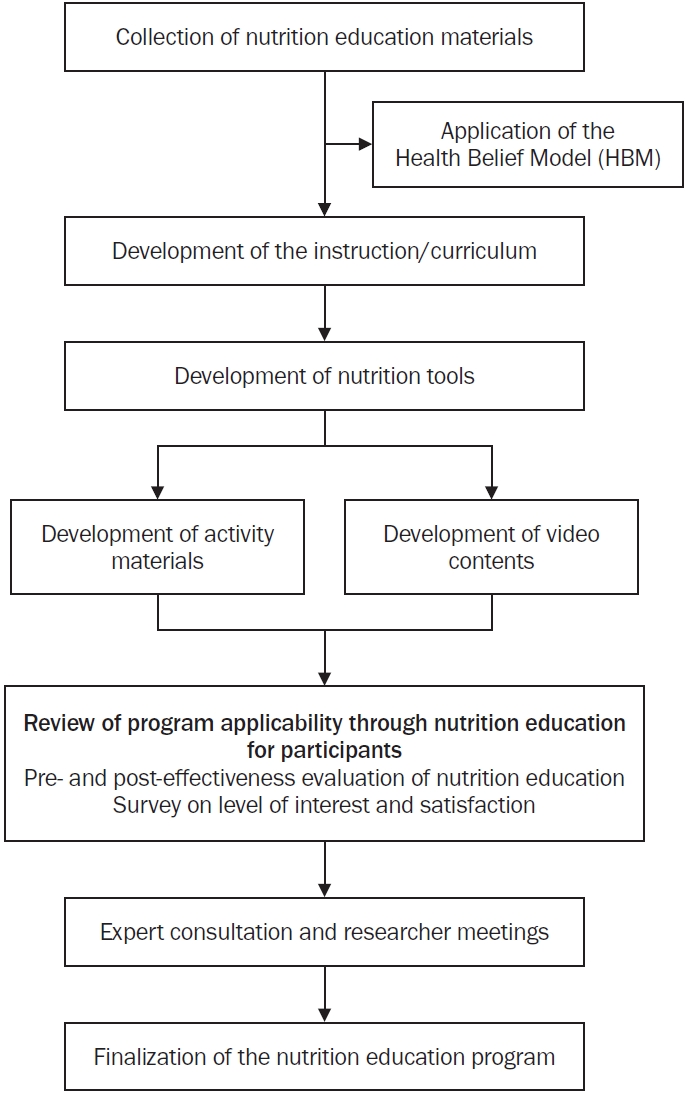
A pre–post intervention study was conducted among 21 adults with T2DM (glycated hemoglobin levels ≥ 7.5%) attending outpatient clinics at university hospitals in Korea. The HBM-based program incorporated passive learning strategies (lectures and videos) and active, experiential learning strategies. Nutrition knowledge, dietary attitudes, and dietary behaviors were assessed before and after the intervention. Participants’ interest and satisfaction were also evaluated using interest–satisfaction analysis (ISA).
Results
Nutrition knowledge and dietary behaviors improved significantly among adults following the intervention. Adults (n = 15) showed significant increases in nutrition knowledge (0.50 to 0.60, P < 0.05) and dietary behavior scores (2.26 to 2.47, P < 0.05), whereas no significant changes were observed among older adults (n = 6). The mean interest and satisfaction scores were 4.44 and 4.43 out of 5, respectively. Experiential learning strategies were associated with higher satisfaction than passive approaches. ISA showed that hands-on activities received the highest interest and satisfaction ratings, whereas passive methods were rated less favorably.
Conclusion
Participation in an HBM-based nutrition education program was associated with improved dietary behaviors among Koreans with T2DM in a clinical nutrition setting. Experiential learning approaches appeared to be more effective than passive methods, and the age-related differences observed suggest a need for tailored intervention strategies. These findings support the development of scalable, patient-centered nutrition interventions for chronic disease management.
|

 KSCN
KSCN