- [Korean]
-
Effect of a community-based nutrition intervention incorporating social cognitive theory constructs and transtheoretical model-based counseling among community-dwelling elderly in Korea: a quasi-experimental study
-
Hyewon Shin, Seungmin Lee
-
Korean J Community Nutr 2026;31(3):264-275. Published online June 30, 2026
-
DOI: https://doi.org/10.5720/kjcn.2026.00073
-
-
 Abstract Abstract
 PDF PDF
- Objectives
This study evaluated the effects of a 7-week nutrition intervention based on the personal and environmental constructs of social cognitive theory (SCT) and the transtheoretical model (TTM) on dietary behavior-related factors, dietary behavior outcomes, and stages of dietary behavior change among community-dwelling older adults.
Methods
A quasi-experimental nonequivalent control group pretest–posttest design was conducted from May to December 2024 at seven senior facilities in Seoul and Gyeonggi, Korea. Older adults aged ≥ 65 years were assigned by facility to either an intervention group (n = 66; four facilities) or a control group (n = 65; three facilities). The intervention group completed a 7-week program consisting of baseline assessment, five weekly group education sessions, individualized nutrition counseling, and post-intervention assessment. The control group received one general nutrition education session. Outcomes included dietary knowledge, outcome expectations, value expectations, self-efficacy, environmental factors (food accessibility and household food availability and social support), dietary behavior outcomes assessed using the Nutrition Quotient for the Elderly (NQ-E), and stage of change. Program effects were analyzed using ANCOVA adjusted for age, family composition, education, baseline dietary knowledge, and value expectations.
Results
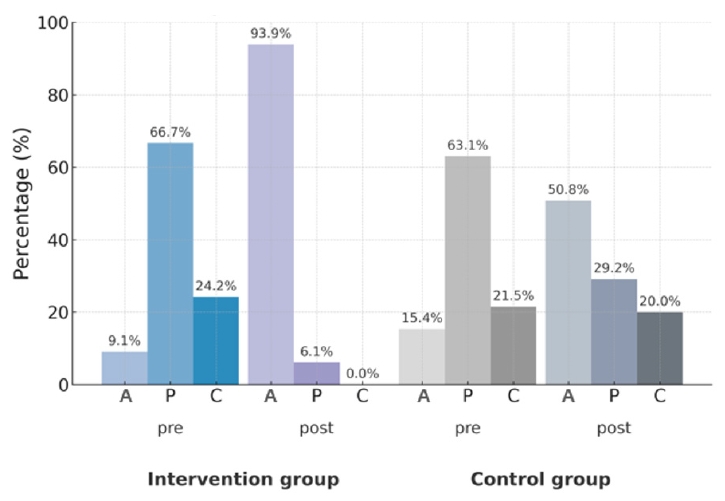
Compared with the control group, the intervention group demonstrated significantly greater improvements in dietary knowledge (P < 0.001), outcome expectations (P = 0.018), self-efficacy (P < 0.001), environmental factors (P < 0.001), and NQ-E total score (P = 0.011). No significant between-group difference was observed for value expectations. The proportion of participants in the action stage increased from 9.1% to 93.9% in the intervention group, and post-intervention stage distribution differed significantly between groups (P < 0.001). Program satisfaction was high (4.69 ± 0.41).
Conclusion
A 7-week nutrition intervention incorporating SCT-based personal and environmental constructs and TTM-based stage-matched counseling improved dietary behavior-related factors, dietary behavior outcomes, and stage distribution among community-dwelling older adults.
- [English]
-
The Effectiveness of Na Reduction Program for Cook in Child-care Center: Focus on Self-reevaluation and Strengthen Consciousness
-
Hyewon Shin, Youngmee Lee
-
Korean J Community Nutr 2014;19(5):425-435. Published online October 31, 2014
-
DOI: https://doi.org/10.5720/kjcn.2014.19.5.425
-
-
Abstract
PDF
- OBJECTIVES
The purpose of this study was to develop a Na-reduction education program and apply it for cooks who prepare meals in day-care centers. To development of the program was based on increasing the self-awareness of salinity, eating behaviors and enforcing skills of low-Na cooking.
METHODS
The study was carried out from April to October in 2013, fifty five cooks participated in this program. The Na reduction program composed of 4 sessions of education which included a 90-minute lecture and self-reevaluation of personal saltsensitivity degree and three low Na recipe cooking classes. In order to measure the effectiveness of the program, the pretest and posttest of salinity of the soups provided by day care centers was conducted at registration and 5 month after the program with the same menu.
RESULTS
After the conduct of the program, salimeter using rate was increased from 8.2% to 94.6% after the program and the other measuring instruments using rate was gradually increased. We observed that the score on eating behaviors increased 1.51 points from 38.80 to 40.31 after the intervention program (p < 0.001). Further, increased knowledge and skill provided by the intervention program resulted in improved Nareduction cooking capability. According to the results from analyzing the soup salinity, the salinity in watery soup was significant reduced from 0.556 to 0.449 0.107 and soybean-paste soup was significant reduced from 0.669 to 0.551 after the intervention program (p < 0.001).
CONCLUSIONS
As the result of fact, the intervention programs that was based on self-reevaluation, to enforce practical skill and consciousness was effective to serve low sodium menu at day care centers.
-
Citations
Citations to this article as recorded by  - Changes in the importance and performance of low-sodium management among childcare center cooks in Yongin, South Korea, after salinometer support programs: a descriptive study
Jiwoo Min, Youngmi Lee, Yunhee Chang, Yujin Lee
Korean Journal of Community Nutrition.2024; 29(4): 304. CrossRef - Comparison of Sodium Reduction Practice and Estimated Sodium Intake by Salty Food Preference on Employees and Customers of Sodium Reduction Restaurant in Daegu, Korea
Su-Jin Lee, Keon-Yeop Kim, Yeon-Kyung Lee
Korean Journal of Community Nutrition.2022; 27(1): 27. CrossRef - Comparison of the Sodium and Sugar Reduction Practices at Samsam Foodservices and General Foodservices in Daegu
Sung-young Kwon, Kilye Kim, Yeon-Kyung Lee
Korean Journal of Community Nutrition.2021; 26(4): 270. CrossRef - Sugar Reduction Perception and Sugary Food Intake among High School Students in Incheon
Gyeong-Ja Bae, Mi-Kyeong Choi
Korean Journal of Community Nutrition.2021; 26(2): 111. CrossRef - Current status, perception and practicability of restaurant staffs related to reducing sodium use in Seongnam, Korea
So-Hyun Ahn, Jong Sook Kwon, Kyungmin Kim, Yoonna Lee, Hye-Kyeong Kim
Journal of Nutrition and Health.2019; 52(5): 475. CrossRef - Perception and Attitudes toward Reducing the Sugar Intake of Childcare Center Foodservice Employees in Chungbuk Province
Sung Hee Min
Korean Journal of Food and Cookery Science.2019; 35(1): 73. CrossRef - Salinity Monitoring of Soups of The Institutions Enrolled at Center for Children’s Foodservice Management
Hyun Nae Park, Soon Mi Kim
Journal of the East Asian Society of Dietary Life.2016; 26(6): 507. CrossRef - School Dietitian Awareness, Practice, and Sodium Reduction Plan in School Meal Service
Eun Kyung Kim, Hae Young Kim
Korean Journal of Food & Cookery Science.2016; 32(2): 222. CrossRef - Management of Sodium-reduced Meals at Worksite Cafeterias: Perceptions, Practices, Barriers, and Needs among Food Service Personnel
Jounghee Lee, Sohyun Park
Osong Public Health and Research Perspectives.2016; 7(2): 119. CrossRef - Nutrition knowledge, eating attitudes, nutrition behavior, self-efficacy of childcare center foodservice employees by stages of behavioral change in reducing sodium intake
Yun Ahn, Kyung Won Kim, Kyungmin Kim, Jinwon Pyun, Ikhyun Yeo, Kisun Nam
Journal of Nutrition and Health.2015; 48(5): 429. CrossRef
-
2,022
View
-
0
Download
-
10
Crossref
|

 KSCN
KSCN