- [English]
-
Ultra-processed food intake and dietary behaviors in Korean adolescents: a cross-sectional study based on the 2019–2023 Korea National Health and Nutrition Examination Survey
-
Jin-A Kim, Sim-Yeol Lee
-
Korean J Community Nutr 2025;30(6):410-418. Published online December 31, 2025
-
DOI: https://doi.org/10.5720/kjcn.2025.00297
-
-
 Abstract Abstract
 PDF PDF
- Objectives
This study aimed to investigate the intake of ultra-processed foods (UPF) and dietary behaviors in Korean adolescents.
Methods
This study used 24-hour dietary recall data from the Korea National Health and Nutrition Examination Survey (2019–2023). In total, 1,720 adolescents aged 12–18 years were included in this study and categorized into quartiles based on the percentage of energy intake from the UPF. Nutritional status, contributing subgroups of UPF intake, and healthy dietary practices were examined using Health Plan 2030 indicators across quartiles of UPF intake.
Results
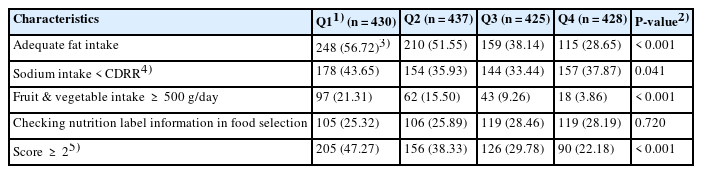
The nutrient intake of protein, vitamins (A, B1, B2, niacin), and minerals (iron, potassium) was the lowest in the fourth quartile of UPF intake compared with the first quartile (P for trend < 0.001), whereas calcium intake increased across quartiles, from 47.68% in the first quartile to 58.51% in the fourth quartile (P for trend < 0.001). The main contributing subgroups to UPF intake differed across quartiles of UPF intake, and the highest contributing subgroups were ‘instant noodles and dumplings,’ ‘desserts, cakes, and ice cream,’ and ‘sauces and seasonings.’ Healthy dietary practices were the lowest in the fourth quartile (22.18%, P < 0.001), and the proportions of appropriate fat and fruit/vegetable intake were significantly lower in the higher quartiles of UPF intake (P < 0.001).
Conclusion
This study suggests that a lower UPF intake was associated with better nutritional status and healthy dietary practices in Korean adolescents. These findings provide fundamental evidence for promoting healthier food choices and balanced dietary practices.
-
Citations
Citations to this article as recorded by  - An Exploratory Indirect Association Analysis of Dietary Supplement Use and Metabolic Risk in Korean Adolescents: A Cross-Sectional Study
Jeoungmi Kim, Vasuki Rajaguru
Foods.2026; 15(14): 2554. CrossRef
-
2,633
View
-
76
Download
-
1
Crossref
- [English]
-
The Study of Dietary Habits and Health Behaviors according to Physical Activity Type in Korean Adults -Based on the 2016~2018 Korea National Health and Nutrition Examination Survey-
-
Jin-A Kim, Sim-Yeol Lee
-
Korean J Community Nutr 2021;26(2):122-133. Published online April 30, 2021
-
DOI: https://doi.org/10.5720/kjcn.2021.26.2.122
-
-
Abstract
PDF
- Objectives
This study evaluated the dietary habits and health behaviors of Korean adults according to their physical activity.
Methods: Adults aged 19~64 years, who participated in the 2016~2018 National Health and Nutrition Examination Survey, were enrolled in this study. The subjects were classified into the physical inactivity group, aerobic physical activity group, strength exercise group, and combined exercise group.
Results: Significant differences in skipping breakfast, frequency of eating out, dietary supplements, and alcohol drinking status were observed among physical activity groups (P < 0.001). The combined exercise group had the highest % KDRI of protein, vitamin A, thiamin, riboflavin, niacin, calcium, potassium, and iron (P < 0.001). The physical inactivity group had the highest obesity rate (35.1%), and they perceived their body image type to be obese. In the combined exercise group, 47.8% of respondents said they were in good health (P < 0.001). The health-related quality of life score of the physical inactivity group was the lowest, with a score of 0.94. The metabolic syndrome risk rate of the combined exercise group was lower at 0.62 times (95% CI, 0.51-0.75) than the physical inactivity group.
Conclusions: The physical activity type was associated with metabolic syndrome.
These results can be useful for supporting dietary education and physical activity programs for adults.
-
Citations
Citations to this article as recorded by - Impact of Dietary Habits, Physical Activity, and Perceived Health Status on Health‐Related Quality of Life by Household Characteristics of Patients With Chronic Diseases: The Korea Community Health Survey (KCHS)
Soyean Kang, Hae Sagong, Juyoung Lee
Public Health Nursing.2025; 42(3): 1182. CrossRef - The Association between the Type and Level of Physical Activity and Metabolic Syndrome in Korean Adults Aged 40 Years and over: Results from the Eighth Korea National Health and Nutrition Examination Survey (2019–2021)
Namkuk Son
The Korean Journal of Sports Medicine.2024; 42(2): 145. CrossRef - Consumption of protein supplements/protein-fortified foods among young adults in Jeju
Hyoju Lee, Youjeong Jang, Sumin Kim, Kyungho Ha
Journal of Nutrition and Health.2024; 57(2): 261. CrossRef - 고령자의 신체건강 및 식생활 행태가 영양소 섭취량에 미치는 영향
하리 임, 다솔 김, 나미 주
Korean Journal of Food and Cookery Science.2023; 39(6): 518. CrossRef - Association of Dietary Quality with Subjective Health-Related Perception and Chronic Diseases According to Age Segmentation of Korean Elderly
Sojeong Lee, Seungmin Lee
Korean Journal of Community Nutrition.2021; 26(5): 363. CrossRef
-
2,272
View
-
21
Download
-
5
Crossref
|

 KSCN
KSCN