- [English]
-
Development of a simplified NOVA-based scoring tool for assessing ultra-processed food consumption among Korean young adults: a cross-sectional study
-
Jinhyun Kim, Eunjin Jang, Sarang Jeong, Sukyoung Jung, Jee Young Kim, Jung Eun Lee, Dahye Han, Eunseo Lee, Junhyeok Jang, Sohyun Park
-
Korean J Community Nutr 2026;31(2):140-152. Published online April 30, 2026
-
DOI: https://doi.org/10.5720/kjcn.2026.00059
-
-
 Abstract Abstract
 PDF PDF Supplementary Material Supplementary Material
- Objectives
This study aimed to develop a NOVA-based scoring approach for evaluating ultra- processed food (UPF) intake among Korean adults and to examine its performance. Previous studies have reported that young adults have the highest levels of UPF consumption. Accordingly, this study focused on adults aged 19–40 years and developed scoring components reflecting dietary patterns specific to Korean eating habits.
Methods
Using 24-hour dietary recall data from adults aged 19–40 years in the Korea National Health and Nutrition Examination Survey (2021–2023), foods were classified according to the Korean-adapted NOVA system. The top 10 food groups accounting for ≥ 80% of cumulative UPF-derived energy were selected to construct the scoring components. The tool was operationalized using food frequency questionnaire (FFQ) data from the Gangwon cohort study (2022–2024). Intake frequencies were converted into scores ranging from 0 (“rarely or never”) to 5 (“≥ 1 time/day”), and summed to generate the NOVA–UPF score (range: 0–50).
Results
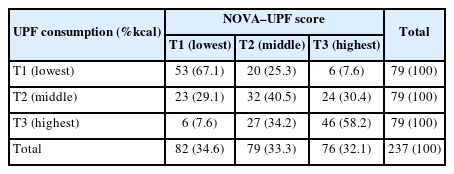
Among 237 young adults (aged 20–49 years), the mean NOVA–UPF score was 22.9 ± 8.3. A positive association was observed between the NOVA–UPF score and FFQbased UPF energy intake (Spearman’s ρ = 0.629, P < 0.001). Cross-classification showed that 51.9% were classified into the same tertile and 94.9% into the same or adjacent tertiles, with a weighted kappa coefficient of 0.279.
Conclusion
This NOVA-based scoring approach may serve as a preliminary tool for assessing UPF intake in Korean young adults. Further refinement and rigorous validation using quantitative dietary assessment methods and more diverse populations are required before broader application.
- [Korean]
-
Assessment of health and nutrition issues and strategic directions for tailored nutrition management in a rural area of Gangwon Province, Korea: a mixed-methods study
-
Eunjin Jang, Jinhyun Kim, Junhyeok Jang, Eunseo Lee, Dahye Han, Sarang Jeong, Sohyun Park
-
Received May 13, 2026 Accepted June 16, 2026 Published online July 1, 2026
-
DOI: https://doi.org/10.5720/kjcn.2026.00178
-
-
Abstract
- Objectives
Rural areas face distinct health and nutrition challenges, including limited healthcare access and rapid population aging. This study assessed health and nutrition challenges in a rural area of Gangwon Province, South Korea, and identified directions for tailored nutrition management using a mixed-methods approach.
Methods
A sequential mixed-methods design was applied. Community Health Survey (CHS) data (2020–2024) were analyzed to compare health indicators across national, provincial, and local levels. Baseline quantitative data were obtained from a community-based cohort of adults aged 20–69 years (n = 403). Qualitative data were collected through focus group interviews with residents and local stakeholders. A needs assessment survey (n = 98) identified program demand and priorities. Quantitative data were analyzed using descriptive statistics and qualitative data using framework analysis.
Results
CHS data showed that obesity prevalence in the study area was higher than that in national and provincial averages, particularly among young and middle-aged adults. The cohort data showed an obesity prevalence of approximately 45%, with no significant age-group differences. Older adults had higher prevalence of abdominal obesity, hypertriglyceridemia, elevated blood pressure, and impaired glucose metabolism. Age-specific dietary imbalances were observed, with higher fat intake among younger adults and excessive carbohydrate intake among older adults; sodium intake exceeded recommended levels across all age groups. Focus group interviews revealed structural constraints on health behaviors, including limited food access, seasonal and geographic barriers, and rural lifestyle patterns involving frequent alcohol use. In the needs assessment, perceived seriousness of obesity was low, whereas demand for nutrition programs and willingness to participate were high.
Conclusion
Health and nutrition problems in this rural setting may reflect individual behaviors and structural and environmental constraints. Preventive, family-based strategies targeting young and middle-aged adults are warranted. Tailored interventions integrating dietary improvement, physical activity, and local context are needed to reduce health disparities and improve community health.
|

 KSCN
KSCN