
 KSCN
KSCN
Search
- Page Path
- HOME > Search
Review
- [English]
- Life-course personalized nutrition strategy for adolescents and young adults in Korea based on a behavioral science approach and community-based model: a narrative review
- Jung-Hyun Kim
- Korean J Community Nutr 2026;31(2):127-139. Published online April 30, 2026
- DOI: https://doi.org/10.5720/kjcn.2026.00129
-
 Abstract
 PDF
PDF - Objectives
This review examines the nutritional challenges among Korean adolescents and young adults from life-course and behavioral science perspectives and proposes an integrated, community-based nutrition strategy for this critical transitional period.
Methods
A narrative review was conducted following the Scale for the Quality Assessment of Narrative Review Articles guidelines. Literature published between January 2015 and June 2025 was retrieved from PubMed, Google Scholar, and Research Information Sharing Service using keywords related to adolescent and young adult nutrition, life course approaches, behavioral nutrition, and personalized nutrition. Policy documents from the World Health Organization, Food and Agriculture Organization of the United Nations, United Nations Nutrition, and Korean government agencies were also included. A total of 40 references (32 peer-reviewed articles and 8 policy reports) were analyzed.
Results
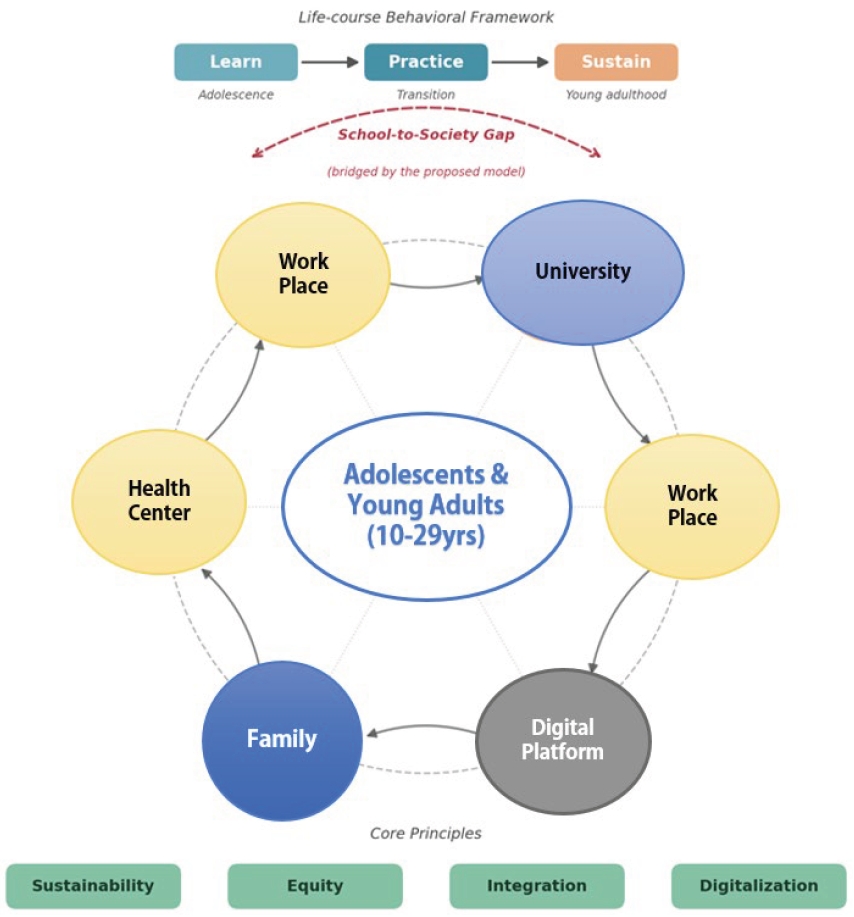
Korean adolescents and young adults exhibited high rates of skipping breakfast (> 38.3%), obesity, and excessive sodium and sugar intakes, with disparities driven by socioecological determinants. The Developmental Origins of Health and Disease framework highlights adolescence as the “second window of plasticity” for reshaping long-term health trajectories. Two behavioral frameworks were synthesized: the Formation–Maintenance Model, distinguishing adolescent (Learn–Practice) and young adult (Sustain) stages, and the socioecological nutrition model, addressing multi-level influences on dietary behavior. A structural discontinuity in public nutrition support, termed the “School-to-Society Nutrition Gap,” was identified. Community-based, participatory, and digitally integrated interventions showed strong potential for sustaining behavioral change.
Conclusion
A personalized life-course nutrition strategy based on a Learn-Practice-Sustain framework was proposed. A Community-Linked Circular Nutrition Model was presented to bridge the gap between school-based and community-level nutrition systems, emphasizing nutrition equity and digital engagement as key drivers of sustainable health outcomes.
- 736 View
- 15 Download

 First
First Prev
Prev



