
 KSCN
KSCN
Articles
- Page Path
- HOME > Korean J Community Nutr > Volume 30(6); 2025 > Article
-
Educational Material
오감체험 놀이 중심의 영유아 식생활 교육자료 개발과 평가 -
유현주1)
 , 박소현2), 오지은3), 황지윤4),†
 - Development and evaluation of play-based food and nutrition education materials for early childhood through sensory experiences: a pre-post observational study
-
Hyunjoo Ryou1), Sohyun Park2), Jieun Oh3), Ji-Yun Hwang4),†
-
Korean Journal of Community Nutrition 2025;30(6):471-483.
DOI: https://doi.org/10.5720/kjcn.2025.00276
Published online: December 31, 2025
1)사단법인 식생태문화협회 이사
2)한림대학교 식품영양학과 및 한국영양연구소 교수
3)이화여자대학교 신산업융합대학 교수
4)상명대학교 식품영양학전공 교수
1)Director, The Ecological Eating and Culture Association, Seoul, Korea
2)Professor, Department of Food Science and Nutrition & The Korean Institute of Nutrition, Hallym University, Chuncheon, Korea
3)Professor, College of Science and Industry Convergence, Ewha Womans University, Seoul, Korea
4)Professor, Major of Foodservice Management and Nutrition, Sangmyung University, Seoul, Korea
- †Corresponding author: Ji-Yun Hwang Major of Foodservice Management and Nutrition, Sangmyung University, 20 Hongjimun 2 gil, Jongno-gu, Seoul 03016, Korea Tel: +82-2-781-7607 Fax: +82-2-2287-0104 Email: jiyunhk@smu.ac.kr
• Received: September 22, 2025 • Revised: November 6, 2025 • Accepted: November 13, 2025
© 2025 The Korean Society of Community Nutrition
This is an Open-Access article distributed under the terms of the Creative Commons Attribution Non-Commercial License (http://creativecommons.org/licenses/by-nc/4.0) which permits unrestricted non-commercial use, distribution, and reproduction in any medium, provided the original work is properly cited.
- 1,065 Views
- 50 Download


Abstract
-
Objectives
- This study aimed to develop play-based nutrition education (PBNE) materials for young children and to evaluate their applicability and effectiveness.
-
Methods
- An online survey of 1,253 primary caregivers of preschool children was conducted, and the findings were used to develop age-specific utilization guides, slides, activity sheets, activity cards, posters, educational videos, and parent newsletters. Selected materials were implemented in child-care centers through the Children’s Foodservice Management Centers between October and November 2023. The effectiveness of the PBNE program was assessed by examining changes in mushroom consumption as well as food awareness and preferences, before and after the intervention.
-
Results
- A total of eight media formats and 320 educational contents were developed, and mushrooms were as the pilot theme among the 12 possible food items. Following the intervention, children’s positive awareness of mushrooms increased, and > 96% of participants attempted to consume them. Teachers in child-care centers rated the appropriateness and applicability of the content, its contribution to behavioral improvement, and their overall satisfaction at > 4.9 out of 5 points.
-
Conclusion
- This study developed experiential, PBNE materials aligned with the national standard child- and play-centered curriculum. The materials were effective in enhancing food awareness and promoting attempts at consumption. Future efforts should focus on developing additional experiential teaching tools that incorporate teacher feedback and on strengthening home-linked programs to support healthy seasonal food intake and positive dietary experiences in young children.
INTRODUCTION
METHODS
1) 주제선정 방법
2) 연령별 발달특성 및 이론 적용
3) 식품놀이 교육자료 제작과정 및 내용
CONTENTS
1) 슬라이드
2) 학습활동지
3) 활동카드
4) 포스터
5) 동영상
6) 요리활동 카드
7) 가정통신문
8) 활동지도안
9) 입체조형물
EVALUATION
IMPLICATIONS
-
CONFLICT OF INTEREST
There are no financial or other issues that might lead to conflict of interest.
-
FUNDING
This research was supported by a grant (23192MFDS063) from Ministry of Food and Drug Safety in 2023.
-
DATA AVAILABILITY
Research data is available upon request to the corresponding author.
NOTES
Fig. 1.Samples of educational materials (user guide, PPT slides, individual activity sheets, activity cards, poster, video clips, lesson plans, cooking recipe, parent newsletter).
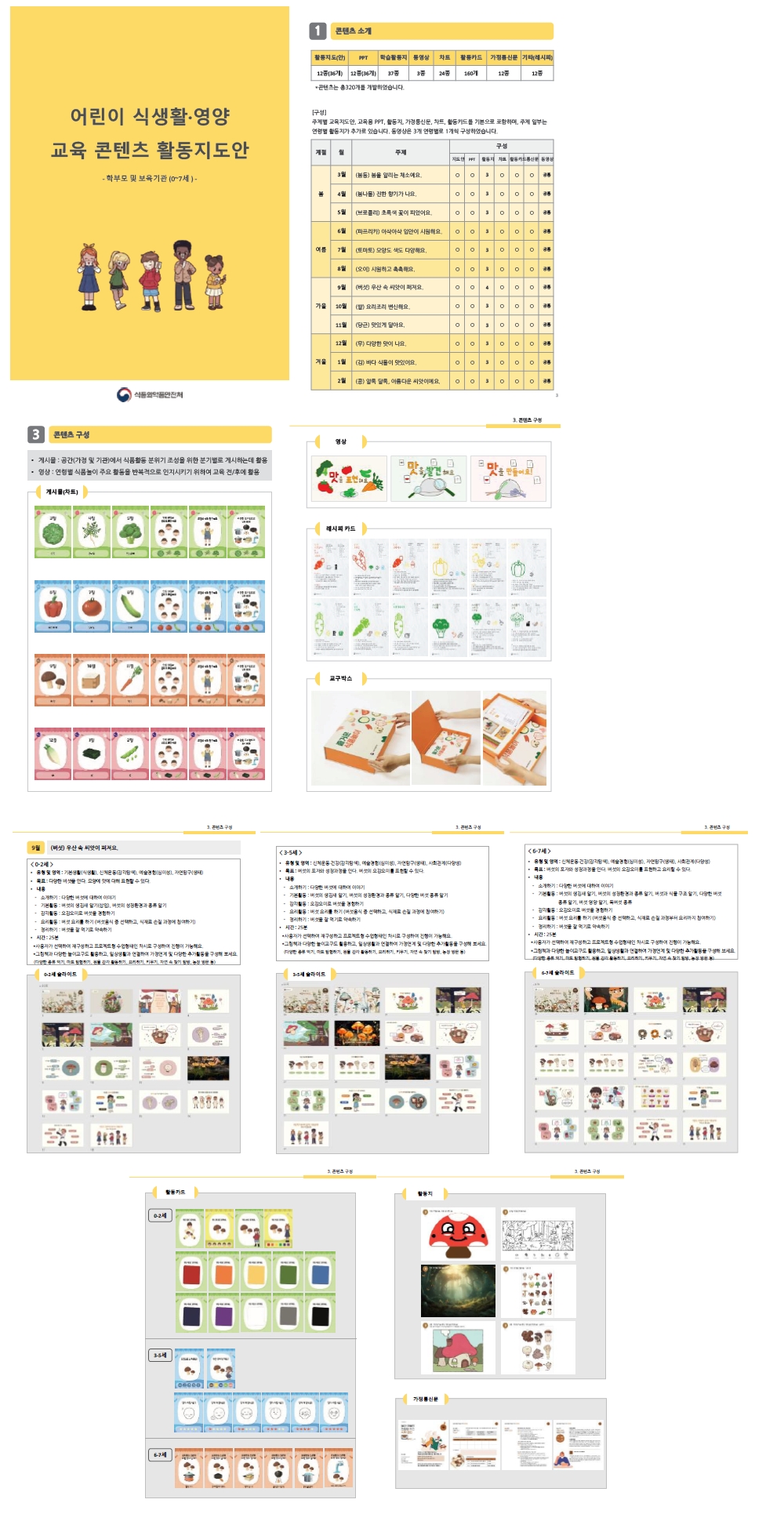
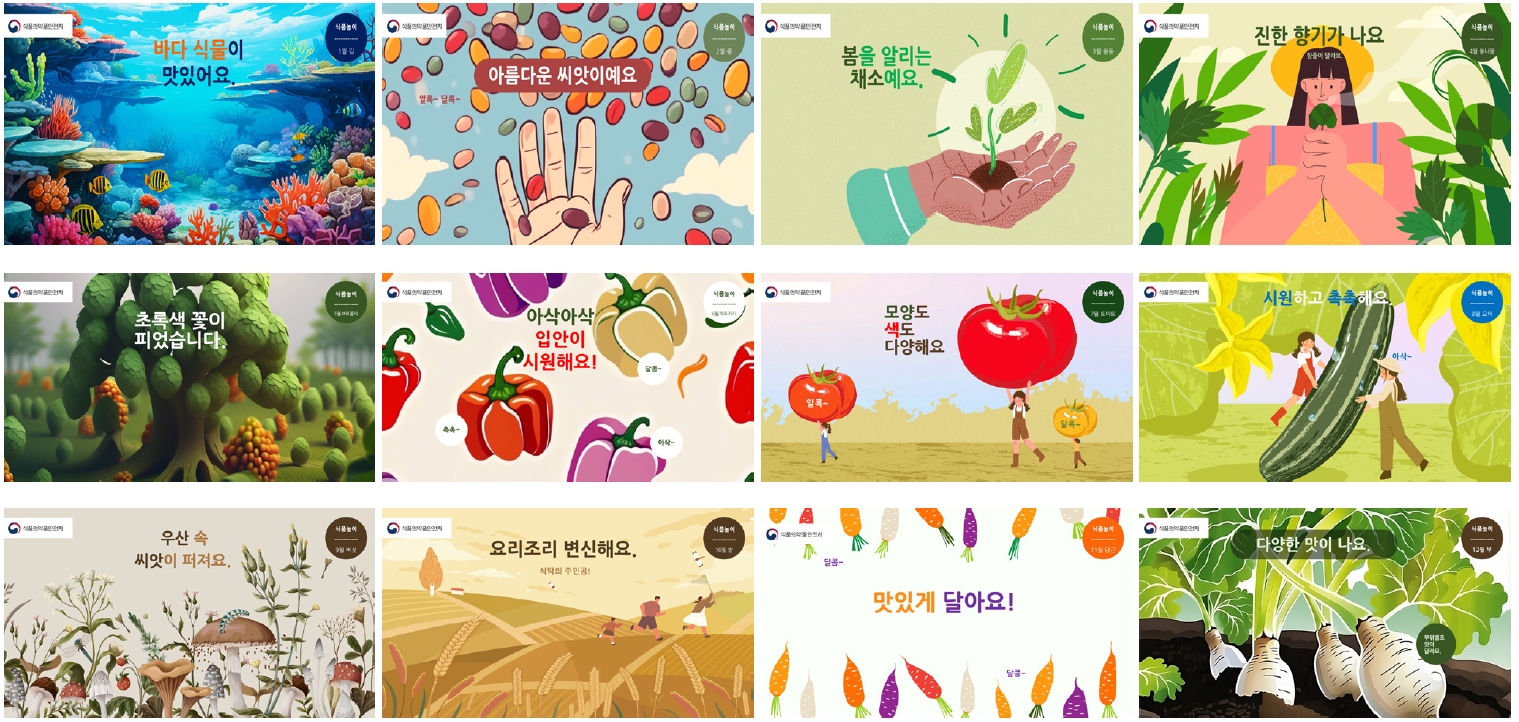
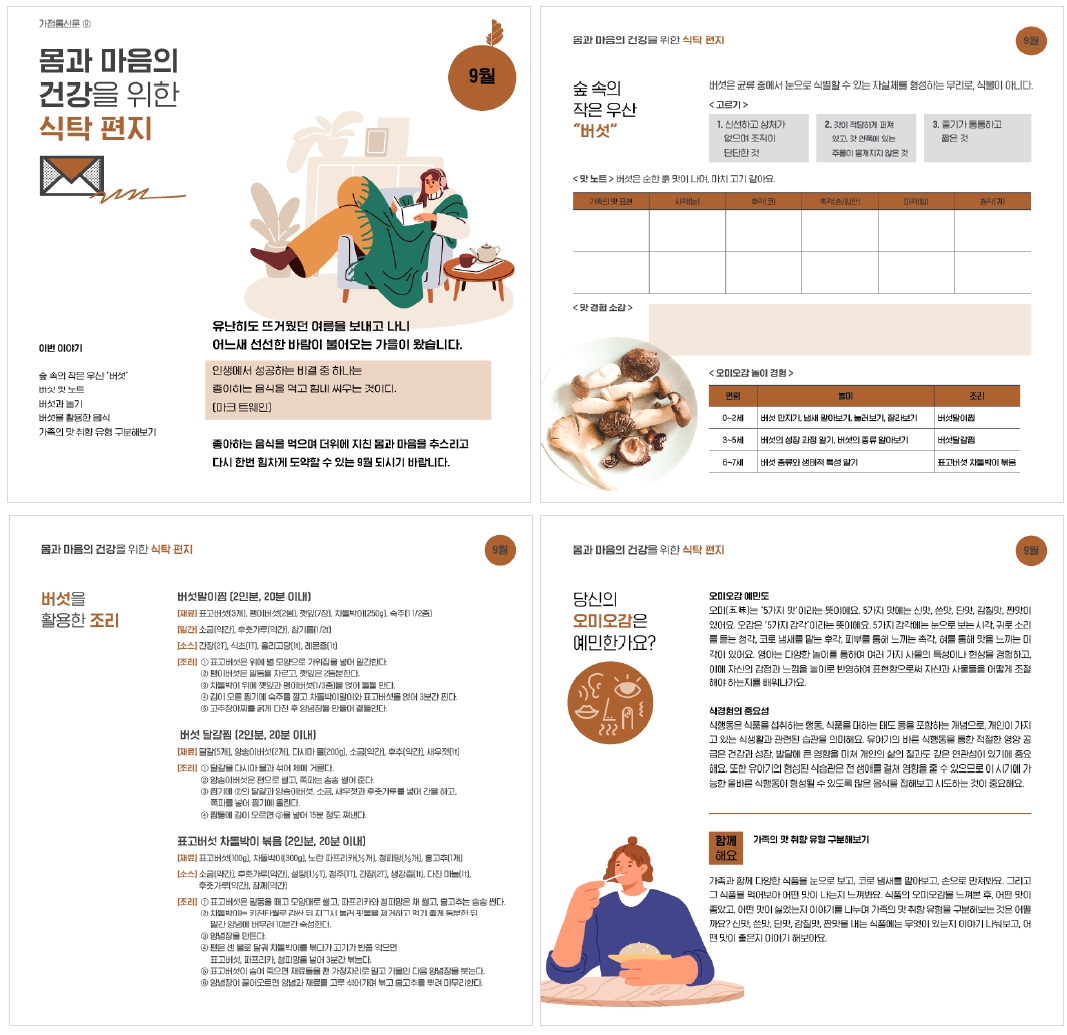
Fig. 4.Examples of age-specific mushroom teaching-learning guides for evaluating field applicability.
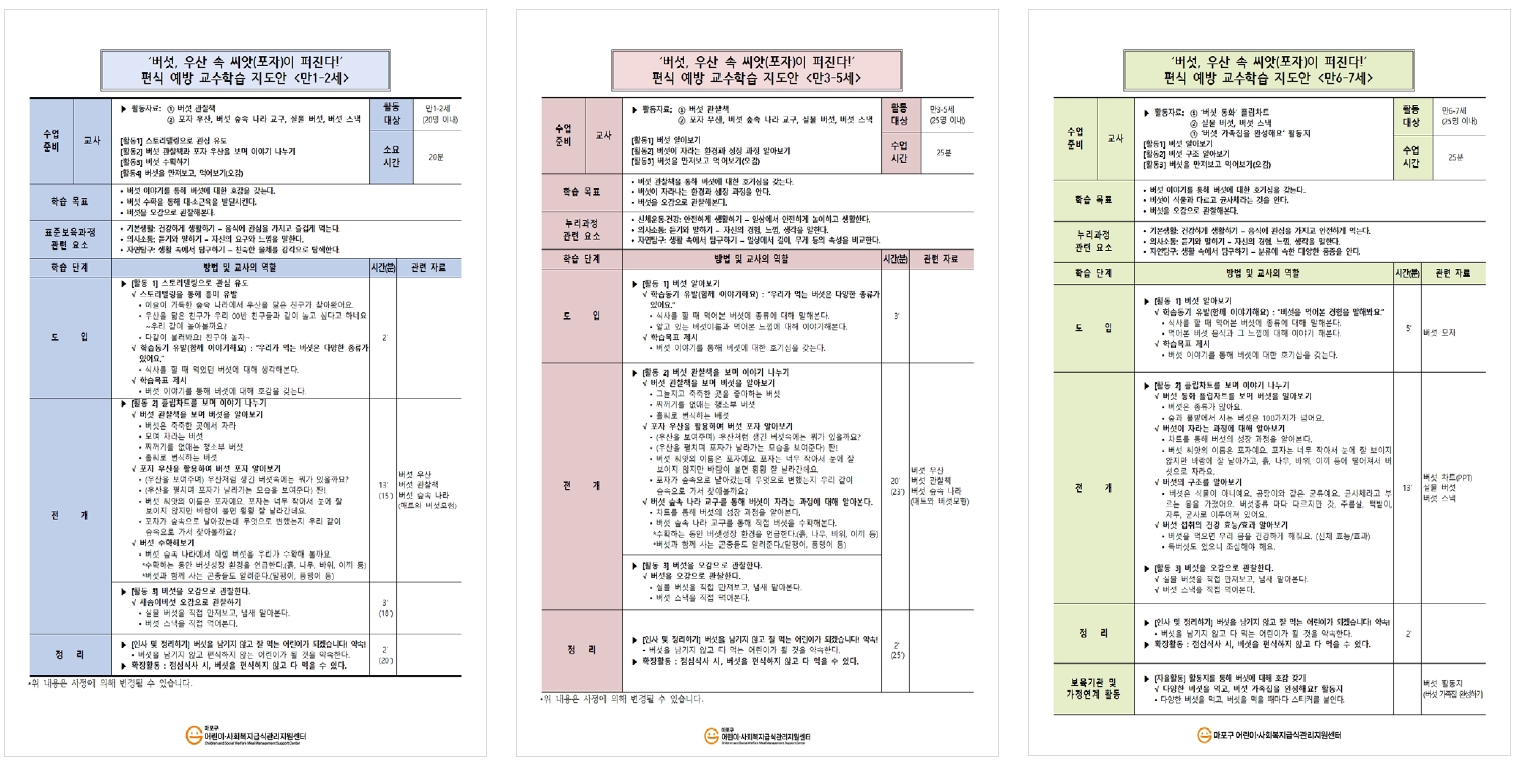
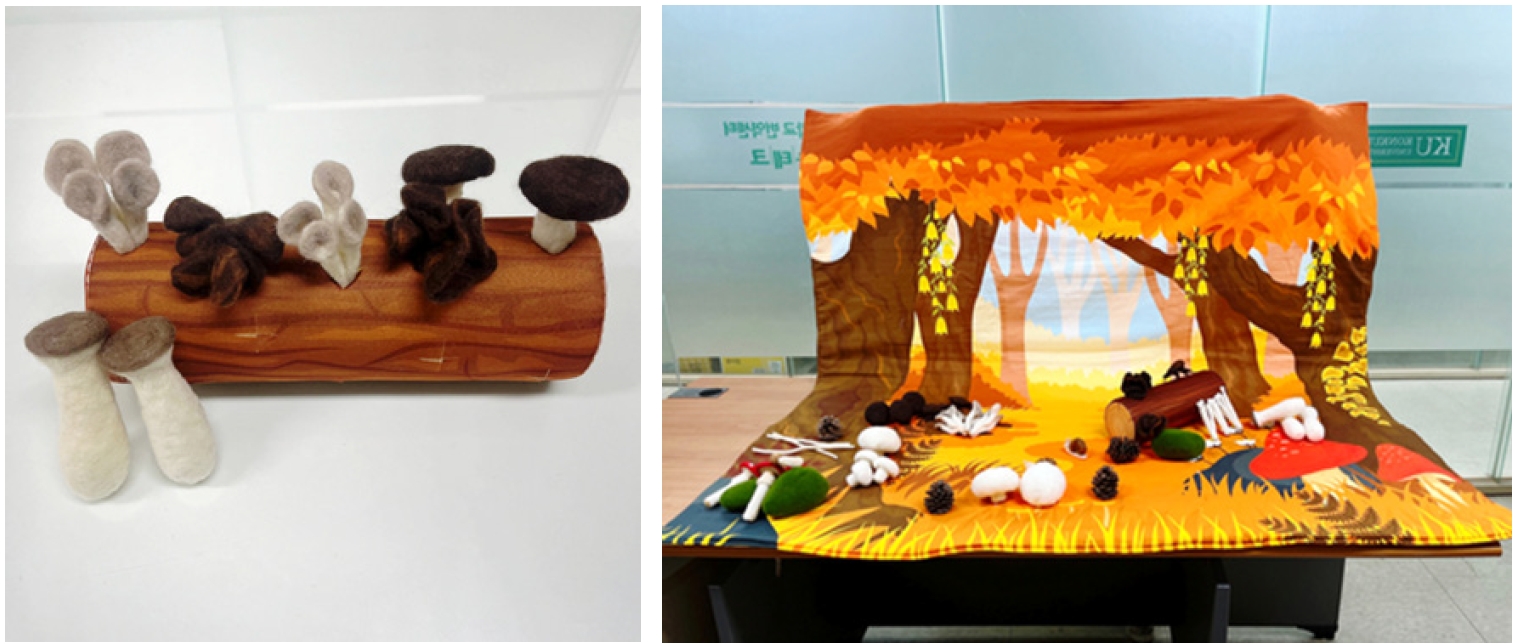
Table 1.Monthly themes for play-based nutrition education
Table 2.Sample composition of play-based activities by age group (mushroom)
Table 3.General characteristics of the study participants
Table 4.Change of mushroom indicators (awareness, consumption experience, preference, intake) (n = 60)
Table 5.Primary caregiver evaluation of educational materials (n = 40)
- 1. Cho HN, Park E. Development and evaluation of sensory education program for young children. Korean J Early Childhood Educ 2015; 35(2): 263-292. Article
- 2. Kim JW, Lee E. Improvement of preschoolers’ five senses and food preferences using ‘Taste with Five Senses!’ in education. Korean J Food Cook Sci 2022; 38(6): 376-383.
- 3. Lee GY, Lim JH, Joung H, Yoon D. Association between ultraprocessed food consumption and metabolic disorders in children and adolescents with obesity. Nutrients 2024; 16(20): 3524.ArticlePubMedPMC
- 4. Kim YH, Kim B, Joo N. The effects of the five senses educational activity using food materials on the dietary behavior of infants - focuse on infants in an area in Seoul -. J Korean Soc Food Cult 2022; 37(1): 39-46.
- 5. Park G, Kim J. The effects of a project-based ecological transition education program on young children’s awareness of sustainable development, ecological literacy, and problem-solving abilities. Korean J Childcare Educ 2024; 20(3): 125-147.
- 6. Kim EH, Na MY. The experiences and changes of the Washington class practicing sustainable eating habits. Korean J Early Childhood Educ 2023; 25(3): 168-201. Article
- 7. Seoul Metropolitan Office of Education, Early Childhood Education Division. 2024 Report on eco-transition education model kindergartens (Seoul Cheongrim, Seoul Hwigyeong, and Seonmi Kindergarten) [Internet]. Seoul Metropolitan Office of Education; 2024 [cited 2025 Jan 20]. Available from: https://buseo.sen.go.kr/buseo/bu11/user/bbs/BD_selectBbs.do?q_rowPerPage=10&q_currPage=1&q_sortName=&q_sortOrder=&q_searchKeyTy2=1005&q_searchStartDt=&q_searchEndDt=&q_bbsSn=1258&q_bbsDocNo=20241209143307435&q_searchKeyTy=ttl___1002&q_searchVal=%EC%83%9D%ED%83%9C&
- 8. Ministry of Agriculture, Food and Rural Affairs (MAFRA). The Ministry of Agriculture, Food and Rural Affairs announced the 3rd Basic Plan for Food Education (‘20-‘24) to present a mid- to long-term development plan for implementing a ‘sustainable diet’ to realize a collaborative agriculture, healthy citizens, and an inclusive society [Internet]. MAFRA; 2020 [cited 2025 Jan 20]. Available from: https://share.google/P4elI28CQIi3ITvdY
- 9. Kähkönen K, Rönkä A, Hujo M, Lyytikäinen A, Nuutinen O. Sensory-based food education in early childhood education and care, willingness to choose and eat fruit and vegetables, and the moderating role of maternal education and food neophobia. Public Health Nutr 2018; 21(13): 2443-2453. ArticlePubMedPMC
- 10. Kim SR, Yu KH, Kim MJ, Ly SY. Effects of vegetable-focused nutrition education on improving nutrition knowledge and dietary habits in young children. Korean J Hum Ecol 2023; 32(5): 665-678. Article
- 11. Kim HJ. Research trends related to play-centered curriculum for young children. J Learner-Centered Curric Instr 2024; 24(22): 923-941. Article
- 12. Kim SH. An exploration of young children’s play based on constructivist and evolutionary-cultural play theories : philosophical justification for a play-based curriculum. Korean J Early Childhood Educ 2025; 45(4): 151-173.
- 13. Kim EA. Interpretation of the cognitive development theory of Piaget in the view of brain science. [master’s thesis]. Seoul National University of Education; 2005.
- 14. Choi EY, Yang MS, Kim JH, Um JW, Jang HJ. Support measures for teacher’s child- and play-centered educational activities. Korea Institute of Child Care and Education; 2019 Feb. Report No. 2019-01.
- 15. Chung C, Choi YC, Lee H, Park KR. A comparative analysis of research trends in ‘child-centered’ and ‘play-centered’ early childhood education curriculum. Korean J Early Childhood Educ 2023; 43(6): 321-347.
- 16. Jang SH, Kim JH. A study on the development and application of dietary education program based on learning cycle model for young children. Korean J Child Care Educ Policy 2017; 11(2): 115-147. Article
- 17. Ahn J, Kim S, Kim D, Lee J. Development and effectiveness evaluation of the STEAM education program on food groups for kindergarteners. Korean J Community Nutr 2022; 27(5): 361-372. ArticleLink
- 18. Lee HH, Shin MK, Kim H, Kwon S, Oh SY, An H. The development and evaluation of a nutrition education program including sensory and cooking activity to promote vegetable intake among school aged children. Korean J Health Promot 2019; 19(1): 49-58. ArticleLink
- 19. Moon SY. The effect of food art sensory play utilizing picture books on the playfulness and creativity in infants. [master’s thesis]. Mokpo National University; 2024.
- 20. Lee S, Lee S. Development and evaluation of booklets and video clips to prevent children from developing picky eating. Korean J Community Nutr 2020; 25(6): 451-463. ArticleLink
- 21. Kim I. Improving parental roles and education for early childhood development [Internet]. Korea Development Institute; 2017 [cited 2025 Sep 16]. Available from: https://www.kdi.re.kr/research/focusView?pub_no=15079
- 22. Kim JM, Ahn JY. Development of nutrition education program for young children using learning cycle. Open Parent Educ Res 2015; 7(4): 35-50.
- 23. Jeon JS, Choi JW. Exploring pre-service early childhood teachers’ perceptions of play for play-based educational practice. J Assoc Child-Cent Practice 2025; 20(1): 125-143. Article
- 24. Lee EY, Kim SY. Effects of sensory action using five sense picture book on the sense ability and language development for infants. Korean J Child Educ 2020; 29(1): 201-219. Article
- 25. Sung Y. Proceedings of 2023 The Korean Society for Early Childhood Education Spring Academic Conference. 2023 April 22; Chungju. p. 201-207.
- 26. Choi EY, Kim EY, Koo JY, Kim MJ, Lee SM, et al. Future-oriented ECEC curriculum design and system (II): restructuring toward future competencies. National Research Council for Economics, Humanities, and Social Sciences; 2024 Aug. Report No. 협동연구총서 24-15-01.
- 27. Choi S. Rudolf Steiner’s twelve senses and education. Res Waldorf Educ 2011; 3(2): 1-28.
- 28. Ministry of Education (MOE). Establishing an integrated childcare implementation plan to ensure that citizens can trust and comfortably entrust their children to childcare [Internet]. MOE; 2024 [cited 2025 Jan 20]. Available from: https://www.moe.go.kr/boardCnts/viewRenew.do?boardID=72779&boardSeq=99239&lev=0&m=0317
- 29. Bae YJ, Lee JH, Yang MS, Cho KJ, Lee HM, Kang MK. Korean early childhood education and care panel study 2024. Korea Institute of Child Care and Education; 2024 Dec. Report No. 2024-21.
- 30. Kim EY, Kang EJ, Lim BY, Jung SA, Park EH, Kwon HJ, et al. Policy research on curriculum development for ages 0-2 (2024). Ministry of Education, Korea Institute of Child Care and Education; 2024 Dec. Report No. 2024-08.
REFERENCES
Figure & Data
REFERENCES
Citations
Citations to this article as recorded by 
 Cite
Cite XML Download
Development and evaluation of play-based food and nutrition education materials for early childhood through sensory experiences: a pre-post observational study
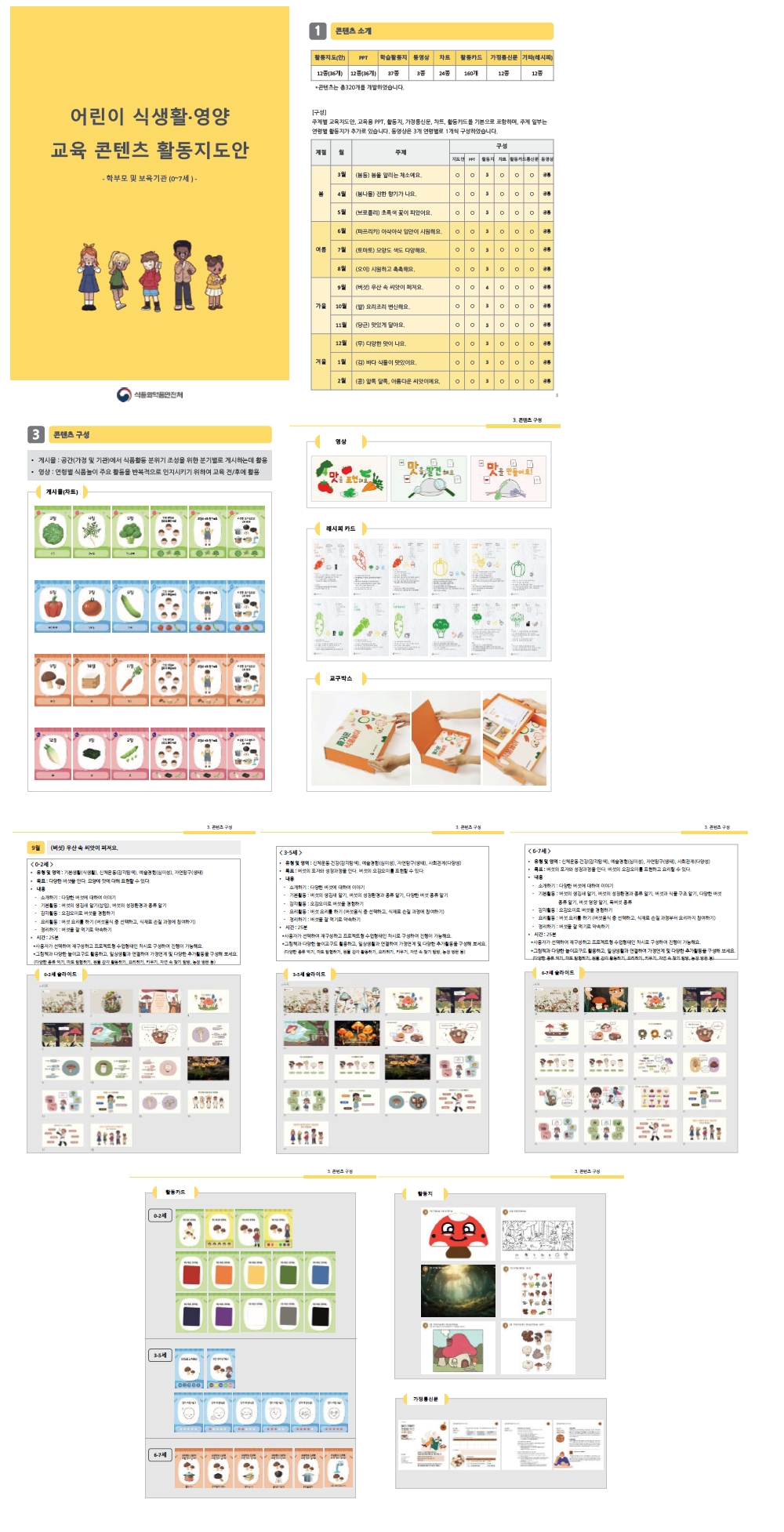

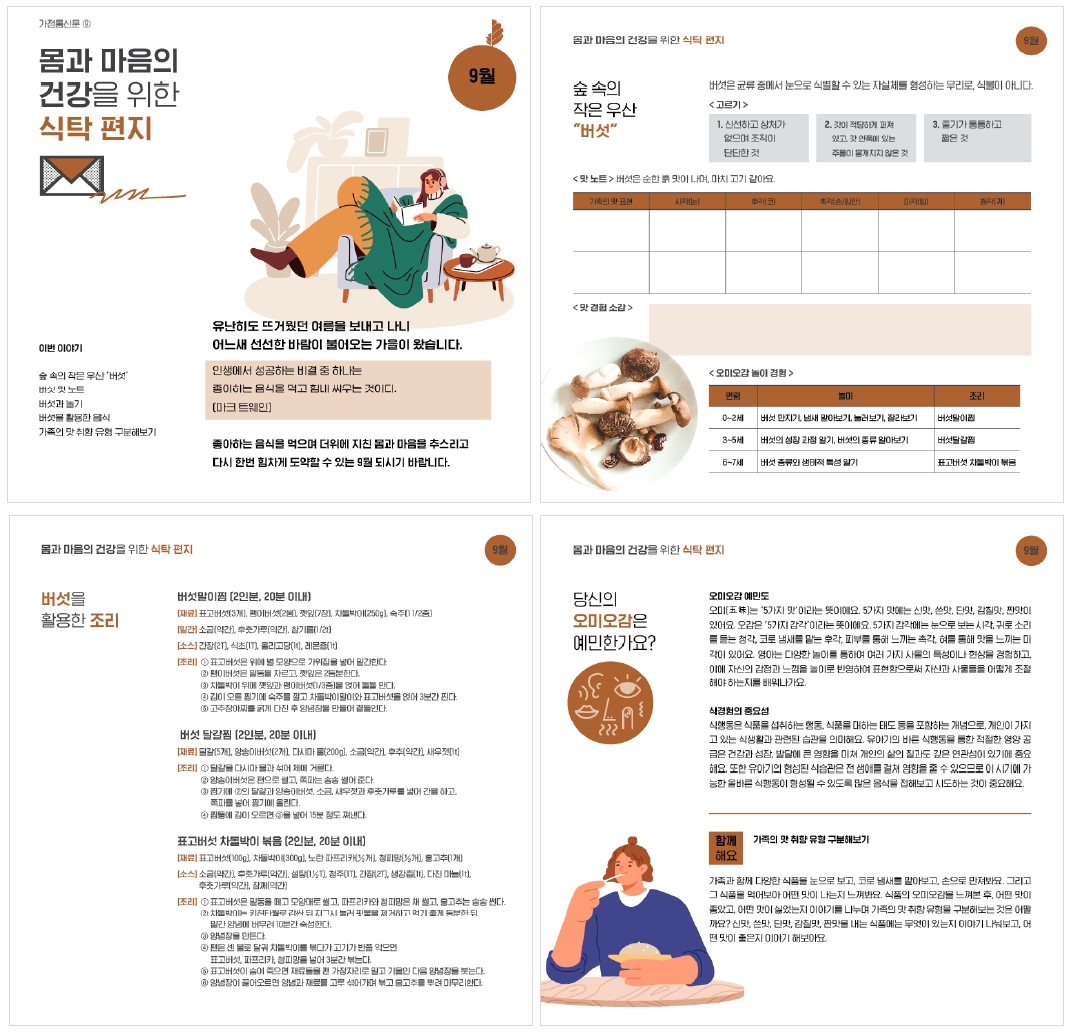
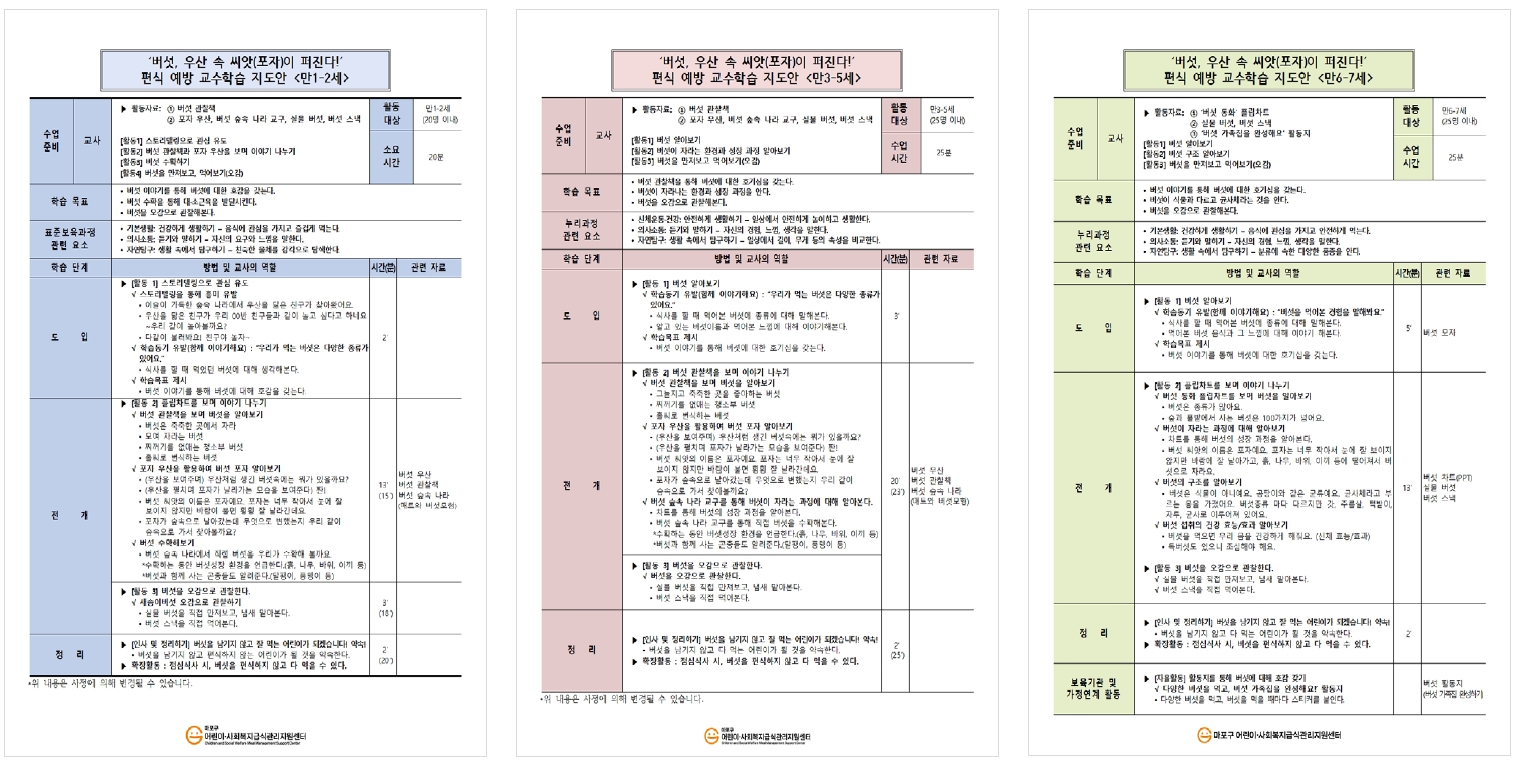
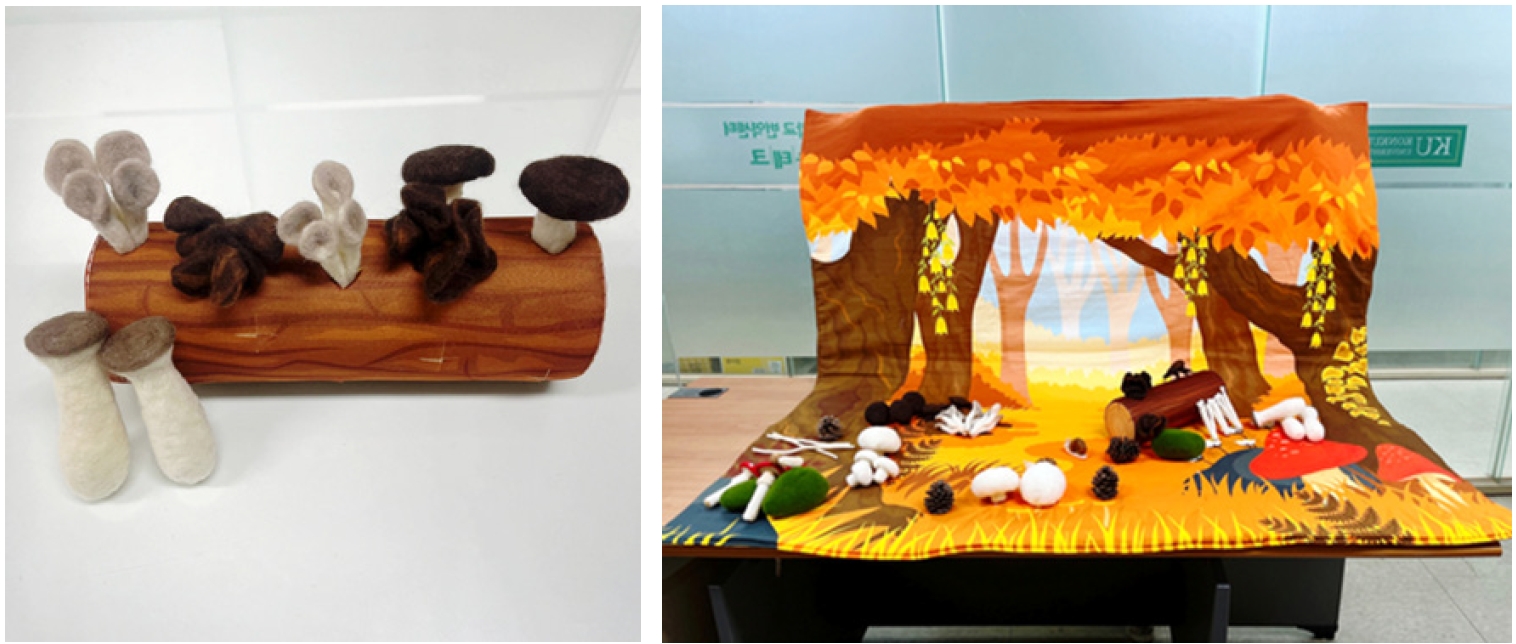
Fig. 1. Samples of educational materials (user guide, PPT slides, individual activity sheets, activity cards, poster, video clips, lesson plans, cooking recipe, parent newsletter).
Fig. 2. Samples of educational materials (cover pages of 12 food-themed slides).
Fig. 3. Samples of educational materials (parent newsletter).
Fig. 4. Examples of age-specific mushroom teaching-learning guides for evaluating field applicability.
Fig. 5. Examples of mushroom experiential tool developed for evaluating field applicability.
Fig. 1.
Fig. 2.
Fig. 3.
Fig. 4.
Fig. 5.
Development and evaluation of play-based food and nutrition education materials for early childhood through sensory experiences: a pre-post observational study
| Season | Month | Food | Theme |
|---|---|---|---|
| Spring | March | Spring cabbage | (Shape) A vegetable that signals the arrival of spring |
| April | Spring Namul | (Scent) It has a rich and strong aroma | |
| May | Broccoli | (Ecology) Green flowers have bloomed | |
| Summer | June | Paprika | (Texture) Crunchy and refreshing in the mouth |
| July | Tomato | (Diversity) Shapes and colors are diverse | |
| August | Cucumber | (Touch) Cool and moist | |
| Autumn | September | Mushroom | (Ecology) Spores spread under the umbrella-like cap |
| October | Rice | (Cooking) Transforms in many cooking styles | |
| November | Carrot | (Sweetness) Deliciously sweet | |
| Winter | December | Radish | (Taste) Offers a variety of flavors |
| January | Seaweed | (Flavor) A tasty sea plant | |
| February | Soybean | (Diversity) A beautiful seed |
| Category | 1–2 years | 3–5 years | 6–7 years |
|---|---|---|---|
| Activities | Learning about mushrooms | Learning about mushrooms | Learning about mushrooms |
| Harvesting mushrooms | Learning about mushroom spores | Singing a mushroom song | |
| Exploring different mushrooms | Harvesting mushrooms | Learning the names of different mushrooms | |
| Pretending to be a mushroom | Guessing mushroom names | Understanding the structure of mushrooms | |
| Sharing feelings after eating mushrooms | Exploring different mushrooms | Learning about mushroom spores | |
| Understanding mushroom nutrition | Sharing feelings after eating mushrooms | Understanding the growth process of mushrooms | |
| Tearing apart enoki mushrooms | Understanding the nutrition of mushrooms | Learning about poisonous mushrooms | |
| Expressing mushroom consumption through facial expressions and body movements | Shaping patterns on shiitake mushrooms | Guessing mushroom names through an initial consonant game | |
| Sharing feelings after eating mushrooms | |||
| Understanding the nutrition of mushrooms | |||
| Observing mushroom spore prints | |||
| Cooking activity | Enoki mushroom Jeon | Shiitake mushroom Jeon | Mushroom Jeongol |
| Activity sheet | Making a mushroom mask | Creating a mushroom hill | Finding mushrooms in the forest |
| Eat the mushroom and complete the mushroom house |
| Participant | Characteristics | Category | Frequency |
|---|---|---|---|
| Child (n = 60) | Gender | Boys | 31 (51.7) |
| Girls | 29 (48.3) | ||
| Age (year) | 1–2 | 20 (33.3) | |
| 3–5 | 40 (66.7) | ||
| Primary caregiver (n = 40) | Gender | Men | 2 (5.0) |
| Women | 38 (95.0) | ||
| Age (year) | 20–29 | 3 (7.5) | |
| 30–39 | 21 (52.5) | ||
| 40–49 | 14 (35.0) | ||
| 50–59 | 2 (5.0) | ||
| Relationship with child | Father | 2 (5.0) | |
| Mother | 35 (87.5) | ||
| Other | 3 (7.5) | ||
| Child’s gender | Boys | 20 (50.0) | |
| Girls | 20 (50.0) | ||
| Child’s age group | 1–2 | 9 (22.5) | |
| 3–5 | 31 (77.5) |
| Age group (year) | Pre-education | Post-education | |||||
|---|---|---|---|---|---|---|---|
| Awareness | Consumption experience | Preference | Awareness | Consumption experience | Preference | Consumption amount (g) | |
| 1–2 (n = 20) | 12 (60) | 9 (45) | 9 (45) | 20 (100) | 20 (100) | 9 (45) | 2.9 ± 0.4 |
| 3–5 (n = 40) | 32 (80) | 29 (73) | 28 (70) | 40 (100) | 40 (100) | 30 (75) | 2.8 ± 0.7 |
| % Change (pre to post) | 136 | 158 | 105 | ||||
| No. | Indicators | Total (n = 40) | Age groups | |
|---|---|---|---|---|
| 1–2 years (n = 9) | 3–5 years (n = 31) | |||
| 1 | The duration of the education was appropriate | 4.4 ± 0.6 | 4.2 ± 0.4 | 4.4 ± 0.6 |
| 2 | The educational content was appropriate for the children’s level | 4.5 ± 0.6 | 4.4 ± 0.5 | 4.5 ± 0.6 |
| 3 | The educational content was easy to understand | 4.5 ± 0.6 | 4.4 ± 0.5 | 4.5 ± 0.7 |
| 4 | The organization and applicability of the educational materials were appropriate | 4.5 ± 0.6 | 4.4 ± 0.5 | 4.5 ± 0.6 |
| 5 | The knowledge gained through the educational course can be applied | 4.5 ± 0.6 | 4.4 ± 0.5 | 4.5 ± 0.6 |
| 6 | The education is expected to help improve dietary habits | 4.3 ± 0.7 | 4.2 ± 0.7 | 4.4 ± 0.7 |
| 7 | Overall, I am satisfied with the education | 4.5 ± 0.6 | 4.4 ± 0.5 | 4.5 ± 0.6 |
| 8 | It was a useful learning experience that can be applied in daily life | 4.5 ± 0.6 | 4.4 ± 0.5 | 4.5 ± 0.6 |
Table 1. Monthly themes for play-based nutrition education
Table 2. Sample composition of play-based activities by age group (mushroom)
Table 3. General characteristics of the study participants
n (%).
Table 4. Change of mushroom indicators (awareness, consumption experience, preference, intake) (n = 60)
n (%) or Mean ± SD.
Table 5. Primary caregiver evaluation of educational materials (n = 40)
Mean ± SD. The 5-point Likert scale (1: not at all, 5: very much).



