
 KSCN
KSCN
Search
- Page Path
- HOME > Search
Research Articles
- [English]
- Understanding the drivers of continuance intention in online grocery shopping using technology continuance theory: a cross-national comparison
- Binglin Liu, Min A Lee
- Korean J Community Nutr 2026;31(1):50-63. Published online February 28, 2026
- DOI: https://doi.org/10.5720/kjcn.2026.00017
-
 Abstract
 PDF
PDF - Objectives
This study examined the determinants of consumers’ continuance intention (CI) toward online grocery shopping (OGS) across different country markets. Drawing on technology continuance theory (TCT), this study compared key drivers of CI in a different countries market.
Methods
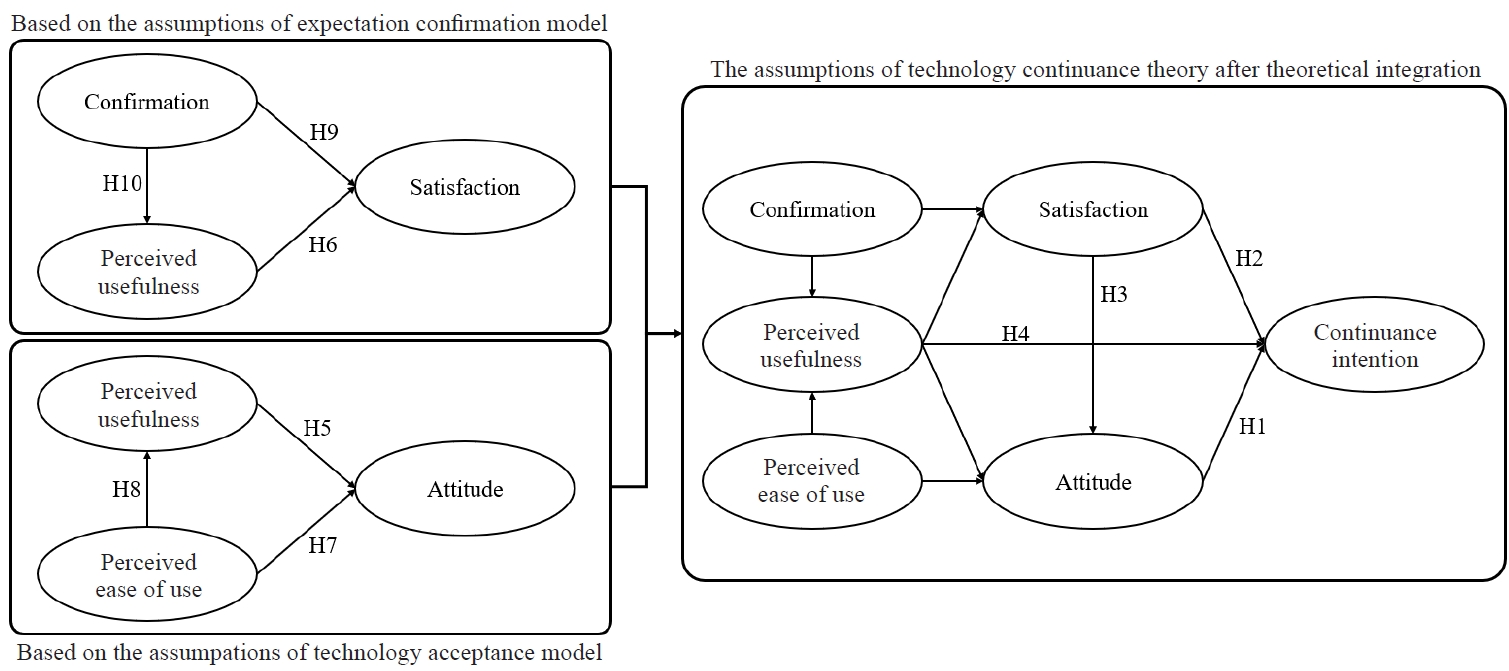
Data were collected via online surveys from 638 OGS users in China (n = 338) and South Korea (n = 300) between November and December 2023. A TCT-based model incorporating satisfaction, attitude, perceived usefulness (PU), perceived ease of use, confirmation, and CI was tested using partial least squares structural equation modeling. Partial measurement invariance testing was conducted to ensure valid cross-national comparison.
Results
In South Korea, both satisfaction and attitude significantly predicted CI, with satisfaction exerting a particularly strong effect. In China, attitude was the primary determinant of CI, whereas satisfaction had minimal impact. Across both countries, PU consistently and positively influenced satisfaction and attitude, thereby indirectly enhancing CI. Partial measurement invariance was confirmed, validating comparisons of the model across contexts.
Conclusion
The findings suggest that the drivers of online grocery continuance differ by cross-national market. In Korean markets, strategies must enhance customer satisfaction (and its influence on attitude) to sustain OGS usage. In Chinese markets, fostering favorable consumer attitudes toward OGS is essential for promoting continued use. This cross-national analysis advances the theoretical understanding of continuance behavior while providing practical guidance for designing market-specific strategies to sustain online grocery engagement.
- 1,230 View
- 37 Download

- [English]
- Factors influencing consumers’ continuance intention in online grocery shopping: a cross-sectional study using application behavior reasoning theory
- Binglin Liu, Min A Lee
- Korean J Community Nutr 2024;29(3):199-211. Published online June 30, 2024
- DOI: https://doi.org/10.5720/kjcn.2024.29.3.199
-
Abstract
PDF
- Objectives
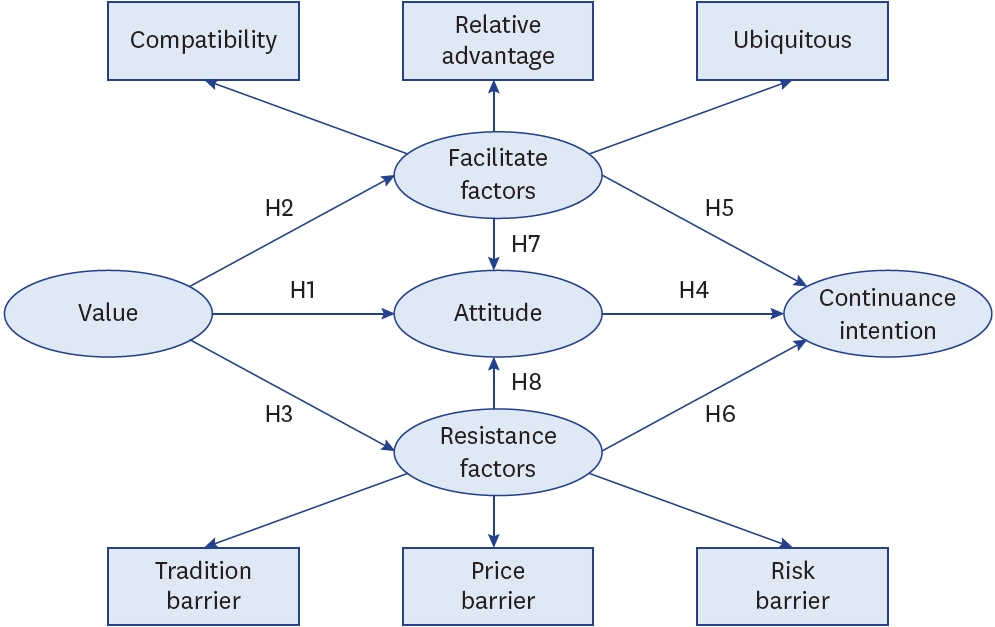
Online grocery shopping has gained traction with the digital transformation of retail. This study constructs a behavioral model combining values, attitudes, and reasons for behavior—specifically, facilitators and resistance—to provide a more novel discussion and further understand the relative influences of the various factors affecting continuance intention in online grocery shopping.
Methods
Data were collected through an online questionnaire from consumers who had engaged in online grocery shopping during the past month in Seoul, Korea. All collected data were analyzed using descriptive analysis, and model validation was performed using partial least squares structural equation modeling.
Results
Continuance intention is primarily driven by facilitative factors (compatibility, relative advantage, and ubiquity). Attitude can also positively influence continuance intention. Although resistance factors (price, tradition, and risk) do not significantly affect continuance intention, they negatively affect attitude. Values significantly influence consumers’ reasoning processes but not their attitude.
Conclusions
These findings explain the key influences on consumers’ online grocery shopping behavior in Seoul and provide additional discussion and literature on consumer behavior and market management. To expand the online grocery market, consumers should be made aware of the potential benefits of the online channel; the barriers they encounter should be reduced. This will help sustain online grocery shopping behavior. Furthermore, its positive impact on attitude will further strengthen consumers’ continuance intention. -
Citations
Citations to this article as recorded by
- Online Food Purchase Frequency Across Generations: Associations with Healthy Eating, Environmental Concern, and Economic Decision Indicators
Robert Wolny, Marcin Awdziej, Magdalena Jaciow, Ilona Lipowska, Marcin Lipowski, Jolanta Tkaczyk
Nutrients.2026; 18(16): 2730. CrossRef - Modelling the mass adoption potentials of fashion-augmented reality among the young consumers: evidence from an emerging economy
Mohima Akther, Mohammad Nurul Hassan Reza, Abdullah Al Mamun, Norzalita Abd Aziz, Marvello Yang
Journal of Fashion Marketing and Management: An International Journal.2025; 29(3): 459. CrossRef
- Online Food Purchase Frequency Across Generations: Associations with Healthy Eating, Environmental Concern, and Economic Decision Indicators
- 9,932 View
- 115 Download
- 2 Crossref
 First
First Prev
Prev



