
 KSCN
KSCN
Search
- Page Path
- HOME > Search
Research Articles
- [Korean]
- Prevalence of coronary artery disease according to lifestyle characteristics, nutrient intake level, and comorbidities among Koreans aged 40 years and older: a cross-sectional study using data from the 7th (2016–2018) Korea National Health and Nutrition Examination Survey
- Areum Song, Sook-Bae Kim
- Korean J Community Nutr 2025;30(6):457-470. Published online December 31, 2025
- DOI: https://doi.org/10.5720/kjcn.2025.00346
-
 Abstract
 PDF
PDF - Objectives
To examine the prevalence of coronary artery disease (CAD) according to lifestyle characteristics, nutrient intake level, and comorbidities among Koreans aged 40 years.
Methods
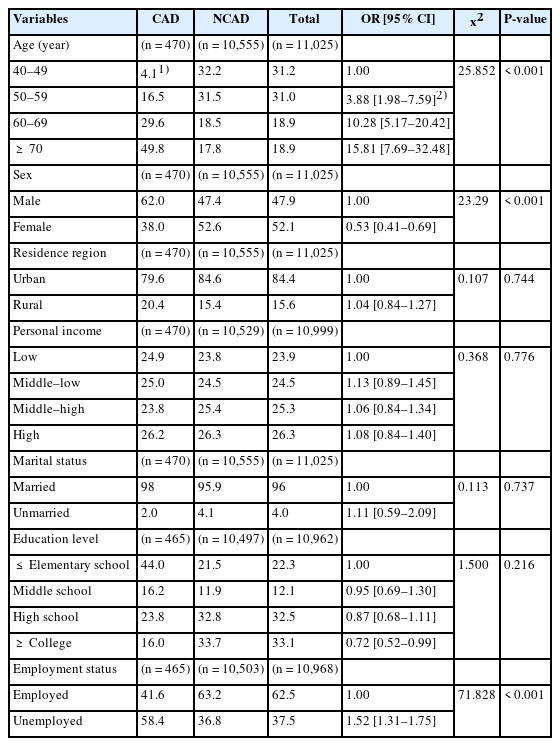
Data were derived from 11,025 participants aged ≥ 40 years in the 7th Korea National Health and Nutrition Examination Survey. Participants were assigned to a CAD group (n = 470) or a non-CAD group (n = 10,555). Socio-demographic characteristics (age, sex, residence, income, marital status, education level, and employment status), lifestyle characteristics (smoking, drinking, walking, strength training, sleep duration, stress level, and subjective health perception), energy and nutrient intakes, and comorbidities, including obesity, hypertension, dyslipidemia, diabetes mellitus, stroke, cancer, depression, renal failure, cataract, asthma, chronic obstructive pulmonary disease, osteoarthritis, and osteoporosis were analyzed.
Results
The prevalence of CAD was higher in older participants and in male. Participants with CAD had higher rates of smoking, engaged in less strength training, experienced higher stress, and had poorer perceived health. They had lower intakes of energy, fiber, folate and iron. The prevalence of obesity, hypertension, dyslipidemia, diabetes mellitus, stroke, depression, renal failure, cataract, asthma, allergic rhinitis, osteoarthritis, or osteoporosis was significantly higher in the CAD group. The likelihood of having CAD was significantly higher among participants with renal failure (odds ratio [OR], 4.25; 95% confidence interval [CI], 2.24–8.08), depression (OR, 2.14; 95% CI, 1.55–2.95), asthma (OR, 2.07; 95% CI 1.48–2.91), and dyslipidemia (OR, 2.03; 95% CI, 1.69–2.44).
Conclusion
In Koreans aged 40 years, CAD was associated with unhealthy lifestyle habits, low nutrient intake, and increased comorbidities such as renal failure, depression, asthma, and dyslipidemia. These findings suggest the need for lifestyle management and intensive chronic disease management to reduce the risk of CAD.
- 1,550 View
- 67 Download

- [English]
- Health-related quality of life and nutrient intake of the elderly with type 2 diabetes according to comorbidity burden: a cross-sectional study
- Yejung Choi, Kyong Park
- Korean J Community Nutr 2024;29(5):418-430. Published online October 31, 2024
- DOI: https://doi.org/10.5720/kjcn.2024.00014

-
Abstract
PDF
- Objectives
This study aimed to explore the cross-sectional association between health-related quality of life (HRQoL) according to the number of comorbidities in older adults with type 2 diabetes mellitus (T2DM) using the Euro Quality of Life-5 Dimensions (EQ-5D) index. Methods: This study included 3,553 participants aged ≥ 65 years from the 2008–2020 Korea National Health and Nutrition Examination Survey. Dietary data were collected through 24-hour recall interviews by trained researchers, and demographic and lifestyle information via self-administered questionnaires. HRQoL was measured using a modified EQ-5D scale. Multivariable linear regression analyzed the associations between EQ-5D scores, nutrients and comorbidity, controlling for sociodemographic and health variables. Results: Most participants reported ‘no problems’ in the EQ-5D scores, although approximately 17% to 47% of participants reported ‘some problems’ or ‘extreme problems,’ depending on the dimension. As comorbidities increased, significant declines were observed across all dimensions, particularly in mobility, usual activities, pain/discomfort, and anxiety/ depression. Nutrient intake analysis revealed that participants with three or more comorbidities consumed less carbohydrates, but more fat. Conclusion: Our findings demonstrate that among older adults with T2DM, a higher number of comorbidities is associated with decreased HRQoL. Additionally, there are differences in nutrient intake patterns among those with more comorbidities, specifically decreased carbohydrate intake and increased fat intake. These results emphasize the need for comprehensive and tailored management strategies that consider both diabetes and the co-occurring health conditions. By addressing the complex healthcare needs of individuals with multiple comorbidities, it is possible to enhance their HRQoL and overall well-being. -
Citations
Citations to this article as recorded by
- Real-World Comparison of the Effectiveness of Defocus Incorporated Multiple Segments and Myopi-X Spectacle Lenses for Myopia Control in Turkish Children: A Retrospective Study
Nilay Akagün, Uğur Emrah Altıparmak
Turkish Journal of Ophthalmology.2026; 56(1): 8. CrossRef - Multidimensional Determinants of Quality of Life in Older Adults with Type 2 Diabetes: A Narrative Synthesis
Martaria Rizky Rinaldi, Nida Ul Hasanat, Kwartarini Wahyu Yuniarti
Clinical Gerontologist.2026; : 1. CrossRef
- Real-World Comparison of the Effectiveness of Defocus Incorporated Multiple Segments and Myopi-X Spectacle Lenses for Myopia Control in Turkish Children: A Retrospective Study
- 3,270 View
- 37 Download
- 2 Crossref
 First
First Prev
Prev



