
 KSCN
KSCN
Search
- Page Path
- HOME > Search
Research Article
- [Korean]
- Evaluation of young children’s dietary behaviors by parental growth concern levels in Gyeonggi area: a descriptive study
- Youn-Rok Kang, Hyung-Sook Kim
- Korean J Community Nutr 2026;31(1):75-86. Published online February 28, 2026
- DOI: https://doi.org/10.5720/kjcn.2025.00269
-
 Abstract
 PDF
PDF - Objectives
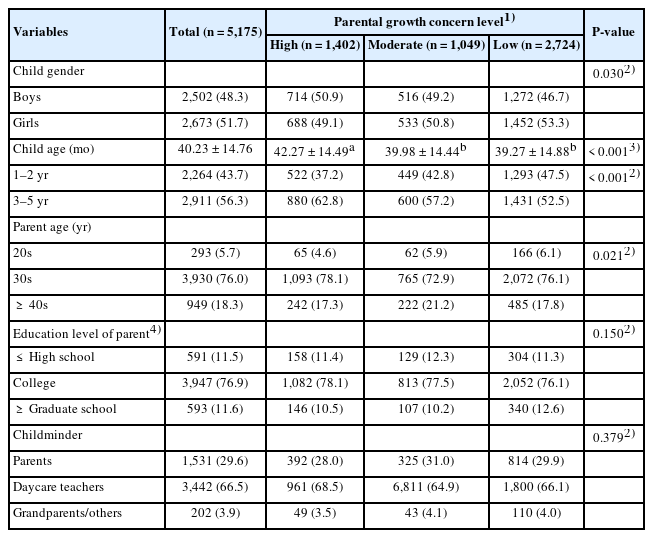
This study investigated differences in dietary habits, lifestyle patterns, and feeding- related developmental issues among Korean preschool children based on their parents’ levels of growth concern, and examined the associations between parental growth concern and children’s eating behaviors.
Methods
A cross-sectional study was conducted with parents of children aged 1–5 years residing in Gyeonggi Province, Korea. Participants were classified into high, moderate, and low growth concern groups using the children’s dietary screening test. Data were collected on the children’s anthropometric status, lifestyle routines, dietary intake patterns, eating behaviors, and mealtime media exposure.
Results
Children in the high growth concern group showed a higher prevalence of underweight; irregular sleep and mealtime routines; and more frequent eating difficulties, including picky eating, slow eating, and oral processing problems. Mealtime media exposure was associated with lower fruit and vegetable intake and higher consumption of processed and sugar-rich foods. Higher parental growth concern did not correlate with healthier dietary or lifestyle outcomes.
Conclusion
Preschool children’s dietary behaviors and routines differed according to the parents’ levels of growth concern. Higher levels of parental concern were associated with increased feeding difficulties and greater mealtime media exposure. These findings suggest that excessive concern may contribute to maladaptive eating patterns in children. Evidence- based parental guidance and structured nutrition education are essential to promote healthy growth and eating behaviors during early childhood.
- 1,080 View
- 55 Download

Original Article
- [English]
- Growth and Development of Infants Fed Soy-Based Formulas over 3 Months
- Sang Woon Cho, Hae Choul Shin, Heon Soo Sohn, Chai Won Chung, Hee Jung Nam, Hye Ryun Park
- Korean J Community Nutr 2004;9(5):555-565. Published online October 31, 2004
-
Abstract
PDF
- The objective of this study was conducted to investigate growth and development status of infants fed soy-based formulas over 3 months. The height and weight were measured and Z-scores were calculated by using standard of the same age groups. Their mothers were interviewed using questionnaires including general and environmental characteristics, total food intakes, soy based formula intakes and Ewha infant development screening test. Main results were as follows: 1) Nutrient intake levels of subjects were similar to or more than the level of Korean Recommended Dietary Allowances except for intakes of vitamin E (79.89% RDA), and the average status of nutrient intakes of infants were fairly good. 2) Z-scores of height for age (HAZ) and Z-scores of weight for age (WAZ), Kaup index, WLI and Ewha Infant Developmental Screening Test score of subjects were in the normal growth range. 3) There were no significant differences among soy based formula intake percentile groups in HAZ, WAZ, Kaup index, WLI and Ewha Infant Developmental Screening Test score. 4) Total energy intake was positively correlated with HAZ (p < 0.01), WAZ (p < 0.01), and WLI (p < 0.05) in infants less than 12 month. Also, soy based formula energy intake was positively correlated with HAZ (p < 0.05) in infants less than 12 month. However, energy and soy based formula intake levels of infants over 12 month were not significant among variables. Considering results of this study, infants fed soy-based formulas over 3 months showed normal growth and development status. Further studies are needed to evaluate long-term growth and development in infants fed soy based formulas.
- 599 View
- 6 Download
 First
First Prev
Prev



