
 KSCN
KSCN
Search
- Page Path
- HOME > Search
Review
- [English]
- Life-course nutrition strategies for Korean middle-aged adults across biological transitions, nutritional burdens, and a community-linked precision nutrition model: a narrative review
- Yoo Kyoung Park
- Korean J Community Nutr 2026;31(3):215-228. Published online June 30, 2026
- DOI: https://doi.org/10.5720/kjcn.2026.00206
-
 Abstract
 PDF
PDF - Objectives
To describe the nutritional challenges faced by Korean middle‑aged adults (40–64 years) from a life‑course and biological transition perspective and to propose systems‑based precision nutrition strategies for this critical stage of the lifespan.
Methods
In this narrative review, PubMed, Medline, and Web of Science were searched for articles published between January 2010 and November 2025 using terms such as “middle aged nutrition,” “healthy aging,” “life course nutrition,” “sarcopenia,” “precision nutrition,” and “chronic diseases.” Policy documents and major national cohort and intervention studies were also reviewed.
Results
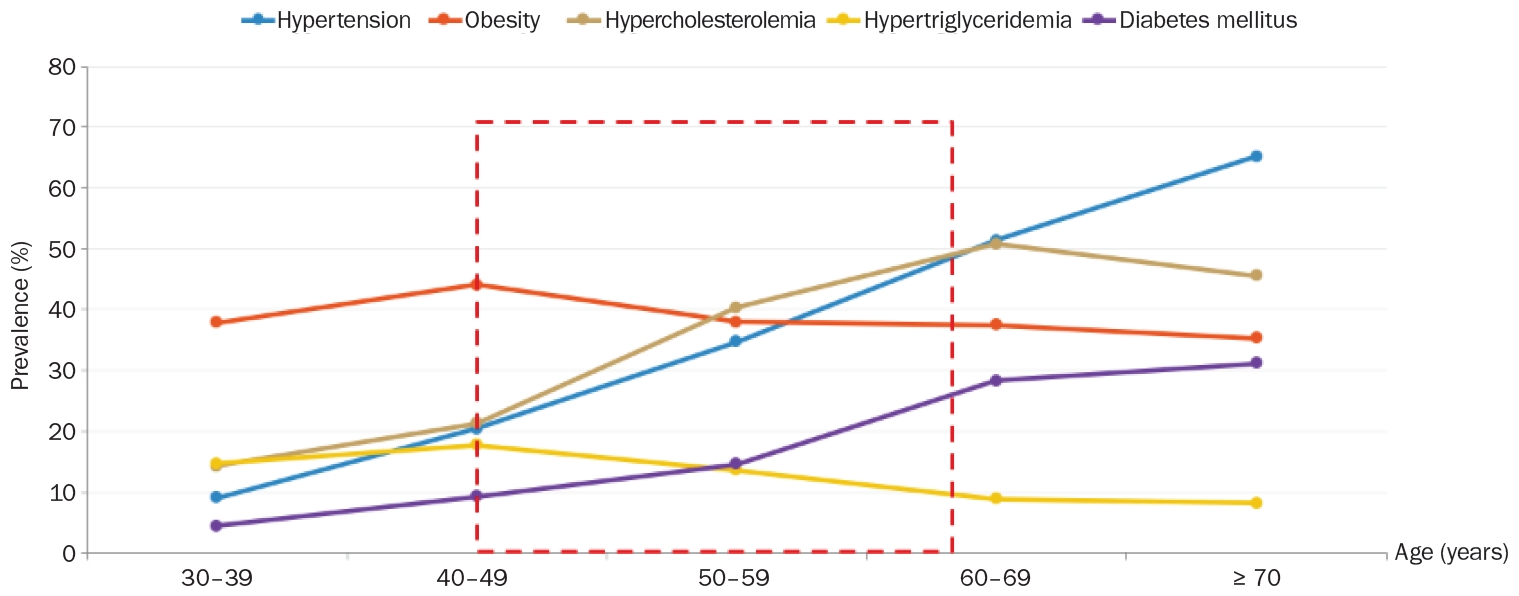
Middle-aged adults in Korea have a high prevalence of chronic disease beginning in their 40s, showing “the triple burden of malnutrition:” obesity, insufficient micronutrients, and sarcopenia onset, along with excessive sodium and sugar consumption combined with socioeconomic factors like living alone. Nutrient and dietary approaches, such as high protein (1.2–1.5 g/kg/d), leucine, dairy products and fruits, anti-inflammatory foods intake, Dietary Approaches to Stop Hypertension (DASH) or Mediterranean diets plus lifestyle modification at public health centers (Korean Diabetes Prevention Study) for cardiometabolic risks, Mediterranean-DASH Intervention for Neurodegenerative Delay diet for cognition maintenance, could greatly impact health trajectories.
Conclusion
Korean middle‑aged adults experience a triple burden of malnutrition on top of nonlinear biological aging shifts, which together accelerate cardiometabolic, musculoskeletal, and cognitive risks. Implementing targeted dietary strategies within a systems‑based, community-linked precision nutrition model is essential to reshape health trajectories and promote healthy longevity in this population.
- 807 View
- 23 Download

Original Article
- [English]
- Development of Nutrition Education Materials for Healthy Aging
- Yun Ahn, Kyung A Kim, Hyunjoo Kang, Kyungwon Kim
- Korean J Community Nutr 2006;11(6):740-749. Published online December 31, 2006
-
Abstract
PDF
- The objective of this study was to develop nutrition education materials for older adults, 'nutritional management for healthy aging'. A booklet and four leaflets were developed based on lesson plans. Topics of the lesson plans included eating habit assessment, Korean food guide pyramid, meal planning, eating sensibly and weight management. The titles of the leaflets were 'Eating right for healthy aging', 'Eat calcium-rich foods', 'Enjoy fruits & vegetables' and 'Weight management'. Illustrations and icons appropriate to the texts were designed using Illustrator 9.0 and Photoshop 6.0. Booklet (letter size, 5 chapters, 44 pages) and leaflets (B4 size, 6 sections) focused on modifying undesirable eating habits, providing practical tips for desirable behaviors, and behavioral modification such as recording in a food diary, goal setting and increasing self-efficacy. The drafts were pilot-tested by interviews with older adults(n=10), and minor changes were made. The characteristics of revised materials are as follows; i) materials focused on providing desirable eating behaviors for healthy aging, ii) messages were simple and specific, iii) large fonts(13 pt) were used and materials included interesting pictures and illustrations, iv) materials provided tips for balanced diets and recipes for older adults, v) materials included sections for participation of learners including assessment of nutritional risk factors and obesity, meal planning and games. The revised materials are self-explanatory and can be used by older adults and in nutrition education for older adults.
- 584 View
- 4 Download
 First
First Prev
Prev



