
 KSCN
KSCN
Search
- Page Path
- HOME > Search
Research Article
- [Korean]
- Effects of senior-friendly foods on health, nutritional status, and dietary intake among rural elderly women in Korea: a quasi-experimental study
- Sang-ju Lee, Ji-hyeon Kim, Jin-suk Han
- Korean J Community Nutr 2026;31(1):101-113. Published online February 28, 2026
- DOI: https://doi.org/10.5720/kjcn.2025.00353
-
 Abstract
 PDF
PDF - Objectives
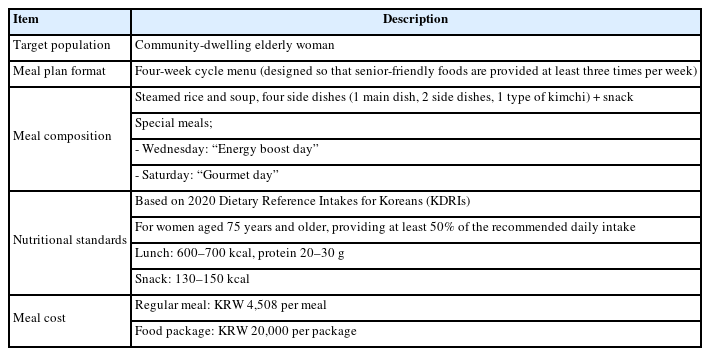
We evaluated the impacts on health, nutritional status, and dietary intake of providing senior-friendly foods to community-dwelling elderly women in a rural area in Korea.
Methods
A pretest–posttest nonequivalent control group design with repeated measures was conducted among 71 rural-dwelling elderly women. Changes in health indicators, nutritional status, and dietary intake were assessed at three time points: baseline, post-intervention, and two months after intervention.
Results
Immediately after a three month intervention, significant differences were observed between the intervention and control groups in frailty score, Dysphagia Handicap Index, Mini Nutritional Assessment, social isolation, resilience, quality of life, and depression (P < 0.05). Significant group-by-time interaction effects were found for muscle mass, hemoglobin A1c, and energy, protein, and micronutrient intake, all of which showed significant improvements in the intervention group (P < 0.05).
Conclusion
Providing senior-friendly foods effectively improved physical and physiological health and emotional well-being among rural older adults. This intervention also contributed broadly to improved dietary intake. These findings provide empirical evidence to support the development of community-based integrated care models and tailored nutrition intervention programs for rural elderly populations in Korea. Trial Registration: Clinical Research Information Service Identifier: KCT0011666.
- 1,108 View
- 61 Download

 First
First Prev
Prev



