
 KSCN
KSCN
Search
- Page Path
- HOME > Search
Research Articles
- [Korean]
- Evaluation of young children’s dietary behaviors by parental growth concern levels in Gyeonggi area: a descriptive study
- Youn-Rok Kang, Hyung-Sook Kim
- Korean J Community Nutr 2026;31(1):75-86. Published online February 28, 2026
- DOI: https://doi.org/10.5720/kjcn.2025.00269
-
 Abstract
 PDF
PDF - Objectives
This study investigated differences in dietary habits, lifestyle patterns, and feeding- related developmental issues among Korean preschool children based on their parents’ levels of growth concern, and examined the associations between parental growth concern and children’s eating behaviors.
Methods
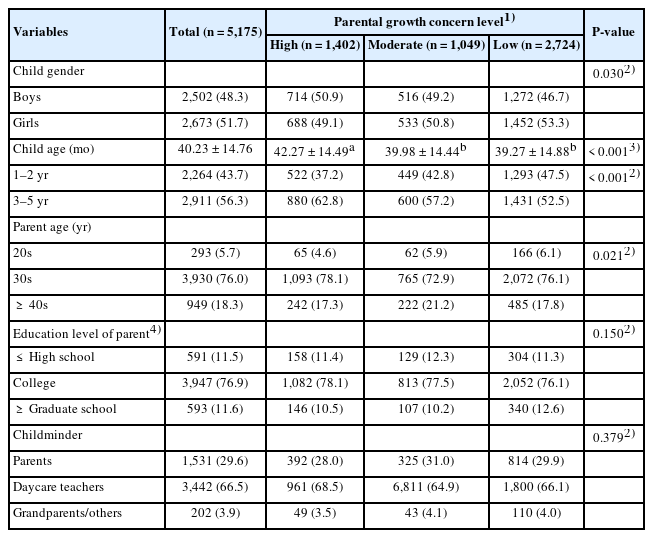
A cross-sectional study was conducted with parents of children aged 1–5 years residing in Gyeonggi Province, Korea. Participants were classified into high, moderate, and low growth concern groups using the children’s dietary screening test. Data were collected on the children’s anthropometric status, lifestyle routines, dietary intake patterns, eating behaviors, and mealtime media exposure.
Results
Children in the high growth concern group showed a higher prevalence of underweight; irregular sleep and mealtime routines; and more frequent eating difficulties, including picky eating, slow eating, and oral processing problems. Mealtime media exposure was associated with lower fruit and vegetable intake and higher consumption of processed and sugar-rich foods. Higher parental growth concern did not correlate with healthier dietary or lifestyle outcomes.
Conclusion
Preschool children’s dietary behaviors and routines differed according to the parents’ levels of growth concern. Higher levels of parental concern were associated with increased feeding difficulties and greater mealtime media exposure. These findings suggest that excessive concern may contribute to maladaptive eating patterns in children. Evidence- based parental guidance and structured nutrition education are essential to promote healthy growth and eating behaviors during early childhood.
- 1,091 View
- 56 Download

- [Korean]
- Food and dish group diversity on menus of daycare centers provided by Center for Children’s Foodservice Management in Korea: a descriptive study
- Youn-Rok Kang, Kyeong-Sook Lim, Hyung-Sook Kim
- Korean J Community Nutr 2023;28(6):449-465. Published online December 31, 2023
- DOI: https://doi.org/10.5720/kjcn.2023.28.6.449
-
Abstract
PDF
- Objectives
This study aimed to analyze menu patterns and food group diversity in daycare centers managed by the Center for Children's Foodservice Management in South Korea.
Methods
Data from 18 Center for Children's Foodservice Management centers across various provinces (excluding Jeju Island) were analyzed. We examined 8,796 meals served in February, May, August, and December 2021, focusing on seasonal lunch and snack menus for children aged 3-5. Foods were categorized into 19 groups for lunch and 21 for snacks. The frequency of food groups and dietary patterns were assessed using the Dietary Diversity Score. Analyses were conducted using Excel 2016 and IBM SPSS Statistics version 28.
Results
Most lunch menus (89%) included five menu items, with a ratio of grain, meat, and vegetables at 88%. Snack menus typically had one item (57%), with significantly more items in the afternoon compared to the morning (P < 0.001). Regarding snack patterns, 75.2% of morning snacks and 61.1% of afternoon snacks contained only one solid food and drink (P < 0.001). Fruit and milk (22.4%) was the most prevalent pattern in morning snacks, while grain and milk (31%) dominated afternoon snacks (P < 0.001). Only 48% of daycare center menus (all snacks and lunch) included all five food groups (grain, meat, vegetables, fruit, and milk). Notably, only 83% included milk and 57% included fruit.
Conclusions
These findings highlight the need to improve food variety and diversity in the Center for Children’s Foodservice Management-managed daycare center menus. Developing more detailed guidelines for menu structure and food composition is crucial to ensure children receive balanced and diverse nutrition. -
Citations
Citations to this article as recorded by
- Nutrient intake and food consumption of Korean preschool children: a comparison between a daycare meal group and non-daycare meal group using the data from the 2016–2019 Korea National Health and Nutrition Examination Survey
Young-Hee Han, Taisun Hyun
Nutrition Research and Practice.2025; 19(2): 225. CrossRef
- Nutrient intake and food consumption of Korean preschool children: a comparison between a daycare meal group and non-daycare meal group using the data from the 2016–2019 Korea National Health and Nutrition Examination Survey
- 2,080 View
- 55 Download
- 1 Crossref
 First
First Prev
Prev



