
 KSCN
KSCN
Search
- Page Path
- HOME > Search
Research Articles
- [Korean]
- Comparison of dietary behaviors and nutrient intake by gender and household type among older Koreans: a cross-sectional study using data from the 8th Korea National Health and Nutrition Examination Survey
- Dana Park, Soo-Kyung Lee
- Korean J Community Nutr 2026;31(1):87-100. Published online February 28, 2026
- DOI: https://doi.org/10.5720/kjcn.2025.00367
-
 Abstract
 PDF
PDF - Objectives
This study aimed to identify gender- and household type-specific nutritional vulnerability among older Koreans by comparing dietary behaviors, nutrient intake, and diet quality.
Methods
We analyzed data from 2,412 adults aged ≥ 65 years (1,118 men; 1,294 women) from the 8th Korea National Health and Nutrition Examination Survey (2019–2021). Household type was classified as one-person, couple-only, or with-children. Outcome variables included dietary behavior, daily energy and nutrient intake, and diet quality, assessed using the Korean Healthy Eating Index (KHEI). Analyses were carried out accounting for the complex sampling design, adjusting for age, residential area, education level, household income level, economic activity status, self-rated health status, and survey year.
Results
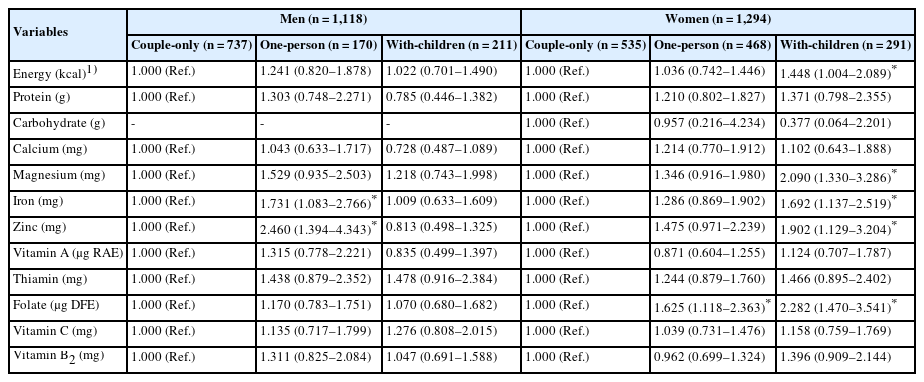
Elderly men in one-person households, compared with those in couple-only households, were more likely to skip breakfast and lunch and to consume less energy. The odds of intake below the estimated average requirement (EAR) were higher for iron (odds ratio [OR] = 1.731, P = 0.022) and zinc (OR = 2.460, P = 0.002) among men in one-person households. The KHEI score was the lowest among men in one-person households. Elderly women in with-children households, compared with those in couple-only households, were more likely to skip breakfast and to consume less energy. The risks of intake below the estimated energy requirement (EER) and EAR were higher among women in with-children households than those in couple-only households (EER: OR = 1.448; magnesium: OR = 2.090; iron: OR = 1.692; zinc: OR = 1.902; folate: OR = 2.282; all P < 0.05). The KHEI score was lower among women in with-children households.
Conclusion
Elderly men living alone and elderly women living with children showed significantly greater nutritional vulnerability. More attention should be given to understanding how gender-specific household types can affect nutritional vulnerability in later life.
- 1,129 View
- 69 Download

- [English]
- Understanding the charactersitics and types of single-person households based on food purchase frequencies in Korea: a cross-sectional study using the 2023 Consumer Behavior Survey for Foods
- So-Yun Kim, Youngmin Nam, Jong-Youn Rha, Haerang Lee
- Korean J Community Nutr 2025;30(1):27-39. Published online February 28, 2025
- DOI: https://doi.org/10.5720/kjcn.2025.00031

-
Abstract
PDF
- Objectives
This study investigated the differences in food purchase frequency among single-person households by gender and age group and explored the characteristics of single-person household groups according to their food purchase patterns.
Methods
Utilizing data from the 2023 Consumer Behavior Survey for Foods conducted by the Korea Rural Economic Institute, this study examined food purchase frequencies among 966 single-person households. Data were analyzed using Rao-Scott chi-square tests, ANCOVA, ANOVA, and K-modes hierarchical cluster analysis.
Results
Significant differences were observed in the food purchase frequencies of single-person households for fresh and convenient food. Women displayed higher purchase frequencies for fish, vegetables, and fruits, whereas men showed higher purchase frequencies for convenient foods (P < 0.005). Single-person households aged 39 years and younger exhibited lower purchase frequencies for vegetables (P < 0.005) and fish (P < 0.001) and substantially higher frequencies of convenient food purchases (P < 0.001). Additionally, this study identified three distinct single-person household groups based on food purchase pattern: the “nutrition-conscious” group, which exhibited high purchase frequency for fresh foods; the “convenience-seeking” group, which showed high purchase frequency for all types of convenient foods; and the “passive food consumer” group, which displayed relatively low purchase frequency for both fresh foods and convenient foods. The socio-demographic characteristics of single-person households differed significantly across these three groups, with the “passive food consumer” group and “convenience-seeking” group exhibiting lower healthy eating competency (MN(nutrition-conscious group) = 3.68, MP(passive-food-consumer group) = 3.40, MC(convenience-seeking group) = 3.52, P < 0.001), safe eating competency (MN = 3.87, MP = 3.57, MC = 3.77, P < 0.001), and satisfaction (MN = 3.36, MP = 3.23, MC = 3.25, P = 0.04) than the “nutrition-conscious” group.
Conclusion
This study underscores the need for targeted nutrition programs to address the unique needs of single-person households depending on their characteristics. Specifically, this study highlights the importance of targeted interventions for “convenience-seeking” and “passive food consumer” to promote dietary competency and encourage healthy dietary behavior. -
Citations
Citations to this article as recorded by
- Dietary behaviors and food waste typologies in single-person households using nationally representative data in South Korea
Wonwi Moon, Sunny Ham, Yonghee Suk
Waste Management.2026; 216: 115446. CrossRef - Cut-Specific Phospholipid Content and Distribution in Commonly Consumed Beef and Pork in Korea
Sunyoung Lim, Heon-Woong Kim, Jung-Ah Shin
Journal of the Korean Society of Food Science and Nutrition.2026; 55(4): 360. CrossRef - Secular trends in dietary patterns among Korean adults: using data from the 2007–2022 Korea National health and nutrition examination survey
Eunyoung Tak, Juhae Kim, Heejin Lee, Minji Kang
Nutrition Journal.2025;[Epub] CrossRef - 남성의 조리문해력이 식생활만족도에 미치는 영향: 조리관심도의 매개효과를 중심으로
진영 장, 지영 윤
Korean Journal of Food and Cookery Science.2025; 41(6): 430. CrossRef
- Dietary behaviors and food waste typologies in single-person households using nationally representative data in South Korea
- 13,862 View
- 138 Download
- 4 Crossref
 First
First Prev
Prev



