
 KSCN
KSCN
Search
- Page Path
- HOME > Search
Research Articles
- [English]
- Understanding the drivers of continuance intention in online grocery shopping using technology continuance theory: a cross-national comparison
- Binglin Liu, Min A Lee
- Korean J Community Nutr 2026;31(1):50-63. Published online February 28, 2026
- DOI: https://doi.org/10.5720/kjcn.2026.00017
-
 Abstract
 PDF
PDF - Objectives
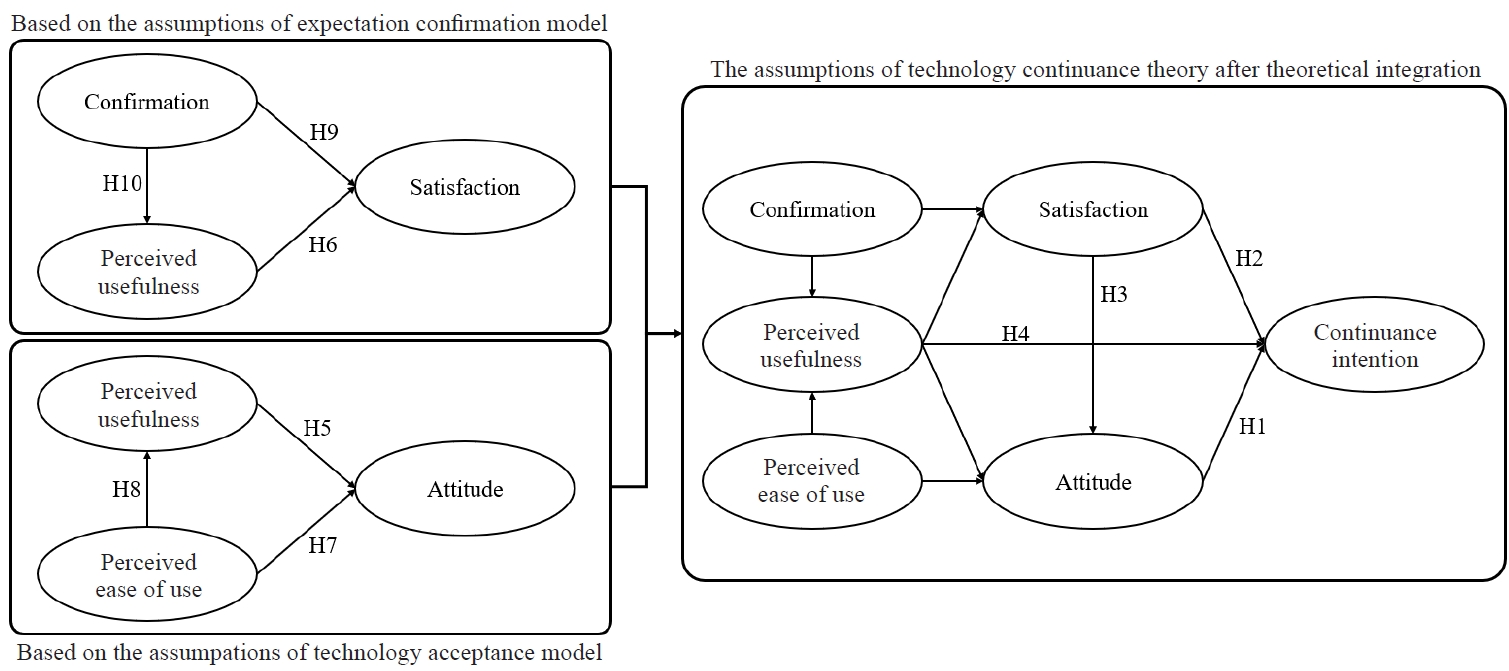
This study examined the determinants of consumers’ continuance intention (CI) toward online grocery shopping (OGS) across different country markets. Drawing on technology continuance theory (TCT), this study compared key drivers of CI in a different countries market.
Methods
Data were collected via online surveys from 638 OGS users in China (n = 338) and South Korea (n = 300) between November and December 2023. A TCT-based model incorporating satisfaction, attitude, perceived usefulness (PU), perceived ease of use, confirmation, and CI was tested using partial least squares structural equation modeling. Partial measurement invariance testing was conducted to ensure valid cross-national comparison.
Results
In South Korea, both satisfaction and attitude significantly predicted CI, with satisfaction exerting a particularly strong effect. In China, attitude was the primary determinant of CI, whereas satisfaction had minimal impact. Across both countries, PU consistently and positively influenced satisfaction and attitude, thereby indirectly enhancing CI. Partial measurement invariance was confirmed, validating comparisons of the model across contexts.
Conclusion
The findings suggest that the drivers of online grocery continuance differ by cross-national market. In Korean markets, strategies must enhance customer satisfaction (and its influence on attitude) to sustain OGS usage. In Chinese markets, fostering favorable consumer attitudes toward OGS is essential for promoting continued use. This cross-national analysis advances the theoretical understanding of continuance behavior while providing practical guidance for designing market-specific strategies to sustain online grocery engagement.
- 1,230 View
- 37 Download

- [English]
- Exploring the customer perceived value of online grocery shopping: a cross-sectional study of Korean and Chinese consumers using Means-End Chain theory
- Xinyu Jiang, Hyo Bin Im, Min A Lee
- Korean J Community Nutr 2024;29(4):318-335. Published online August 31, 2024
- DOI: https://doi.org/10.5720/kjcn.2024.00007
-
Abstract
PDF
- Objectives
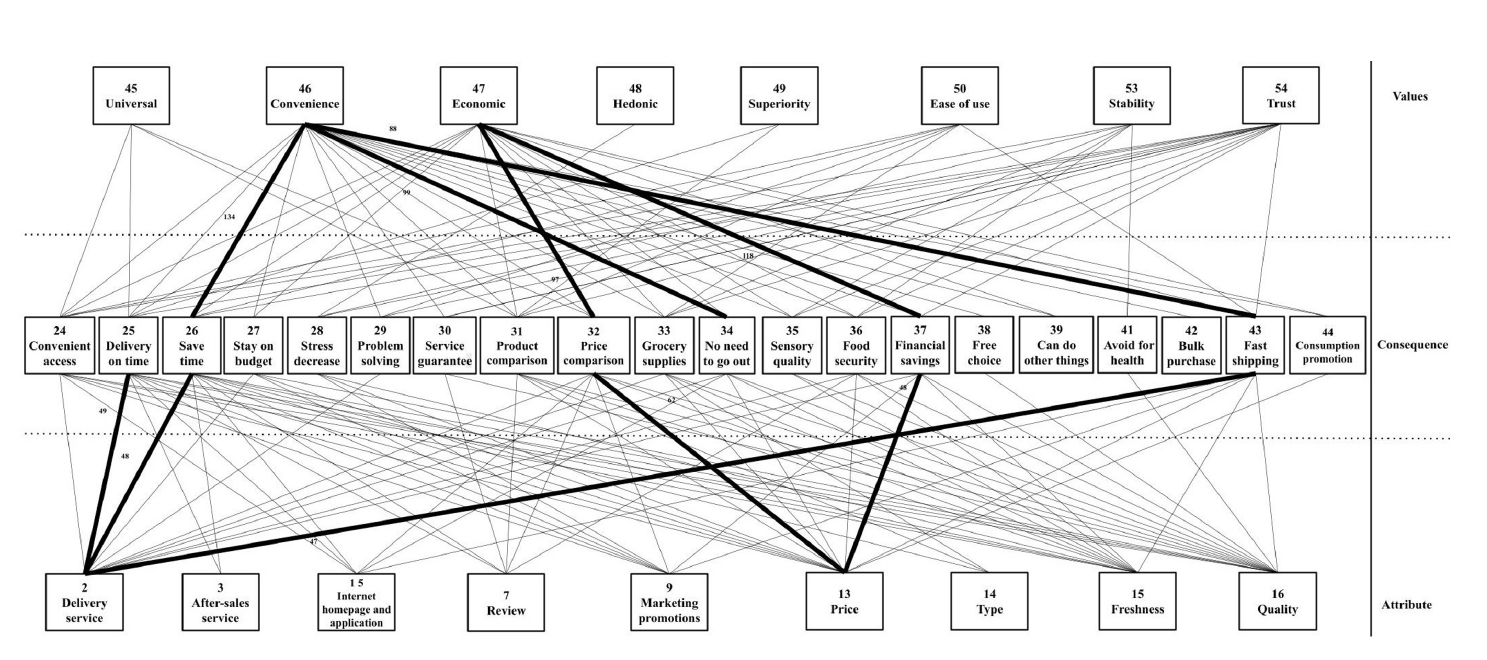
Despite the growing market share of online grocery shopping, there is a need to understand customer perceived value due to the ongoing advancements in information technology. This study explores the connections between attributes, consequences, and values. Additionally, it conducts a cross-country comparison of consumers’ online grocery shopping behaviors to gain a deeper understanding of consumer market segments and any potential variations among them.
Methods
Data was collected through an online questionnaire survey conducted from May 1 to 15, 2024, targeting 400 consumers in Seoul, Korea, and Shanghai, China, who have experience with online grocery shopping. The survey utilized the Means-End Chain theory and association pattern technique hard laddering. Data collation and analysis were conducted using the IBM SPSS Statistics 28.0 program. The LadderUX software was employed to analyze the links between attributes, consequences, and values and create the consumer purchasing process’s implication matrix and hierarchical value map (HVM).
Results
The study identified key attributes that influence online grocery shopping decisions, including delivery service, price, freshness, and quality. Korean consumers demonstrated a higher sensitivity to price (19.0%) and delivery service (17.0%). In contrast, Chinese consumers prioritized delivery service (15.0%) and after-sales service (14.8%). Commonly cited consequences included time saving (12.6% for Koreans, 11.3% for Chinese), whereas prevalent values encompassed convenience (36.8% for Koreans, 19.6% for Chinese) and economic value (26.6% for Koreans, 14.7% for Chinese). The HVM underscored these insights, highlighting diverse consumer preferences and country-specific nuances.
Conclusions
The findings highlight the current state of online food consumption and consumers’ value systems, revealing variations among countries. These findings offer empirical insights that can be used to create customized global marketing strategies that resonate with various consumer preferences and market dynamics. -
Citations
Citations to this article as recorded by
- Beyond the stage: how performing arts tourism shapes tourist perceptions and destination image
Islam Elbayoumi Salem, Mohammed Ali Bait Ali Sulaiman, Enrico di Bella, Sara Preti, Mohamed Kamal Abdien, Ahmed Magdy
Journal of Hospitality and Tourism Insights.2026; 9(1): 375. CrossRef - Decoding digital market power: a network-based framework for consumer behaviour and strategic advantage
Larissa M. Batrancea, Ömer Akgüller, Mehmet Ali Balcı, Anca Nichita, Mircea-Iosif Rus
Journal of Marketing Analytics.2026;[Epub] CrossRef
- Beyond the stage: how performing arts tourism shapes tourist perceptions and destination image
- 8,058 View
- 95 Download
- 2 Crossref
 First
First Prev
Prev



