
 KSCN
KSCN
Search
- Page Path
- HOME > Search
Research Articles
- [Korean]
- Association between mukbang and cookbang watching and obesity in Korean adolescents: a cross-sectional study
- Ji-Hye Jung, Yeon-Oh Han
- Korean J Community Nutr 2026;31(4):339-347. Published online August 31, 2026
- DOI: https://doi.org/10.5720/kjcn.2026.00171

-
 Abstract
 PDF
PDF - Objectives
In this study, the association between the frequency of watching mukbang/ cookbang (online eating and cooking broadcasts) and obesity in Korean adolescents was investigated using data from the 21st (2025) Korea Youth Risk Behavior Web-based Survey.
Methods
The subjects were 52,624 middle- and high-school students, who were classified based on watching frequency as follows: non-watchers, monthly watchers, and weekly watchers (≥ 1 time/week). Changes in the dietary behavior of the watchers (n = 34,375) were assessed. Obesity was defined as a sex- and age-specific body mass index ≥ 95th percentile as per the 2017 Korean Children and Adolescents Growth Standard. Complex sample multiple logistic regression was used to calculate the adjusted odds ratios (aORs) and 95% confidence intervals (CIs), controlling for sociodemographic, health-related, and dietary covariates. Sex-stratified analyses and P for trend tests were also conducted.
Results
Overall, 65.3% of students watched mukbang/cookbang in the past year. The weekly watchers had significantly higher odds of obesity than the non-watchers (aOR = 1.09, 95% CI: 1.02–1.16; P for trend = 0.011). Sex-stratified analyses showed a positive association in boys (aOR = 1.20, 95% CI: 1.11–1.30), but an inverse association in girls (aOR = 0.86, 95% CI: 0.77–0.97). Among the watchers, the “eating quickly” group had the highest odds for obesity (aOR = 1.54, 95% CI: 1.31–1.82), whereas the “eating night snacks/ snacks” (aOR = 0.85, 95% CI: 0.74–0.98) and “eating spicy or highly flavored foods” (aOR = 0.85, 95% CI: 0.73–0.99) groups were associated with lower odds of obesity.
Conclusion
Regular mukbang/cookbang viewing was significantly associated with adolescent obesity. A media-induced “fast eating rate” was identified as a potential behavioral pathway linked to higher obesity risk, suggesting that adolescent obesity prevention programs should incorporate media literacy and behavioral interventions that promote slower eating.
- 224 View
- 11 Download

- [English]
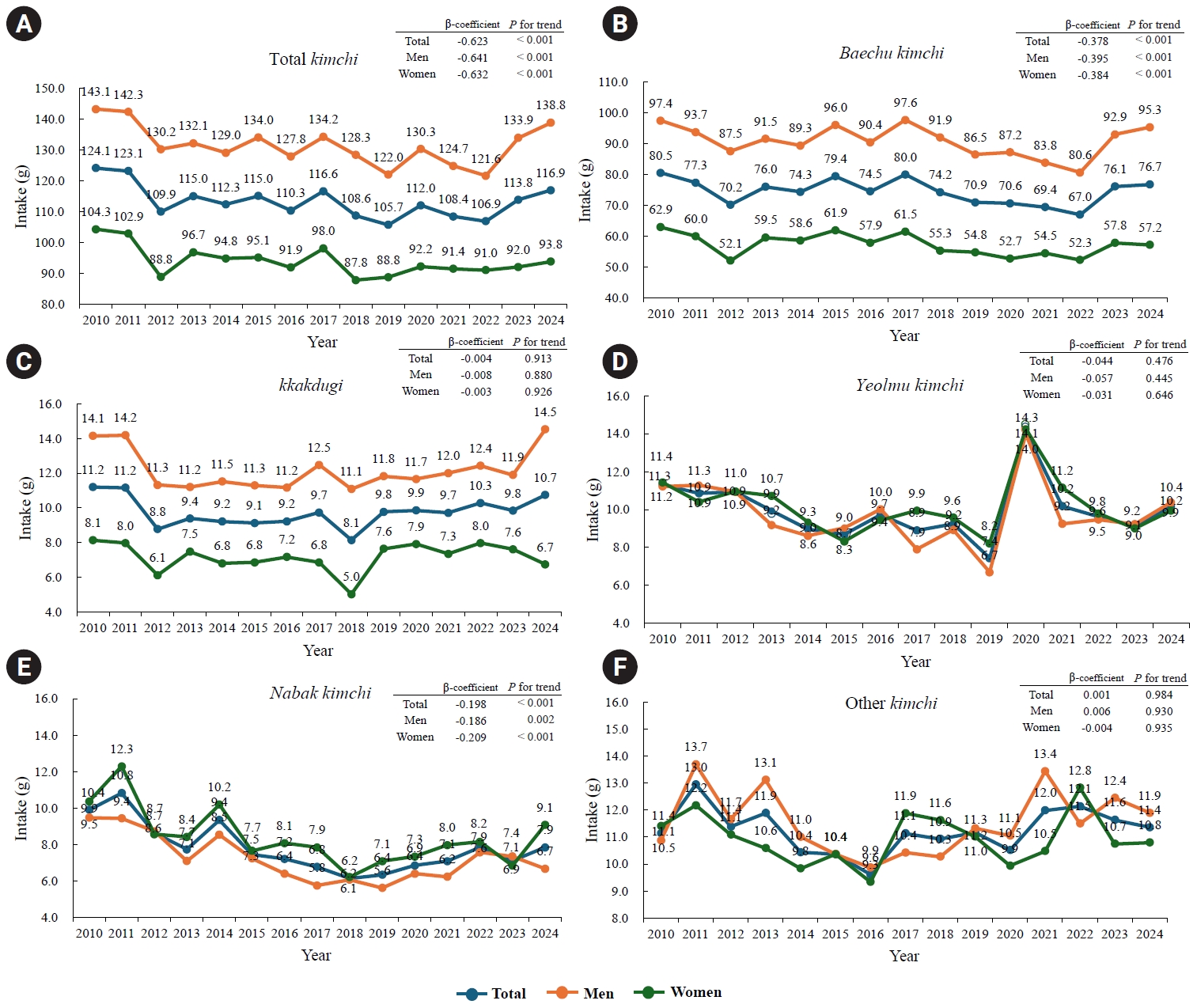
- Changing patterns and related factors of kimchi consumption among Korean adults: a nationwide cross-sectional analysis of the Korea National Health and Nutrition Examination Survey, 2010–2024
- Hui-Yang Zhao, Hyunji Ham, Sumin Kim, Chang Hyeon Lee, Kyungho Ha, Sangah Shin
- Korean J Community Nutr 2026;31(3):244-263. Published online June 30, 2026
- DOI: https://doi.org/10.5720/kjcn.2026.00108
-
Abstract
PDF
- Objectives
This study was conducted to analyze long-term trends in kimchi consumption and patterns among Korean adults using data from the Korea National Health and Nutrition Examination Survey (KNHANES) from 2010 to 2024, and to identify sociodemographic, dietary, and health-related factors associated with recent kimchi consumption.
Methods
Data from the 5th (2010) through 9th (2024) KNHANES were utilized. Trend analysis included 103,267 participants, while factor analysis focused on 14,244 adults aged ≥ 30 years (2022–2024). Changes in consumption form (side dish versus ingredient) and locations were examined. Multiple logistic regression was used to calculate odds ratios (ORs) for meeting the recommended intake (40 g/day).
Results
Over the past 15 years, kimchi consumption among Korean adults has significantly decreased regardless of gender (men: β = –1.53, women: β = –1.31, P for trend < 0.05). The proportion of individuals reporting no kimchi intake on the 24-hour recall day increased from 11.7% in 2010 to 22.7% in 2024. Among young adults (20–39 years), a qualitative shift occurred as consumption transitioned from side dishes to dish ingredients. At-home consumption decreased for all age groups under 60 years. Conversely, eating-out consumption increased for most groups, except for those aged 20–39 years, while school/ workplace consumption increased only in the 0–9 years age group. Analysis of the factors associated with meeting the recommended intake revealed that men, older adults, rural residents, married individuals, alcohol consumers, and smokers were more likely to meet the recommendation. Conversely, frequent solo dining or skipping meals were significantly associated with a lower likelihood of meeting the recommendation.
Conclusion
This study confirms a structural shift in the Korean diet. Future strategies for preserving traditional food culture and establishing nutritional policies must be tailored to reflect modern dietary changes, such as an increase in single-person households and the spread of a solo-dining culture.
- 1,652 View
- 32 Download
Review
- [Korean]
- Research trends in dietary behaviors and nutrition education among individuals with developmental disabilities in Korea: a scoping review (2015–2025)
- Nakyung Kwak, Wonyeong Park, Yu-Ri Kim, Jieun Oh
- Korean J Community Nutr 2026;31(1):1-20. Published online February 28, 2026
- DOI: https://doi.org/10.5720/kjcn.2025.00374
-
Abstract
PDF
- Objectives
We mapped trends in studies on dietary behaviors, nutritional status, and nutrition-related education among individuals with developmental disabilities in Korea over the past decade to identify research gaps and inform future research and policy development.
Methods
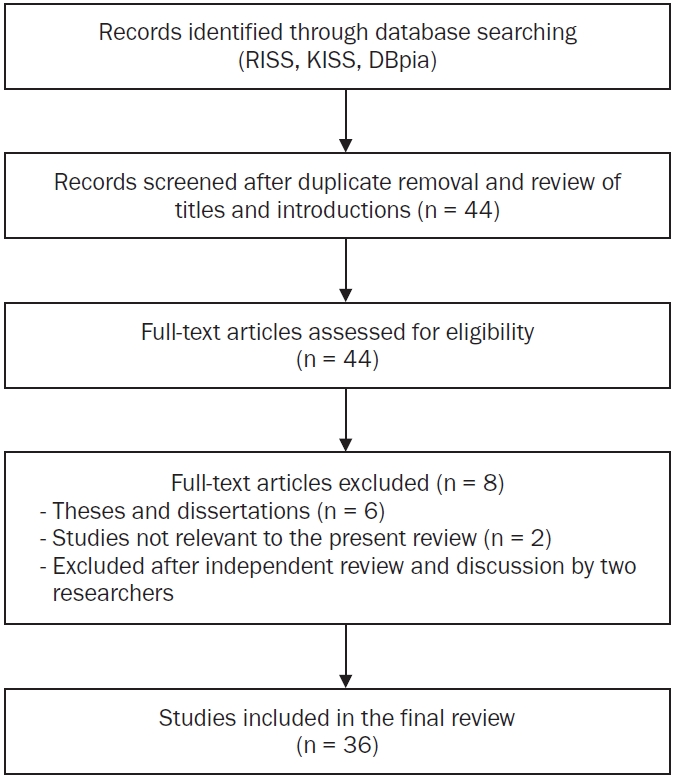
A scoping review was conducted using three major Korean academic databases (RISS, KISS, and DBpia). Studies published between 2015 and September 2025 were identified using combinations of keywords related to developmental disabilities, dietary behavior, nutrition, and health-related interventions. Eligible studies included empirical studies and secondary research (e.g., systematic or scoping reviews) conducted in Korea that focused on dietary behaviors, nutrition, health promotion, or nutrition-related education for individuals with developmental disabilities. Thirty-six studies met our inclusion criteria and were analyzed based on study design, study population, disability type, research topic, and publication period.
Results
Observational quantitative, qualitative, intervention-based experimental, and evidence synthesis accounted for 27.8%, 13.9%, 22.2%, and 36.1% of all included studies, respectively. Children and adolescents (27.8%) and adults (25.0%) were the most frequently studied populations, with limited studies focusing on professionals or teachers. Most studies targeted individuals with developmental disabilities as a combined group (61.1%), followed by those specifically targeting autism spectrum disorder. Research topics included dietary behaviors and nutritional status, nutrition-related education and interventions, health promotion, and medical or clinical issues, with many small-scale and shortterm intervention studies.
Conclusion
Although research on dietary and nutrition-related issues among individuals with developmental disabilities in Korea has expanded in scope and methodology, significant limitations remain. Future research should adopt longitudinal and community-based approaches, incorporate diverse populations, and strengthen policy-oriented nutrition support systems to promote sustainable health and quality of life for individuals with developmental disabilities.
- 1,524 View
- 83 Download
Research Articles
- [Korean]
- Evaluation of young children’s dietary behaviors by parental growth concern levels in Gyeonggi area: a descriptive study
- Youn-Rok Kang, Hyung-Sook Kim
- Korean J Community Nutr 2026;31(1):75-86. Published online February 28, 2026
- DOI: https://doi.org/10.5720/kjcn.2025.00269
-
Abstract
PDF
- Objectives
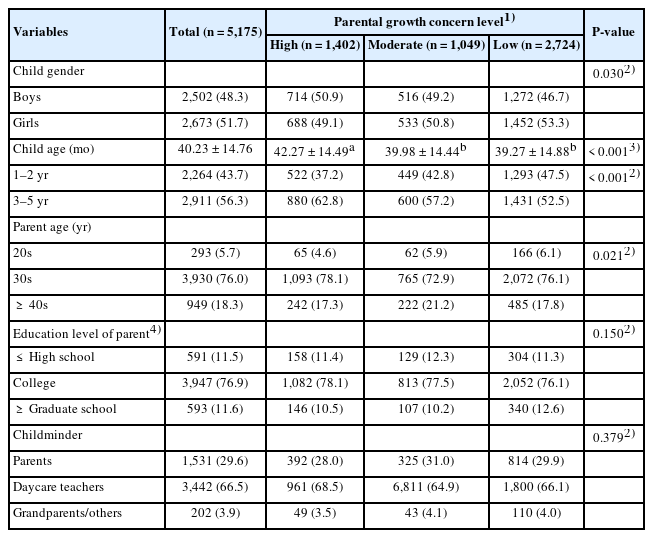
This study investigated differences in dietary habits, lifestyle patterns, and feeding- related developmental issues among Korean preschool children based on their parents’ levels of growth concern, and examined the associations between parental growth concern and children’s eating behaviors.
Methods
A cross-sectional study was conducted with parents of children aged 1–5 years residing in Gyeonggi Province, Korea. Participants were classified into high, moderate, and low growth concern groups using the children’s dietary screening test. Data were collected on the children’s anthropometric status, lifestyle routines, dietary intake patterns, eating behaviors, and mealtime media exposure.
Results
Children in the high growth concern group showed a higher prevalence of underweight; irregular sleep and mealtime routines; and more frequent eating difficulties, including picky eating, slow eating, and oral processing problems. Mealtime media exposure was associated with lower fruit and vegetable intake and higher consumption of processed and sugar-rich foods. Higher parental growth concern did not correlate with healthier dietary or lifestyle outcomes.
Conclusion
Preschool children’s dietary behaviors and routines differed according to the parents’ levels of growth concern. Higher levels of parental concern were associated with increased feeding difficulties and greater mealtime media exposure. These findings suggest that excessive concern may contribute to maladaptive eating patterns in children. Evidence- based parental guidance and structured nutrition education are essential to promote healthy growth and eating behaviors during early childhood.
- 1,091 View
- 56 Download
- [English]
- Associations between diet quality and regional factors in Korea vary according to individuals’ characteristics: a cross-sectional study
- Hyunmi Han, Clara Yongjoo Park, Jeonghwa Lee
- Korean J Community Nutr 2025;30(4):274-285. Published online August 29, 2025
- DOI: https://doi.org/10.5720/kjcn.2025.00157

-
Abstract
PDF
 Supplementary Material
 - Objectives
Although diet quality is known to be associated with environment and individuals’ characteristics, these have not been studied together. We determined the association of diet quality with regional factors stratified by individuals’ sociodemographic characteristics.
Methods
This study used nationally representative survey data on regional factors (2010–2020) and the Korea National Health and Nutrition Examination Survey data on individuals’ sociodemographic characteristics (2013–2018). Community-dwelling Koreans aged ≥ 20 were included (n = 26,853). Regions were categorized into metropolitan cities or provinces and subsequently according to regional factors (level of educational attainment, income per capita, food security status, physical activity facilities, time to the nearest large retailer, and internet use of the region). Individuals’ sociodemographic characteristics included age, education status, income, and number of household members. Diet quality was assessed using the Korean Healthy Eating Index (KHEI).
Results
In the entire population, education status of metropolitan cities was positively associated with the KHEI. Shorter time to retailers and higher internet use were positively associated with the KHEI in metropolitan residents with higher income levels but negatively associated with the KHEI in those with lower income status. Among provincial residents with a low education status or income, regional physical activity facilities were positively associated with the KHEI.
Conclusion
The association between diet quality and regional factors varied depending on the resident’s sociodemographic characteristics. Both regional and individual sociodemographic factors must be considered to address gaps in nutritional equity. -
Citations
Citations to this article as recorded by
- Determinants of Metabolic Syndrome Among Rural Older Adults: A Cross-Sectional Analysis of the 2023 Korea National Health and Nutrition Examination Survey
Changhee Lee, Kyeongmin Jang
Journal of Ageing and Longevity.2026; 6(1): 22. CrossRef
- Determinants of Metabolic Syndrome Among Rural Older Adults: A Cross-Sectional Analysis of the 2023 Korea National Health and Nutrition Examination Survey
- 2,768 View
- 43 Download
- 1 Crossref
- [English]
- Comparison of clinical characteristics and dietary intakes according to phenotypes of type 2 diabetes mellitus in South Korea: a cross-sectional study
- Mi-Jin Kim, Ji-Sook Park, Sung-Rae Cho, Daeung Yu, Jung-Eun Yim
- Korean J Community Nutr 2025;30(2):127-139. Published online April 29, 2025
- DOI: https://doi.org/10.5720/kjcn.2025.00059
-
Abstract
PDF
- Objectives
Clinical nutrition treatment is the central part of diabetes management, such as prevention, treatment, and self-management of diabetes, and personalized clinical nutrition treatment, which enables improvement in patients with type 2 diabetes mellitus (T2DM). Our study aimed to contribute to the improvement of appropriate nutrition management in personalized treatment for obese and non-obese diabetes patients.
Methods
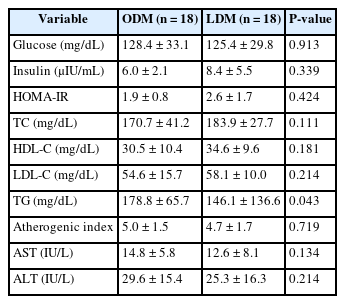
T2DM patients were recruited as participants, and 36 final participants were assigned to the lean diabetes mellitus group (LDM; body mass index [BMI] < 25 kg/m2) and the obese diabetes mellitus group (ODM; BMI ≥ 25 kg/m2). We assessed the dietary intakes, body composition, dietary habits, the Korean version of obesity-related quality of life, and biochemical indices.
Results
According to the phenotype’s comparison, the ODM group had a high prevalence of T2DM complications and hypertension, had a dietary habit of less than 10 minutes of mealtime duration and preferred fast food intake, and had a low obesity-related quality of life. However, the LDM group had a high choice of Korean dishes at the time of eating out and a high intake of vitamin C, and iodine because of the intake of vegetables and seaweeds.
Conclusion
We observed differences in diet, nutrient intake, and clinical characteristics according to the phenotype of T2DM patients. In particular, obese diabetes patients have an increased risk of cardiovascular diseases, bad dietary habits, and low obesity-related quality of life. Therefore, personalized nutrition treatment is needed in consideration of the risk of cardiovascular disease and dietary habits for patients in the ODM group, as well as determining the energy requirements of Korean patients with T2DM.
- 3,036 View
- 40 Download
Original Article
- [English]
- The Characteristics of Infants' Temperament, Maternal Feeding Behavior and Feeding Practices in Picky Eaters
- Yoon Jung Kim, Sang Jin Chung, Young Shin Han, Yoonna Lee, Sang Il Lee, Ki Won Byun, Haymie Choi
- Korean J Community Nutr 2005;10(4):462-470. Published online August 31, 2005
-
Abstract
PDF
- The purpose of this study was to determine the characteristics of infants' temperaments, maternal feeding behaviors and feeding practices in picky eaters. Participants were 83 infants (aged 12 - 24 months) from "A" hospital (Seoul) and "B" public health center (Kyunggido). Mothers completed questionnaires that assessed their own feeding behavior, feeding practices, infants' temperament and infants' feeding behavior. Picky eaters' demographics were not significantly different from non-picky eaters after adjusting sex and age. The average of thiamin, niacin and vitamin E intakes of picky eaters were below 75% Korean RDA, whereas vitamin A intakes exceed 120% RDA in both groups. Activity level of infants' temperament and disinhibition of maternal feeding behavior in picky eaters were significantly higher than those in non-picky eater. All constructs of infants feeding behavior were significantly associated with certain constructs of infants' temperament, maternal feeding practice and maternal feeding behavior. The pickiness of infants feeding behavior was positively correlated with activity level of infants' temperament, pickiness and disinhibition of maternal feeding behavior and negatively correlated with adaptability of infants' temperament. Findings suggest that maternal feeding behavior and feeding practices as well as infants' temperament should be addressed in nutrition education for picky eaters.
- 539 View
- 1 Download
 First
First Prev
Prev



