
 KSCN
KSCN
Search
- Page Path
- HOME > Search
Research Articles
- [Korean]
- Survey on consumer perceptions, health benefits and preferences of kindergarten and school foodservices in Korea, including related keywords reported in newspaper: a mixed-methods study
- Gyoungok Gang, Chaewon Park, Hyeja Chang
- Korean J Community Nutr 2025;30(4):309-320. Published online August 29, 2025
- DOI: https://doi.org/10.5720/kjcn.2025.00199

-
 Abstract
 PDF
PDF - Objectives
With the rapid development of social culture, the perception of kindergarten and school foodservice, as well as opinions on its health benefits, has changed significantly. However, research on this topic remains scarce. We conducted a survey in South Korea on consumers’ perceptions, healthiness, and preferences regarding kindergarten and school foodservice.
Methods
With the nationwide cooperation of 17 city and provincial education offices, online and offline surveys were conducted targeting the parents of kindergarten and lower-grade elementary school children, as well as upper-grade elementary, middle, and high school students. In addition, keywords in newspaper reports were analyzed using the Big Kinds platform. A total of 532 valid questionnaires were collected, and statistical analysis was performed using IBM SPSS Statistics version 27.0 (IBM Co.).
Results
The average age of the parents and students was 40 and 12.5 years, respectively, with 36.4% of the students attending schools in the Seoul and Gyeonggi areas. The main keywords reported in newspaper articles, as analyzed using the Big Kinds platform, were “eco-friendly agricultural products,” “food ingredients,” “safety,” and “marine products.” The perception of kindergarten and school foodservice was very positive, especially regarding the attributes of safe ingredient use (4.44), menu variety (4.29), cafeteria cleanliness (4.31), cleanliness of plates, spoons, and utensils (4.24), thorough hygiene management (4.2), nutritional excellence (4.24), and support for proper eating habits (4.18). The healthiness of school foodservice was highly rated, although there is still room for improvement in terms of “not serving fried foods more than twice a week”. In terms of preference for school meals, the most preferred items were meat side dishes, followed by chicken, noodles, fried food, beverages, and bread. In contrast, soybean paste soup, vegetables, and mixed-grain rice received relatively low preference.
Conclusion
The results described above may be used to develop educational programs or policies that inform students and parents about the goals of school foodservice and help address common misunderstandings.
- 3,158 View
- 51 Download

- [Korean]
- Maternal home meal replacement use and attitudes, and young children’s preferences by usage frequency in meals for young children: a cross-sectional study
- Bo-Yeon Kim, Mi-Hyun Kim, Jee-Young Yeon
- Korean J Community Nutr 2025;30(2):163-172. Published online April 29, 2025
- DOI: https://doi.org/10.5720/kjcn.2025.00066
-
Abstract
PDF
- Objectives
With the increase in women’s workforce participation and changing family eating habits, home meal replacements (HMRs) have become more prevalent. However, research on how mothers incorporate HMR into meals of young children remains limited. This study examined mothers’ attitudes toward and use of HMR, as well as their association with young children’s HMR preferences.
Methods
A survey was conducted between June 1 and July 3, 2020, involving 337 mothers of 5-year-old children in Sejong, South Korea. The questionnaire assessed mothers’ perceptions of HMR, consumption patterns, and their children’s preferences for HMR.
Results
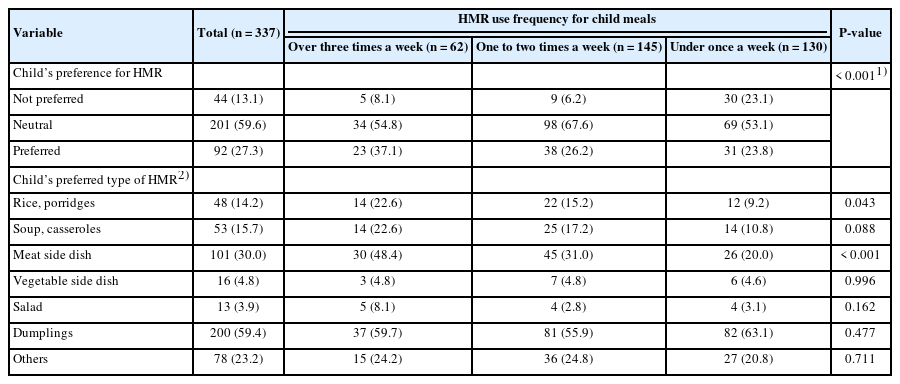
The average age of participating mothers was 38.3 years, with 93.2% living in nuclear families. Full-time homemakers constituted 40.1% of the respondents and showed lower HMR usage among them. HMR was primarily consumed as late-night snacks, side dishes, and dinners, with large discount stores (81.6%) being the primary purchase location. The high HMR consumption group exhibited more positive attitudes toward HMR (P < 0.001). HMR types varied in consumption frequency. Among ready-to-eat foods, kimbap (38.3%) was the most common, followed by meat side dishes (11.3%) and salads (11.0%). Among the heat-and-eat items, dumplings were the most frequently consumed. Simple cooking kits for Korean street food were used by 56.5% of mothers in the high-frequency HMR group, compared to 38.6% and 29.2% in the lower consumption groups (P < 0.01). Children’s preference for HMR was significantly associated with maternal HMR consumption frequency (P < 0.001). The most preferred items among children were rice porridge (P < 0.05) and meat side dishes (P < 0.001).
Conclusion
Higher maternal HMR consumption was associated with increased acceptance by children. Mothers who frequently used HMR exhibited more positive attitudes toward its palatability, convenience, nutritional value, and variety. While HMR offers diverse and tasty meal options, overreliance on processed foods warrants caution. Importantly, high HMR consumption during early childhood may influence long-term dietary behaviors, including a continued preference for HMRs.
- 2,026 View
- 39 Download
- [Korean]
- Analysis of pork consumption attribute factors by consumer lifestyle in Korea: a cross-sectional study
- Jounghee Lee, Juhyun Lee, Wookyoung Kim
- Korean J Community Nutr 2025;30(1):75-88. Published online February 28, 2025
- DOI: https://doi.org/10.5720/kjcn.2024.00332
-
Abstract
PDF
- Objectives
This study aims to identify and analyze how different South Korean lifestyles impact attitudes towards pork consumption.
Methods
We implemented a cross-sectional survey targeting 705 adult consumers in South Korea using hierarchical and K-means cluster analyses. Respondents were classified into three relevant lifestyles: (1) domestic preference, (2) price-sensitive, and (3) quality-experience-oriented. The importance-performance analysis was employed to evaluate discrepancies between how they rated pork consumption using factors of “importance” and “satisfaction”. We employed Borich’s needs assessment and the Locus for Focus model to prioritize management areas.
Results
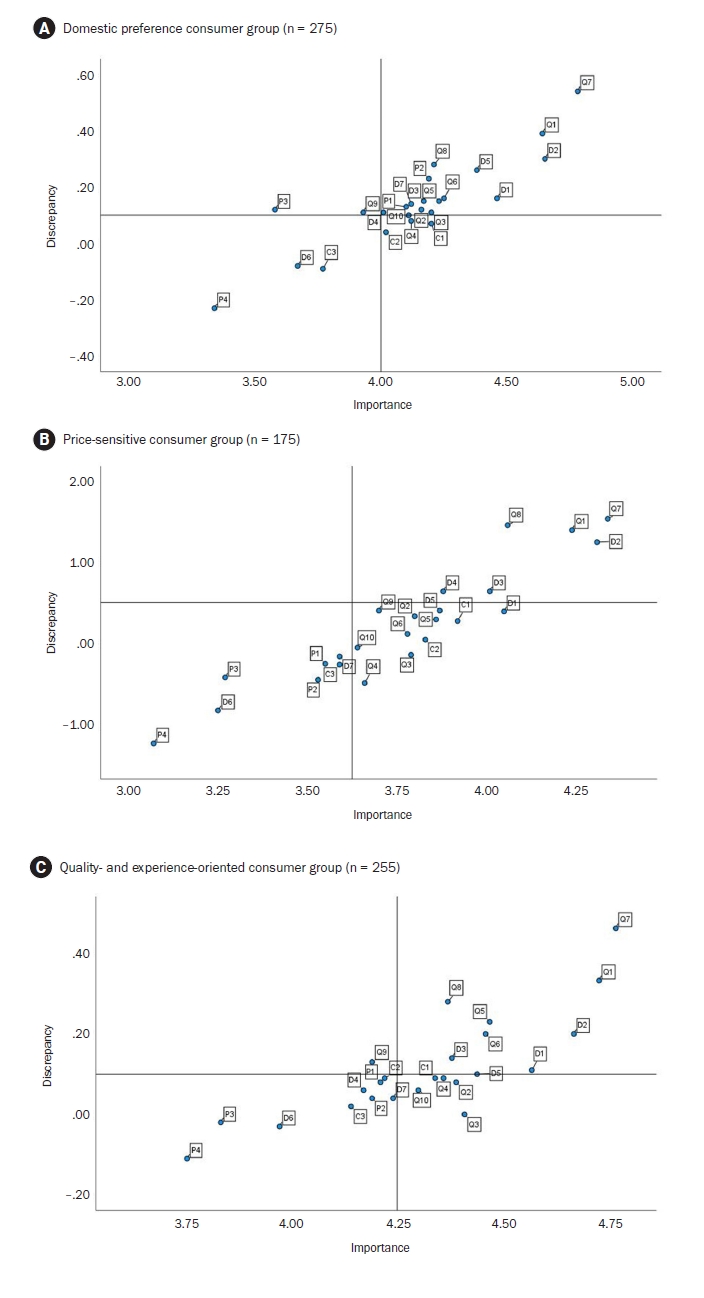
The research findings highlight that unpleasant odor/smell (Q7) and hygiene (Q1) were common key areas for management across all consumer groups, emphasizing their importance in enhancing pork consumption satisfaction. Among the groups, the domestic preference group showed high importance-performance discrepancies in attributes like expiry date (D2), suggesting a need for strengthened trust in domestic pork distribution and information transparency. The price-sensitive group prioritized economic factors, with fat thickness (Q8) identified as an essential management area. The quality-experience-oriented group emphasized sensory qualities such as juiciness (Q6) and meat color (Q5), with off-flavors (Q7) displaying the largest discrepancy. These results show the significant role of sensory attributes in consumer satisfaction.
Conclusion
This study demonstrated the multidimensional nature of pork consumption behavior, emphasizing the need for tailored strategies across consumer groups. Managing hygiene (Q1) and reducing off-flavors (Q7) are critical for all segments, while group-specific strategies include managing sensory quality for the quality-experience-oriented group, providing product information (D2) to increase trust for the domestic preference group, and emphasizing value for money for the price-sensitive group.
- 2,541 View
- 48 Download
- [English]
- Exploring the customer perceived value of online grocery shopping: a cross-sectional study of Korean and Chinese consumers using Means-End Chain theory
- Xinyu Jiang, Hyo Bin Im, Min A Lee
- Korean J Community Nutr 2024;29(4):318-335. Published online August 31, 2024
- DOI: https://doi.org/10.5720/kjcn.2024.00007
-
Abstract
PDF
- Objectives
Despite the growing market share of online grocery shopping, there is a need to understand customer perceived value due to the ongoing advancements in information technology. This study explores the connections between attributes, consequences, and values. Additionally, it conducts a cross-country comparison of consumers’ online grocery shopping behaviors to gain a deeper understanding of consumer market segments and any potential variations among them.
Methods
Data was collected through an online questionnaire survey conducted from May 1 to 15, 2024, targeting 400 consumers in Seoul, Korea, and Shanghai, China, who have experience with online grocery shopping. The survey utilized the Means-End Chain theory and association pattern technique hard laddering. Data collation and analysis were conducted using the IBM SPSS Statistics 28.0 program. The LadderUX software was employed to analyze the links between attributes, consequences, and values and create the consumer purchasing process’s implication matrix and hierarchical value map (HVM).
Results
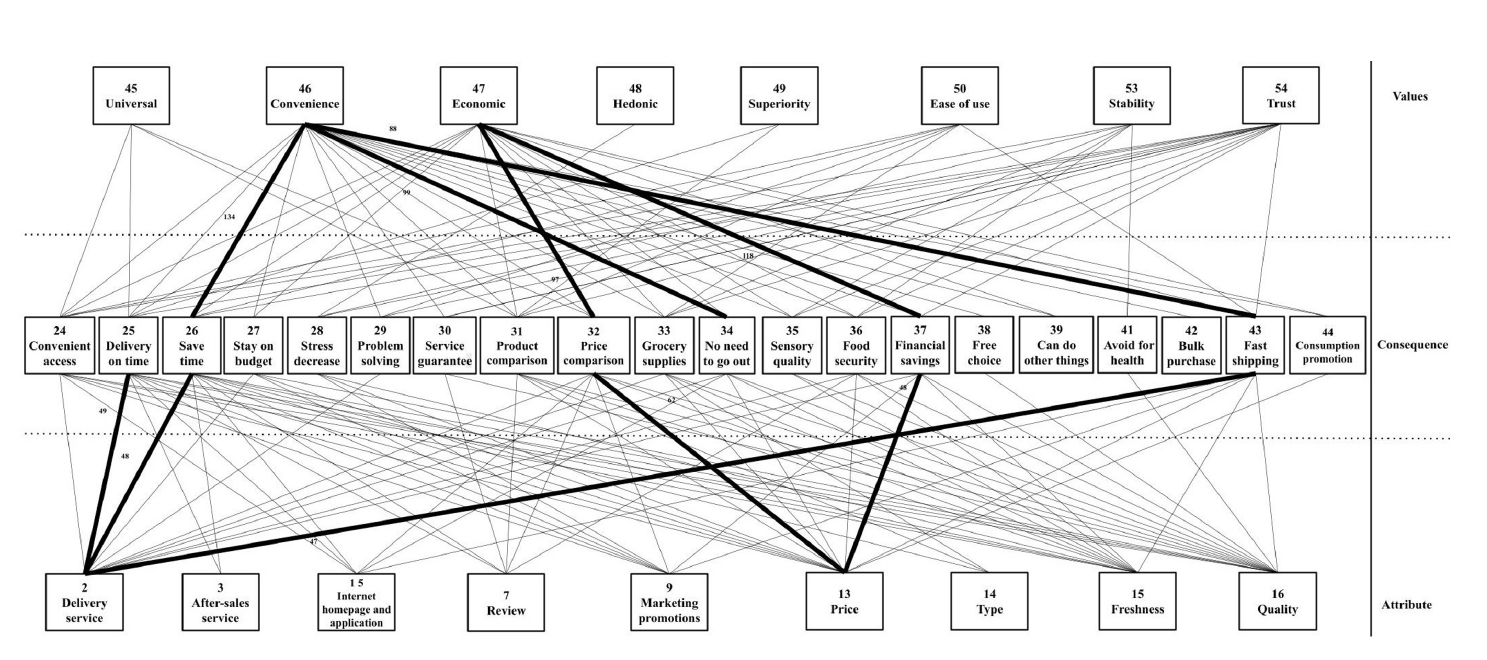
The study identified key attributes that influence online grocery shopping decisions, including delivery service, price, freshness, and quality. Korean consumers demonstrated a higher sensitivity to price (19.0%) and delivery service (17.0%). In contrast, Chinese consumers prioritized delivery service (15.0%) and after-sales service (14.8%). Commonly cited consequences included time saving (12.6% for Koreans, 11.3% for Chinese), whereas prevalent values encompassed convenience (36.8% for Koreans, 19.6% for Chinese) and economic value (26.6% for Koreans, 14.7% for Chinese). The HVM underscored these insights, highlighting diverse consumer preferences and country-specific nuances.
Conclusions
The findings highlight the current state of online food consumption and consumers’ value systems, revealing variations among countries. These findings offer empirical insights that can be used to create customized global marketing strategies that resonate with various consumer preferences and market dynamics. -
Citations
Citations to this article as recorded by
- Beyond the stage: how performing arts tourism shapes tourist perceptions and destination image
Islam Elbayoumi Salem, Mohammed Ali Bait Ali Sulaiman, Enrico di Bella, Sara Preti, Mohamed Kamal Abdien, Ahmed Magdy
Journal of Hospitality and Tourism Insights.2026; 9(1): 375. CrossRef - Decoding digital market power: a network-based framework for consumer behaviour and strategic advantage
Larissa M. Batrancea, Ömer Akgüller, Mehmet Ali Balcı, Anca Nichita, Mircea-Iosif Rus
Journal of Marketing Analytics.2026;[Epub] CrossRef
- Beyond the stage: how performing arts tourism shapes tourist perceptions and destination image
- 7,676 View
- 91 Download
- 2 Crossref
- [Korean]
- Comparison of Sodium Reduction Practice and Estimated Sodium Intake by Salty Food Preference on Employees and Customers of Sodium Reduction Restaurant in Daegu, Korea
- Su-Jin Lee, Keon-Yeop Kim, Yeon-Kyung Lee
- Korean J Community Nutr 2022;27(1):27-35. Published online February 28, 2022
- DOI: https://doi.org/10.5720/kjcn.2022.27.1.27
-
Abstract
PDF
- Objectives
The purposes of this study were to compare the degree of sodium reduction practice and estimate sodium intake by salty food preference.
Methods
Sodium reduction practices, salty food preferences and estimated sodium intake were surveyed for restaurant owners (n = 80), employees (n = 82) and customers (n = 727) at the restaurants participating in the sodium reduction project in Daegu, Korea. Estimated sodium intake was performed by examining sex, age, body mass index (BMI), salty eating habit and dietary behaviors.
Results
The degree of sodium reduction practice was significantly higher in salinity meter use (P < 0.001), low salt seasonings (P < 0.001) and efforts to make the foods as bland as possible overall (P < 0.001) in the restaurants participating in sodium reduction project than in homes (P < 0.001). The degree of sodium reduction practice appeared lower in the high salty food preference group than in the low-preference group in such items as efforts to make the foods as bland as possible overall (P < 0.05) and washing the salty taste and then cooking (P < 0.05). The high-preference group showed high-salt dietary behavior, including eating all the soup until nothing was left (P < 0.05) more than the low-preference group, but low-salt dietary behavior included checking the sodium content in processed foods (P < 0 .0 5) less than the low-preference group. The high-preference group was higher in the soup and stew intake frequency than the low-preference group (P < 0.05) and much lower in nuts (P < 0.05) and fruits (P < 0.05) intake frequency. The high-preference group had a higher salty eating habit (P < 0.05), salty taste assessment (P < 0.05) and estimated sodium intake (P < 0.05) than the low-preference group.
Conclusions
The present study showed that the salty food preference was strongly associated with lower sodium reduction practice and higher estimated sodium intake. -
Citations
Citations to this article as recorded by- Amelioration of metabolic disturbances and adipokine dysregulation by mugwort (Artemisia princeps P.) extract in high-fat diet-induced obese rats
Yun-Hye Kim, Chung-Mu Park, Gun-Ae Yoon
Journal of Nutrition and Health.2016; 49(6): 411. CrossRef - Comparison of Serum Adiponectin Levels According to Body Mass Index and Dietary Behaviors of Female University Students in Seoul
Mi Joung Kim, Hyun Young Jun, Hye Bog Rha
Korean Journal of Community Nutrition.2013; 18(4): 354. CrossRef - Effects of age on changes of body composition through caloric restriction in overweight and obese women
Jung-Eun Yim, Young-Seol Kim, Ryowon Choue
Journal of Nutrition and Health.2013; 46(5): 410. CrossRef - Nutrient Intake, the Concentrations of Leptin, Adiponectin, Cotisol & Insulin by the Body Fat Content of Women
Soon Yei Lee, Hyun Sook Bae
Korean Journal of Community Nutrition.2012; 17(6): 714. CrossRef - Relationship between Nutrients Intakes, Dietary Quality, and Serum Concentrations of Inflammatory Markers in Metabolic Syndrome Patients
Misung Kim, Juyoung Kim, Wookyung Bae, Sohye Kim, Yesong Lee, Woori Na, Cheongmin Sohn
Korean Journal of Community Nutrition.2011; 16(1): 51. CrossRef - Comparison of Serum Insulin, Leptin, Adiponectin and High Sensitivity C-Reactive Protein Levels according to Body Mass Index and their Associations in Adult Women
Mi Young Lee, Jung Hee Kim
Korean Journal of Community Nutrition.2011; 16(1): 126. CrossRef
- Amelioration of metabolic disturbances and adipokine dysregulation by mugwort (Artemisia princeps P.) extract in high-fat diet-induced obese rats
- 1,729 View
- 8 Download
- 6 Crossref
Original Articles
- [English]
- Sleep Quality and Its Association with the Dietary Behavior and Lifestyle of University Students in Cheongju
- Sewhan Jin, Munkyong Pae
- Korean J Community Nutr 2019;24(5):395-407. Published online October 31, 2019
- DOI: https://doi.org/10.5720/kjcn.2019.24.5.395
-
Abstract
PDF
- OBJECTIVES
This study examined the association of the sleep quality and patterns with the dietary behavior, including snack and beverage consumption, taste preferences, as well as lifestyle of university students.
METHODS
The subjects were 406 university students in Cheongju, Korea, and the data were collected using a self-administered questionnaire. They were divided into two groups according to the Pittsburgh Sleep Quality Index (PSQI): good-quality sleepers (PSQI score ≤ 5) and poor-quality sleepers (PSQI score > 5). The data were analyzed using a χ2-test, independent t-test, and analysis of covariance using the SPSS 25.0 program.
RESULTS
Fifty-two percent of university students were categorized as poor-quality sleepers by the PSQI. Students classified as poor-quality sleepers had delayed bedtimes, and a shorter duration in bed and total sleep hours than the good-quality sleepers did. Poor-quality sleepers were more prevalent among those who were female, having irregular mealtimes, or frequent late night meals. They also consumed fast food frequently, such as fried chicken and hamburgers, and noodles when adjusted for gender. In addition, drinks with caffeine over milk were dominant among poor-quality sleepers. Furthermore, the preferences for spicy and salty tastes and longer smartphone usage were more prevalent in those with poor-sleep quality.
CONCLUSIONS
These results showed that more than 50% of university students reported disturbed sleep and poor quality sleep was associated with less desirable snack consumption and taste preference, more smartphone usage, and others. Therefore, nutrition education program along with lifestyle changes promoting sufficient sleep are encouraged to provide for university students, particularly those who have poor sleep quality. -
Citations
Citations to this article as recorded by- Relationship of sleep quality, BMI, Dietary, and socioeconomic attributes among young adults: A systematic review
Seohyun Ahn, Wan Safwani Binti Wan Kamarul Zaman, Sim-Kuan Goh, Chow-Khuen Chan
Journal of Health Psychology.2026; 31(5): 1771. CrossRef - Health Behaviors and Dietary Habits according to Sleep Duration in Korean Adults Based on the 2013–2015 Korea National Health and Nutrition Examination Survey
Jin-A Kim, Sim-Yeol Lee
Korean Journal of Health Promotion.2019; 19(4): 237. CrossRef
- Relationship of sleep quality, BMI, Dietary, and socioeconomic attributes among young adults: A systematic review
- 2,990 View
- 28 Download
- 2 Crossref
- [English]
- A Study on Dietary Behavior and Food Preference of Sramanera·Sramanerika Monks in Nationwide Buddhist Monk's Universities
- Su Jin Han, Sim Yeol Lee
- Korean J Community Nutr 2017;22(5):387-400. Published online October 31, 2017
- DOI: https://doi.org/10.5720/kjcn.2017.22.5.387
-
Abstract
PDF
- OBJECTIVES
This study was designed to find out factors that are needed to be improved for the Buddhist training environment of Sramanera·Sramanerika monks, who have been newly adapted for their life style after becoming a monk, and to provide basic data for the development of the standard diet in Buddhist temples.
METHODS
A self-administered questionnaire was applied to 365 Sramanera·Sramanerika monks at 11 Buddhist monk universities. The questionnaire was designed to investigate their dietary habits, dietary evaluation, satisfaction of food service, and food preferences.
RESULTS
The study population consisted of 52.6% men, and 47.4% women. The subjects who had a vegetarian diet before joining the Buddhist priesthood were 27.7% women, and 13.5% men (p<0.01). 42.2% of the total subjects felt that they are healthy now and 19.4% felt weak. The most difficulty of dieting adaptation as soon as entering the priesthood was the strict diet rules (42.9%). The subjects considered health or nutrition (40.0%) highly when having meals. 94.8% women, 84.1% men ate breakfast every day (p<0.001). Women (55.4%) frequently ate snacks more than men (26.6%) (p<0.001). The results of the dietary evaluation indicated that the intake of milk, soy milk or dairy products and beans or tofu received lower than 3 points and women had lower point result than men (p<0.001). Foods with higher preference were grilled mushrooms, grilled laver, miso stew, sweet and sour mushrooms, steamed tofu with seasoning.
CONCLUSIONS
Women were more interested in their health than men but they also required to improve the nutritional eating habits. It appeared that the lower intake rates of the calcium containing food (milk and dairy), and proteins (beans and tofu) could result in nutritional imbalance. Therefore, it is necessary to offer food based on the standard menu plan with consideration given to their food preferences in order to maintain their health and desirable dietary habits. -
Citations
Citations to this article as recorded by- Dietary Behavior and Food Preferences of Buddhist Monks in Korean Temples
Choong-Sun Lim, Sim-Yeol Lee
Journal of the East Asian Society of Dietary Life.2023; 33(4): 331. CrossRef - Vegetarianism as a protective factor for asymptomatic colonic diverticulosis in Asians: a retrospective cross-sectional and case-control study
Jihun Bong, Hyoun Woo Kang, Hyeki Cho, Ji Hyung Nam, Dong Kee Jang, Jae Hak Kim, Jun Kyu Lee, Yun Jeong Lim, Moon-Soo Koh, Jin Ho Lee
Intestinal Research.2020; 18(1): 121. CrossRef
- Dietary Behavior and Food Preferences of Buddhist Monks in Korean Temples
- 2,137 View
- 6 Download
- 2 Crossref
- [English]
- Lifestyle, Dietary Behavior and Snack Preference of Upper-grade Elementary School Students in Cheongju according to the Usage Time of Smartphones
- Hayeon Kim, Munkyong Pae
- Korean J Community Nutr 2017;22(1):40-52. Published online February 28, 2017
- DOI: https://doi.org/10.5720/kjcn.2017.22.1.40
-
Abstract
PDF
- OBJECTIVES
This study was conducted to examine the length of exposure to smartphone and its association with dietary behavior toward snacks, lifestyle, and nutrition knowledge in elementary school students.
METHODS
Subjects were 372 5th and 6th grade schoolchildren in Cheongju, Korea, and data was collected by a self-administered questionnaire. They were divided into two groups by the time spent using smartphone: moderate (< 2 hours/day) and overexposure (≥ 2 hours/day). Data was analyzed using frequency analysis, χ²-test, and independent t-test as well as analysis of covariance when necessary.
RESULTS
Approximately half of subjects (41.4%) reported spending ≥ 2 hours/day using smartphone. That habit was more frequent among students in the 6th grade, those who received more monthly allowance, and who has a working mother. 63.4% of the subjects reported that they consumed snacks while watching television, using a computer and/or a smartphone and 48.1% said that they consumed snacks while they use a smartphone. Both situations were most prevalent among those with overexposure to smartphone (≥ 2 hours/day). We also observed that a higher percentage of subjects from the overexposure group spent more money on snack foods with the preference for ice cream, fast food, and carbonated drinks. Further, those in the overexposure group consumed more ice cream, cookies, and carbonated drinks. In addition, they had less desirable dietary behavior and health-related lifestyle (sleep duration and frequency of regular exercise) compared to those with moderate smartphone usage (< 2 hours/day). However, there was no statistical difference in nutrition knowledge among children with different degrees of smartphone usage.
CONCLUSIONS
Our results showed that longer smartphone use was associated with less desirable snack preference/consumption and other dietary behavior in elementary school students. Thus interest and positive attitudes towards healthy snacks and diet should be reinforced in nutrition education programs, especially for those who are prone to use smartphones. -
Citations
Citations to this article as recorded by- Evaluation of the association between nomophobia, mindful eating, and nutritional status
Aliye Kuyumcu, Müberra Yıldız, Kadriye Toprak
Turkish Journal of Clinics and Laboratory.2025; 16(2): 349. CrossRef - The impact of maladaptive perfectionism on college students' bedtime procrastination: The chain mediating effects of nomophobia and physical exercise
Yong Jiang, Chuanyang Jiang
Acta Psychologica.2025; 260: 105504. CrossRef - The relationship between smartphone usage and eating behavior for elementary school students in Gangneung, South Korea: cross-sectional study
Minji Kim, Meera Jang
Korean Journal of Community Nutrition.2024; 29(4): 278. CrossRef - Screen time, mealtime media use, and dietary behaviors in Korean preschoolers: a cross-sectional study
Young-Hee Han, Saerom Shin, Eun Yeol Woo, Hye-Kyung Park, Taisun Hyun
Korean Journal of Community Nutrition.2023; 28(3): 206. CrossRef - Comparing the Mediating Effect of Adolescent Lifestyle Profiles on the Relationship between Smartphone Addiction and Health-related Quality of Life Among Male and Female Senior High School Students in the Philippines
Danilo B. Buctot, Nami Kim, Sun Hee Kim
International Journal of Mental Health and Addiction.2023; 21(1): 511. CrossRef - The Effects of Smartphone and Internet Gaming Addiction on Eating Attitudes Among University Students
Bahar Yeşil Örnek, İbrahim Gündoğmuş
Psychiatry Investigation.2022; 19(1): 1. CrossRef - The role of nomophobia and smartphone addiction in the lifestyle profiles of junior and senior high school students in the Philippines
Danilo B. Buctot, Nami Kim, Sun Hee Kim
Social Sciences & Humanities Open.2020; 2(1): 100035. CrossRef - Relationship between the Intake of Children's Favorite Foods and Policy based on Special Act on Safety Control of Children's Dietary Life
Taejung Woo, Jihye Yoo, Kyung-Hea Lee
Korean Journal of Community Nutrition.2019; 24(2): 106. CrossRef - Health Behavior Factors Associated with Sugar-sweetened Beverage Intake among Adolescents
Hyae Min Gu, Jong Park, So Yeon Ryu
Korean Journal of Community Nutrition.2018; 23(3): 193. CrossRef - A Study on Weight Control Behaviour, Eating Habits and Health-related Life Habits According to Obesity Degree of University Students in Jeonbuk
Hye-Soon Chang
Korean Journal of Human Ecology.2016; 25(1): 73. CrossRef - Weight loss effects of Bariatric Surgery after nutrition education in extremely obese patients*
Eun-Ha Jeong, Hong-Chan Lee, Jung-Eun Yim
Journal of Nutrition and Health.2015; 48(1): 30. CrossRef - A Study of Nutrient Intakes, Blood Lipids and Bone Mineral Density according to Obesity Degree by Percentage of Body Fat and Age between Male and Female Teacher in Jeonbuk Province, Korea
Hye-Soon Chang
Korean Journal of Community Nutrition.2012; 17(1): 49. CrossRef - A Study of Glycemic Index, Glycemic Load and Food Sources according to Body Mass Index in Female College Students
Jee-Young Yeon, Eun-Young Kim
Korean Journal of Community Nutrition.2012; 17(4): 429. CrossRef
- Evaluation of the association between nomophobia, mindful eating, and nutritional status
- 2,214 View
- 9 Download
- 13 Crossref
- [English]
- Status of Dietary Life Related Knowledge, Self-Efficacy, Food Preference and Dietary Behavior of Preschoolers in Kyunggi Area
- A Reum Lee, Ye Lee Yu, Hye Jin Kim, Kyung A Kim, Kyung Won Kim
- Korean J Community Nutr 2016;21(3):274-283. Published online June 30, 2016
- DOI: https://doi.org/10.5720/kjcn.2016.21.3.274
-
Abstract
PDF
- OBJECTIVES
The purpose of the study was to examine dietary life characteristics such as knowledge, self-efficacy and dietary behavior of preschoolers in Namyangju, Kyunggi-province, Korea.
METHODS
The survey questionnaire was developed based on literature review. Preschoolers aged 4-5 years (n=208) responded to the questionnaire to measure knowledge, self-efficacy, food preference, and dietary behavior. After excluding incomplete responses, the data of 197 subjects were used for analysis.
RESULTS
Mean score of dietary life knowledge was 8.0 out of 12, showing a low level of knowledge. Two out of 12 knowledge items were significantly different by gender. Percentage of correct answer on items of 'foods to make bones strong' and 'kinds of fast foods' was higher in girls than in boys (p<0.05). Total score of self-efficacy regarding dietary life was 40.1 (possible score: 12~48), on average. Compared to girls, boys had more confidence in 'not over-eating', and 'eating balanced meals with meat, fish and vegetables' (p<0.05). Boys scored higher on total score of food preference than girls (p<0.01). The preference for fruits was quite high. Among food items, boys scored higher on the preference for rice (p<0.01), fish (p<0.01), pork (p<0.05), beef (p<0.05), milk (p<0.01), and ice cream (p<0.05) than girls. Boys also liked fast foods more than girls did, showing preference for chicken (p<0.01) and soda (p<0.05). Compared to girls, boys showed more desirable behavior in 'eating breakfast everyday' (p<0.01). Dietary behavior was significantly correlated with self-efficacy (r=0.52, p<0.01), food preference (r=0.35, p<0.01), and knowledge (r=0.25, p<0.01) of subjects.
CONCLUSIONS
In this study, we observed differences in food preference by gender. Dietary behavior of preschoolers was correlated with several factors, including dietary life related knowledge, self-efficacy and food preference. Thus, it is needed to develop nutrition education programs focusing on increasing dietary life related knowledge and self-efficacy, and consider the differences in food preference of preschoolers by gender. -
Citations
Citations to this article as recorded by- Dietary Assessment and Trends Among Preschoolers in South Korea: Data from KNHANES 2012–2021
Yong-Seok Kwon, Ye-Jun Kim, Eun-Kyung Kim, Jin-Young Lee, Yangsuk Kim, Sohye Kim
Nutrients.2026; 18(2): 240. CrossRef - Dietary intake and nutritional status of Korean children and adolescents: a review of national survey data
Minji Kang, So Yoon Choi, Minyoung Jung
Clinical and Experimental Pediatrics.2021; 64(9): 443. CrossRef - Study on the snack meal management for infants and toddlers and the demand for snack products according to the sustainable dietary style of mothers in Jeonbuk area
Ji-Eun Lee, Jeong-Ok Rho
Journal of Nutrition and Health.2020; 53(1): 39. CrossRef - Development of nutrition quotient for elementary school children to evaluate dietary quality and eating behaviors
Jung-Sug Lee, Ji-Yun Hwang, Sehyug Kwon, Hae-Rang Chung, Tong-Kyung Kwak, Myung-Hee Kang, Young-Sun Choi, Hye-Young Kim
Journal of Nutrition and Health.2020; 53(6): 629. CrossRef - Menu Recommendation System Using Smart Plates for Well-balanced Diet Habits of Young Children
Kwon Namgung, Tae-Hwan Kim, Youn-Sik Hong
Wireless Communications and Mobile Computing.2019; 2019: 1. CrossRef - A Comparative Study of Eating Behavior and Prosocial Behavior among Preschool Children in Kindergartens vs. Childcare Centers
So-Sun Sun, Ji-Young Ha, So Jung Seo
Journal of the East Asian Society of Dietary Life.2019; 29(2): 130. CrossRef - Fruit and vegetable intakes in relation to behavioral outcomes associated with a nutrition education intervention in preschoolers
Eun Byul Choi, Ji Eun Lee, Ji-Yun Hwang
Nutrition Research and Practice.2018; 12(6): 521. CrossRef - Dietary status of young children in Korea based on the data of 2013 ~ 2015 Korea National Health and Nutrition Examination Survey
Eun-kyung Kim, Byengchun Song, Se-Young Ju
Journal of Nutrition and Health.2018; 51(4): 330. CrossRef - Evaluation of Dietary Behavior among Preschooler in Jecheon Area Using Nutrition Quotient for Preschoolers
Sung Hee Min
Korean Journal of Food and Cookery Science.2018; 34(4): 413. CrossRef
- Dietary Assessment and Trends Among Preschoolers in South Korea: Data from KNHANES 2012–2021
- 2,263 View
- 5 Download
- 9 Crossref
- [English]
- Study on Energy and Nutrient Intake and Food Preference of the Elderly in Care Facilities
- Jong Sook Kwon, Seung Hee Lee, Kang Min Lee, Yoonna Lee
- Korean J Community Nutr 2016;21(2):200-217. Published online April 30, 2016
- DOI: https://doi.org/10.5720/kjcn.2016.21.2.200
-
Abstract
PDF
- OBJECTIVES
The purpose of this study was to assess energy and nutritional intake and investigate the preference for food and cooking methods of the residents in elderly care facilities.
METHODS
Data were collected from 72 residents (10 males and 62 females) aged ≥ 70 years in elderly care facilities using questionnaires, food photographs for estimating dietary intake and records for daily physical activity.
RESULTS
Average age of the study participants was 85.0 years and 41, 36 and 8 had dementia, hypertension and diabetes mellitus, respectively. 15%, 65% and 19% of subjects were physically mobile, enervated, and immobile, respectively. Daily energy intake was 1360.2 kcal in men and 1378.0 kcal in women, which were 68.0% and 86.1% of the estimated energy requirement (EER) of dietary reference intake for Koreans (KDRI) for ≥ 75 year old individuals, respectively. Estimated energy expenditure (EEE) of subjects calculated using formula from KDRI was 1361.9 kcal and EER calculated using estimated daily physical activity (EDPA) was 1232.9 kcal. Energy intake and EEE from KDRI were higher than EER from EDPA. Dietary intake of dietary fiber, calcium, potassium, zinc, vitamin B2, niacin, vitamin C were lower, and protein, phosphorous, iron, sodium, vitamin A, vitamin B1, vitamin B6, vitamin E were higher than the corresponding ones of KDRI. Subjects liked meats, fishes and shellfish, and fruits, while subjects disliked milk, seaweeds and salted fish and salted vegetables. Cooked rice, soybean paste soup, beef, cooked sliced radish strip, and yogurt were favorite foods, with steam being a favorite cooking method. Subjects considered nutrition as the most important factor for improving food service quality.
CONCLUSIONS
Results of this study could be utilized for improving food-service for the residents in elderly care facilities, and provide a basis for setting reference intake of energy and nutrients of the elderly having very low activity levels. -
Citations
Citations to this article as recorded by- Differences in lunch nutrient intake and nutritional adequacy among Korean older adults by meal site: a cross-sectional analysis of the 2018–2021 Korea National Health and Nutrition Examination Survey data
Daeun Choi, Sunhee Seo
Korean Journal of Community Nutrition.2026; 31(2): 205. CrossRef - A study on the diet and nutrition management status and educational needs in elderly care facilities in Korea: focus group interviews with staff from children’s and social welfare meal management support centers and elderly care facilities
Seo Young Choi, Hyun joo Ryou, Jieun Oh
Korean Journal of Community Nutrition.2025; 30(4): 286. CrossRef - Snack Provision Practice in Long-Term Care Hospitals and Facilities in Korea
Dayeong Yeo, Hae Jin Kang, Hyejin Ahn, Yoo Kyoung Park
Clinical Nutrition Research.2024; 13(2): 108. CrossRef - A Comparison of Status of Nutrition Management in Long-Term Care Facilities With and Without Dietitian
Jin Hee Kwon, Rah Il Hwang, Jaehyeon Ryu
Journal of Health Informatics and Statistics.2022; 47(1): 27. CrossRef - Classification of Texture-Modified Korean Soups with a Thickener under IDDSI Criteria
Kui-Jeong Choi, Hyun-Jung Lee, Weon-Sun Shin
Journal of the Korean Dysphagia Society.2022; 12(2): 123. CrossRef - Current status of foodservice nutrition management and effects of welfare facility support for the elderly in Cheongju City
Joo-Eun Lee
Nutrition Research and Practice.2022; 16(4): 527. CrossRef - Comparison of Food Service Provision by Food Service Operational Types for Residential Facilities
Jin Hee Kwon, Rah Il Hwang, Hyeon Jin Jeong, Hye Min Jang
Journal of Health Informatics and Statistics.2022; 47(4): 258. CrossRef - Factors Associated with Person-Centered Care among Care Workers at Long-term Care Facilities
Geun-Young Kim, Hye-Young Jang
Journal of Korean Gerontological Nursing.2021; 23(1): 13. CrossRef - Dietary quality of lunches in senior leisure service facilities in South Korea: analysis of data from the 2013–2017 Korea National Health and Nutrition Examination Survey
Daeun Choi, Youngmi Lee, Haeryun Park, Kyunghee Song, Jinah Hwang
Nutrition Research and Practice.2021; 15(2): 266. CrossRef - Evaluation of the dietary quality and nutritional status of elderly people using the Nutrition Quotient for Elderly (NQ-E) in Seoul
Sun-Wook Ham, Kyung-Hee Kim
Journal of Nutrition and Health.2020; 53(1): 68. CrossRef - Status of health and nutritional intake of the elderly in long-term care facilities: focus on Gwangju Metropolitan City
Gyusang Han, Eunju Yang
Journal of Nutrition and Health.2020; 53(1): 27. CrossRef - Study on the Nutrient Intake and Dietary Quality of Elderly Residents on Various Meal Types in Long-Term Care Facility
Hee-Sook Lim, Eun Bi Oh, Yoo Kyoung Park, Hae-Yun Chung
Journal of the East Asian Society of Dietary Life.2020; 30(2): 172. CrossRef - Health and Nutrition Status of Elderly People with Multimorbidity: A Korea National Health and Nutrition Examination Survey (2013~2015)
Na-Gyeong Oh, Jung-Sook Seo
Korean Journal of Community Nutrition.2020; 25(6): 502. CrossRef - Nutritional status of Korean elderly with dementia in a long-term care facility in Hongseong
Ji-Yeon Lee, Yeong-Soon Hyun, Hee-Seon Kim
Nutrition Research and Practice.2019; 13(1): 32. CrossRef - Food and nutrient intake status of Korean elderly by perceived anxiety and depressive condition: data from Korean National Health and Nutrition Examination Survey 2013 ~ 2015
Da-Mee Kim, Kyung-Hee Kim
Journal of Nutrition and Health.2019; 52(1): 58. CrossRef - Analysis of Food Preference, Recognition and Experience of Elderly Foods among Elderly People
Mi Young Kim, Yoo Na Lee
The Korean Journal of Food And Nutrition.2016; 29(6): 971. CrossRef
- Differences in lunch nutrient intake and nutritional adequacy among Korean older adults by meal site: a cross-sectional analysis of the 2018–2021 Korea National Health and Nutrition Examination Survey data
- 2,263 View
- 12 Download
- 16 Crossref
- [English]
- The Development of Institutional Food-Service Menu with Temple Food
- Sim Yeol Lee, Jin A Kim
- Korean J Community Nutr 2015;20(5):338-350. Published online October 31, 2015
- DOI: https://doi.org/10.5720/kjcn.2015.20.5.338
-
Abstract
PDF
- OBJECTIVES
This study developed two weeks menu using temple foods, assessed preference for the menu among ordinary people, and determined the possibility of using temple foods to make out institutional food service menu.
METHODS
To make out the menu, 153 typical types of temple food were selected, under several conditions, thus including balanced food groups, natural foods in season, preparation time, preparation methods, and foods appropriated for institutional foodservice.
RESULTS
Developed menu contained 1905.8 kcal, had low fat content, high dietary fiber, vitamin, and mineral content, and good protein content in the nutritional respect, and fit protein requirements with low calorie content and high nutritional value. In the assessment of the food preference for 73 temple food items, most of the foods scored high (4 out of 5 points) for preference in general; therefore, the menu tended to be satisfied to the adults' preference. In particular, boiled rice (rice with chwi, rice with cirsium, rice with mushroom, rice with mushroom & vegetable and gimbap with tofu) and fried foods (fried shiitake with sweet & sour sauce and fried kelp) were highly preferred.
CONCLUSIONS
The menu using temple foods can be a healthy choice for adults if it is well planned and managed. This study may be expected to provide basic data that would help developing menu to popularize temple foods. The above results could be applied at home as well as at foodservice institutes and furthermore could offer information for developing temple food products. -
Citations
Citations to this article as recorded by- Dietary Behavior and Food Preferences of Buddhist Monks in Korean Temples
Choong-Sun Lim, Sim-Yeol Lee
Journal of the East Asian Society of Dietary Life.2023; 33(4): 331. CrossRef - Food and dish group diversity on menus of daycare centers provided by Center for Children’s Foodservice Management in Korea: a descriptive study
Youn-Rok Kang, Kyeong-Sook Lim, Hyung-Sook Kim
Korean Journal of Community Nutrition.2023; 28(6): 449. CrossRef - Age, sex, and the association of chronic kidney disease with all-cause mortality in Buddhist priests
Hyo Jin Kim, Yunmi Kim, Sejoong Kim, Ho Jun Chin, Hajeong Lee, Jung Pyo Lee, Dong Ki Kim, Kook-Hwan Oh, Kwon Wook Joo, Yon Su Kim, Deuk-Young Nah, Sung Joon Shin, Kyung Soo Kim, Jae Yoon Park, Kyung Don Yoo
Medicine.2018; 97(45): e13099. CrossRef - Recognition and Propagation for Temple Food among University Students with Food-related Majors
In-Joon Huh, Sim-Yeol Lee
Korean Journal of Community Nutrition.2018; 23(2): 137. CrossRef - A Study on Recognition, Preference and Popularization of Temple Food - Among Local and Foreign Restaurant Visitors
Yang-Su Moon, Sim-Yeol Lee
Korean Journal of Community Nutrition.2017; 22(1): 53. CrossRef - A Study on Dietary Behavior and Food Preference of Sramanera·Sramanerika Monks in Nationwide Buddhist Monk's Universities
Su-Jin Han, Sim-Yeol Lee
Korean Journal of Community Nutrition.2017; 22(5): 387. CrossRef
- Dietary Behavior and Food Preferences of Buddhist Monks in Korean Temples
- 2,088 View
- 10 Download
- 6 Crossref
- [English]
- A comparison of Dietary Habits and Influencing Factors for Vegetable Preferences of Adolescents in Gyeongnam Province
- Suhyang Kwak, Taejung Woo, Kyoung Ae Lee, Kyung Hea Lee
- Korean J Community Nutr 2015;20(4):259-272. Published online August 31, 2015
- DOI: https://doi.org/10.5720/kjcn.2015.20.4.259
-
Abstract
PDF
- OBJECTIVES
A higher consumption of vegetables is emphasized as the core component of most dietary guidelines. Thus, this research investigated the dietary habits and influencing factors of vegetable preferences of adolescents.
METHODS
This study was conducted by using a self-administered questionnaire. 400 students from two high schools in Gyeongnam (193 boys, 207 girls) participated in the survey. The questionnaire consisted of the following variables: dietary habit, dietary action guide and factors based on Social Cognitive Theory (SCT).
RESULTS
The dietary habits of subjects showed significant differences depending on whether they prefer vegetables or not. The subjects in the group who liked vegetables had better dietary habits than the other group. Also, the study determined that the most important reason for liking or disliking vegetables is due to the taste. In the practice of dietary guidelines, the group of subjects who liked vegetables followed dietary guidelines more closely than the other group (p < 0.001). When the factors based on SCT were analyzed, personal factors showed significant differences between the groups: outcome expectation (p < 0.001), self-efficacy (p < 0.001) and affective attitude (p < 0.001). Personal factors and rated vegetable preferences showed a significant correlation in multiple regression analysis (F=42.015, p < 0.001).
CONCLUSIONS
These results showed that vegetable preference is associated with a key point of desirable dietary habits among subjects. In order to increase vegetable preference or consumption, it is important to focus on strengthening not only self-efficacy of students, but also affective attitude of vegetable. -
Citations
Citations to this article as recorded by- Development of evaluation items for adolescents’ dietary habits and nutritional practices reflecting eating behaviors and food environment
Jimin Lim, Hye Ji Seo, Jieun Oh
Journal of Nutrition and Health.2024; 57(1): 136. CrossRef - Analysis of socio-demographic and dietary factors associated with fruit and vegetable consumption among Korean adolescents: use of data from the 7th and 8th Korea National Health and Nutrition Examination Survey (2016–2019)
Bokyeong Yun, Seunghee Kye
Journal of Nutrition and Health.2024; 57(3): 292. CrossRef - Factors affecting sugar intake in adults based on the social cognitive theory
Kilye Kim, Yeon-Kyung Lee
Journal of Nutrition and Health.2024; 57(1): 120. CrossRef - Factors influencing the consumption of convenience foods among Korean adolescents: analysis of data from the 15th (2019) Korea Youth Risk Behavior Web-based Survey
Seul Ki Park, Ji Hyun Lee
Journal of Nutrition and Health.2020; 53(3): 255. CrossRef - The Influence of Social Media Affinity on Eating Attitudes and Body Dissatisfaction in Philippine Adolescents
Shannen Tadena, So Ra Kang, Shin-Jeong Kim
Child Health Nursing Research.2020; 26(1): 121. CrossRef - Home Meal Replacement Use and Eating Habits of Adults in One-Person Households
Mi-Kyeong Choi, Eun-Sun Park, Mi-Hyun Kim
Korean Journal of Community Nutrition.2019; 24(6): 476. CrossRef - Relationships among Skeletal Muscle Mass, Health Related Factors, Nutrient Intake, and Physical Activities in Male Adolescents: Based on the 5th (2009-2011) Korean National Health and Nutrition Examination Survey (KNHANES)
In-Kyung Jung, Jung-Hyun Kim
The Korean Journal of Community Living Science.2018; 29(2): 185. CrossRef - Study on Perception and Preference of Vegetable Intake of Alienated Children in Gyeongbuk Area according to Gender and Grade
Won-Hui Choe, Eun-Soon Lyu, Kyung-A Lee
Korean Journal of Food and Cookery Science.2018; 34(4): 394. CrossRef - Analysis of health habit and hair mineral nutrition status of media addicted adolescent
Hee-Sook Lim, Soon-Kyung Kim
Journal of Nutrition and Health.2018; 51(4): 295. CrossRef - Development of NQ-A, Nutrition Quotient for Korean Adolescents, to assess dietary quality and food behavior
Hye-Young Kim, Jung-Sug Lee, Ji-Yun Hwang, Sehyug Kwon, Hae Rang Chung, Tong-Kyung Kwak, Myung-Hee Kang, Young-Sun Choi
Journal of Nutrition and Health.2017; 50(2): 142. CrossRef - Factors affecting vegetable preference in adolescents: stages of change and social cognitive theory
Taejung Woo, Kyung-Hea Lee
Nutrition Research and Practice.2017; 11(4): 340. CrossRef - Status of Dietary Life Related Knowledge, Self-Efficacy, Food Preference and Dietary Behavior of Preschoolers in Kyunggi Area
A Reum Lee, Ye Lee Yu, Hye Jin Kim, Kyung A Kim, Kyung Won Kim
Korean Journal of Community Nutrition.2016; 21(3): 274. CrossRef - Gender Differences in Adolescents' Dietary Perceptions and Practices
Taejung Woo, Hye-Jin Lee, Kyoung Ae Lee, Seung Min Lee, Kyung-Hea Lee
Korean Journal of Community Nutrition.2016; 21(2): 165. CrossRef
- Development of evaluation items for adolescents’ dietary habits and nutritional practices reflecting eating behaviors and food environment
- 2,334 View
- 17 Download
- 13 Crossref
- [English]
- The Relationship between Dietary Behaviors/health Risk Factors and Preference for Salty Taste among Korean Elderly People Living in Rural Areas
- Mee Sook Lee
- Korean J Community Nutr 2014;19(5):448-458. Published online October 31, 2014
- DOI: https://doi.org/10.5720/kjcn.2014.19.5.448
-
Abstract
PDF
- OBJECTIVES
Increasing salt preferences with age are said to increase preferences of salty foods, thereby leading to greater sodium consumption, which has further implication for hypertension. This study examined the link between preference of salty taste and dietary factors and health-related risk factors in Korean elderly people.
METHODS
We studied 312 elderly individuals aged > 65 years (male, 100 and female, 212). With each subject, pleasant concentration of NaCl was estimated using the sipand-spit method. Dietary habits, food preferences, consumption frequencies, anthropometric and biochemical assessment were assessed.
RESULTS
The pleasant salt concentration was significantly increased in individuals older than 75 years (p < 0.05). Subjects who liked high concentration of salt showed significantly higher preferences for salty foods (p < 0.001). Results showed significant effects (p < 0.01) of fruit & fruit juice consumption frequencies, MNA (mini-nutritional assessment), cognition score, BMI, body fat %, waist circumference, arm circumference, calf circumference, vitamin D level that subjects who likes low salty taste were higher than subjects who likes high salty taste.
CONCLUSIONS
The preference for salty taste in the elderly was not correlated with hypertension. But, increased preference for salty taste with age and increased salty food preferences may result in higher sodium consumption. Therefore, nutritional education regarding lowering salt preference and favorable behaviors of low-salt diet is needed to improve the quality of life in the rural elderly. -
Citations
Citations to this article as recorded by- Intention to reduce dietary salt and its influencing factors in middle-aged and older hypertensive patients: a theory of planned behavior-based cross-sectional study
Yaqi Wen, Xia Li, Ya Shi, Lei Luo, Du Zhang, Zumin Shi, Manoj Sharma, Yong Zhao
Frontiers in Public Health.2026;[Epub] CrossRef - Taste Propensity in Obese and Nonobese Older Adults
Maedeh Akbari, Ladan Alizadeh Lemani, Nasim Abedimanesh, Jalal Hejazi
AGING MEDICINE.2025; 8(6): 577. CrossRef - Link Between Dietary Sodium Intake, Cognitive Function, and Dementia Risk in Middle-Aged and Older Adults: A Systematic Review
Devi Mohan, Kwong Hsia Yap, Daniel Reidpath, Yee Chang Soh, Andrea McGrattan, Blossom C.M. Stephan, Louise Robinson, Nathorn Chaiyakunapruk, Mario Siervo, Matthew Pase
Journal of Alzheimer's Disease.2020; 76(4): 1347. CrossRef - Comparison of Taste Preferences, Eating Behaviors, and Dietary Habits according to Age of the Elderly in Chungcheong-do
Eun-Sun Park, Mi-Kyeong Choi
Journal of the East Asian Society of Dietary Life.2019; 29(2): 139. CrossRef - Operation and Process Evaluation of a Community Meal Program for the Elderly in Rural Areas during Agricultural Off-Season Perceived by Cooking Volunteers
Jeong-Sook Bae, Sol-Bee Seong, So-Mang Jang, Chang-Hee Yoo, Young-Suk Lim, Young-Mi Lee, Hae-Ryun Park, Kyung-Eun Lee
Korean Journal of Community Nutrition.2019; 24(4): 277. CrossRef
- Intention to reduce dietary salt and its influencing factors in middle-aged and older hypertensive patients: a theory of planned behavior-based cross-sectional study
- 1,974 View
- 3 Download
- 5 Crossref
- [English]
- The Differences in Preference for Vegetables among Primary School to University Students in Gyeongbuk Area
- Yun Kyeong Lee, Youngnam Kim
- Korean J Community Nutr 2014;19(5):415-424. Published online October 31, 2014
- DOI: https://doi.org/10.5720/kjcn.2014.19.5.415
-
Abstract
PDF
- OBJECTIVES
Vegetables are the most left over side dishes in school lunch programs. This study intended to analyze the differences in preference for vegetables among the students of different age groups in order to determine potential ways of increasing vegetable consumption in this study group.
METHODS
A total of 308 primary to university students in Gyeongbuk area were recruited and a questionnaire-based survey was conducted. The preference score (7-Likert scale: very much dislike (1)~so-so (4)~like very much (7)) and intake frequency (5-Likert scale) of 48 kinds of vegetables in 4 vegetable groups, such as vegetable (fruit-, root-, leaf-, and stalk- vegetable), seaweeds, mushrooms, and kimchi were investigated, and data were analyzed by SPSS WIN (ver 12.0).
RESULTS
The preference scores of vegetables except for seaweeds were significantly different among school groups, university was the highest, followed by high school. Primary and middle school students showed the lowest preference score, especially for leaf- and stalk- vegetables. The preference score for seaweeds was the highest of 5.28, followed by kimchi of 4.99. With regard to kimchis, the preference score was the highest in university', followed by high school, middle school, and primary school' was the lowest. The number of vegetables with < 4.0 preference score was the highest in primary school of 16, 15 in middle school, 11 in high school, and 7, the lowest in university. The vegetable with preference score of < 4.0 in all 4 school groups were mallow, chard, bud, radish leaf, mugwort, butterbur and sweet potato stalk. With regard to the intake frequency of vegetables, kimchis, an indispensable part of the Korean diet, was the highest of 2 times/day, followed by cooked vegetables of 1.5 times/day. The correlation coefficients between preference scores and intake frequencies were statistically significant in all groups of vegetables. As for the coefficient of variation (CV) of preference score, primary school' was the highest and university' was the lowest. The number of vegetables with high CV and high inexperience were highest in primary school students.
CONCLUSIONS
Providing more opportunities for consuming a variety of vegetables, such as leaf- and stalk- vegetable, it may be possible to increase vegetable consumption, especially for the primary school students. -
Citations
Citations to this article as recorded by- Dietary Lifestyle Status of Adolescents: Analysis of Large-Scale Survey Data in Korea
Soo Jin Lee, Ho Kyung Ryu
Journal of the Korean Society of Food Science and Nutrition.2021; 50(1): 95. CrossRef - Analysis of the Dietary Life of Adolescents by Household Types in Korea using the Korea National Health and Nutrition Examination Survey
Soo Jin Lee, Ho Kyung Ryu
The Korean Journal of Community Living Science.2021; 32(2): 285. CrossRef - Consumption Status of Foods Using Kimchi by Korean Adults: Analysis of the 2015 Korea National Health and Nutrition Examination Survey
Mi-Kyung Choi
Korean Journal of Food and Cookery Science.2018; 34(3): 319. CrossRef - Study on Perception and Preference of Vegetable Intake of Alienated Children in Gyeongbuk Area according to Gender and Grade
Won-Hui Choe, Eun-Soon Lyu, Kyung-A Lee
Korean Journal of Food and Cookery Science.2018; 34(4): 394. CrossRef - The Development of Institutional Food-Service Menu with Temple Food
Sim-Yeol Lee, Jin-A Kim
Korean Journal of Community Nutrition.2015; 20(5): 338. CrossRef
- Dietary Lifestyle Status of Adolescents: Analysis of Large-Scale Survey Data in Korea
- 1,698 View
- 3 Download
- 5 Crossref
- [English]
- Comparisons of Consumption Attitude toward Vegetables and Fragrance Vegetables Preference among Primary School to University Students in Gyeongbuk Area
- Yun Kyeong Lee, Youngnam Kim
- Korean J Community Nutr 2014;19(3):223-230. Published online June 30, 2014
- DOI: https://doi.org/10.5720/kjcn.2014.19.3.223
-
Abstract
PDF
- OBJECTIVES
The purpose of this study was to provide the preliminary data for dietary education to increase students' vegetables intake.
METHODS
The attitude of vegetables consumption (5-Likert scale), preference score (7-Likert scale) and eating frequency (5-Likert scale) of 9 fragrance vegetables were investigated by survey questionnaire. A total of 370 students enrolled in primary, middle, high schools, and university participated in the study and data were analyzed by the SPSS WIN (ver 12.0).
RESULTS
About 40% of those surveyed answered that they do not eat some kinds of foods and 16% of students do not eat vegetables, the most unfavorable foods. The students in all groups (primary 2nd and 5th, middle and high school, university students) answered that they liked vegetables with the highest score in university students, and they did not often eat fragrance vegetables. Lower age student group, especially primary school 2nd showed more positive attitudes of eating challenge toward no experience, bad taste, and dislike but nutritious vegetable foods. The most important factor of vegetable preference was taste, the biggest reason of both like and dislike. Only 4 students designated nutrition as for vegetable dislike reason, means that all students knew about the nutritional importance of vegetables. It was shown that the color and flavor of the vegetables act as dislikable reason rather than likable reason. The significant correlations between preference score and intake frequency of fragrance vegetables were confirmed, and the younger the students the greater the correlation coefficient.
CONCLUSIONS
Thus providing more chance to experience vegetables, such as fragrance vegetables and education about the importance of balanced diet will be an effective way of increasing vegetables intake, and the younger the students the greater the education effect. -
Citations
Citations to this article as recorded by- Analysis of socio-demographic and dietary factors associated with fruit and vegetable consumption among Korean adolescents: use of data from the 7th and 8th Korea National Health and Nutrition Examination Survey (2016–2019)
Bokyeong Yun, Seunghee Kye
Journal of Nutrition and Health.2024; 57(3): 292. CrossRef - Factors affecting preference of vegetable in elementary school students: based on social cognitive theory
Su Hyeon Cha, Ho Kyung Ryu
Journal of Nutrition and Health.2019; 52(3): 285. CrossRef - Relative Importance of Selection Attributes in Garlic-Based Health Functional Food Using Conjoint Analysis
Jisun Lee
Journal of the East Asian Society of Dietary Life.2019; 29(4): 336. CrossRef - Estimation of Usual Intake and Assessment of Nutrient Intake for Korean Adolescents: Analysis of the 2010-2012 Korea National Health and Nutrition Examination Survey
Meeyoung Kim, Jihyun Yoon
Family and Environment Research.2017; 55(4): 385. CrossRef - The Differences in Preference for Vegetables among Primary School to University Students in Gyeongbuk Area
Yun Kyeong Lee, Youngnam Kim
Korean Journal of Community Nutrition.2014; 19(5): 415. CrossRef
- Analysis of socio-demographic and dietary factors associated with fruit and vegetable consumption among Korean adolescents: use of data from the 7th and 8th Korea National Health and Nutrition Examination Survey (2016–2019)
- 1,973 View
- 1 Download
- 5 Crossref
- [English]
- Diet-Related Behaviors and Food Preference of Indonesian
- Chan Yoon Park, Sung Nim Han
- Korean J Community Nutr 2014;19(1):41-50. Published online February 28, 2014
- DOI: https://doi.org/10.5720/kjcn.2014.19.1.41
-
Abstract
PDF
- As Korea is moving toward multicultural society, the number of Muslim, whose religion has a great influence on diet-related behaviors, is increasing in Korea. Since the number of immigrants from Indonesia ranks within top ten in Korea and Indonesia is one of the most representative Islamic countries in Asia, understanding the diet-related behaviors and food preferences of Indonesians is needed. This study was conducted to investigate diet-related behaviors, factors affecting the diet-related perceptions, and food preferences of the Indonesians. The subjects included 500 Indonesians dwelling in Jakarta, Indonesia. About ninety % of the subjects in this study were Muslims. They did not eat pork and dog meat for religious reason and they practiced fasting during Ramadan period. Indonesians avoided pineapple, durian, and hot foods during pregnancy and usually ate vegetables and fruits after birth, which seemed to be due to sociocultural influence. Among the subjects, 21.5% were obese and major health problems reported were hypertension and hyperlipidemia. Their preference for fried food items might have contributed to health problems. Subjects had meals mostly at home (2.3 times/day) and dined out occasionally (1.2 times/ week) at Indonesian restaurants (56.6%) or family restaurants (21.0%). In conclusion, Indonesians had home-based and native food-oriented dietary life with strong religious and sociocultural influence on food choices. Further research on specific nutrient intake analysis is needed to better understand and to improve dietary life of Indonesians in Korea.
-
Citations
Citations to this article as recorded by- Analysis of eating behavior of Indonesian women from multicultural and non-multicultural families
Ulya Ardina, Su-In Yoon, Jin Ah Cho
Journal of Nutrition and Health.2024; 57(2): 228. CrossRef
- Analysis of eating behavior of Indonesian women from multicultural and non-multicultural families
- 2,434 View
- 8 Download
- 1 Crossref
- [English]
- Interrelations Among Snack Preference, Purchasing Behaviors and Intake in Upper Grade Elementary School Students: Compared by the Gender and TV Watching Time
- Eun Sil Her
- Korean J Community Nutr 2013;18(5):429-441. Published online October 31, 2013
- DOI: https://doi.org/10.5720/kjcn.2013.18.5.429
-
Abstract
PDF
- This study was conducted to examine the interrelations among snack preference, purchasing behavior and intake of fifth and sixth grade students in elementary schools in Gyeongnam province. Frequency of snack intake was the highest in those who reported 'once a day' (45.6%) snack habit. Longer-time television viewers also showed higher frequency of snack intake than shorter-time viewers. Thirty-three percent of students purchased snacks by themselves and the frequency of snack purchasing had a significant positive relationship with TV watching time (p < 0.01). The main reason, place and time of eating snacks were 'hunger' (79.2%), their home environment (50.9%) and 'after school hours' (89.7%). The favorite snack was 'ice cream' and, this snack habit was significantly different by gender of the child (p < 0.01) and TV watching time (p < 0.01). 'Milk and dairy products' scored highest (3.47) in snack intake frequency among longer-time TV viewers (> 2hr) compared to shorter-time TV viewers and this difference was statistically significant (p < 0.001). The snack preference score was correlated positively (r = 0.454) with the intake frequency for snack and its explanation power (R2) was 20.5%. With regard to snack purchase behaviors, the scores of 'checking the expiration date' and 'comparing the price with similar products' were high (in what group?). Female students (p < 0.001) and shorter-time TV viewers (< 2hr) (p < 0.01) had a more reasonable purchasing behavior. The total score of preference was significantly higher (p < 0.05) in shorter-timeTV viewers (< 2hr). In the correlation between snack purchasing behaviors and intake frequency, attractiveness (r = 0.208, p < 0.001) and preference (r = 0.330, p < 0.001) showed significant positive correlations. The result of regression analysis, preference only was selected (R2= 0.108).
-
Citations
Citations to this article as recorded by- The relationship between smartphone usage and eating behavior for elementary school students in Gangneung, South Korea: cross-sectional study
Minji Kim, Meera Jang
Korean Journal of Community Nutrition.2024; 29(4): 278. CrossRef - Association between eating habits, sweet taste assessment, and high-sugar food consumption among elementary school students in Daegu: a descriptive study
Min-Jung Kim, Eun-Kyung Shin, Yeon-Kyung Lee
Korean Journal of Community Nutrition.2023; 28(2): 104. CrossRef - A Comparative Study of the Dietary Behavior of Adults Aged 20 and Over according to theMukbangViewing Time
Ha-Yan Nam, Bok-Mi Jung
Korean Journal of Community Nutrition.2021; 26(2): 93. CrossRef - A Study on the Development of the Goals and Contents System of Healthy Dietary Education Program for After-School Care in Lower Grade in Elementary School
Jung-Hyun Kim, Myoung Hee Lee, Okjin Park, Kyung Sook Choi
Korean Journal of Community Nutrition.2019; 24(1): 24. CrossRef - Eating patterns of children's favorite foods and its related factors among elementary, middle, and high school students in Korea
YuJin Lee, Seungmin Lee, KyoungAe Lee, Kyung-Hea Lee, Inkyung Baik
Nutrition Research and Practice.2017; 11(6): 517. CrossRef - Lifestyle, Dietary Behavior and Snack Preference of Upper-grade Elementary School Students in Cheongju according to the Usage Time of Smartphones
Hayeon Kim, Munkyong Pae
Korean Journal of Community Nutrition.2017; 22(1): 40. CrossRef - Association of Interpersonal Relationships with Preference and Intake Frequency of Snack with a Focus on Obesity Index and Snack Preparations in Upper Grade Elementary School Students
Eun Sil Her
The Korean Journal of Food And Nutrition.2015; 28(2): 178. CrossRef - Perceptions and Use of Premium Snacks and Associated Factors in School Aged Children and Their Mothers in Kyung-Ki Area
Hye-Young Yang, Hyo-Suk Lee, Jayong Chung
Korean Journal of Health Promotion.2014; 14(3): 121. CrossRef
- The relationship between smartphone usage and eating behavior for elementary school students in Gangneung, South Korea: cross-sectional study
- 2,139 View
- 4 Download
- 8 Crossref
- [English]
- Adaptability and Preference to Korean Food with Foreigners Who Reside in Seoul, Korea
- Soojin Park, Dong Ju Kim, Weon Sun Shin
- Korean J Community Nutr 2012;17(6):782-794. Published online December 31, 2012
- DOI: https://doi.org/10.5720/kjcn.2012.17.6.782
-
Abstract
PDF
- The purpose of this study was to investigate the Korea-resident foreigners's adaptability and preference to Korean foods. The survey was carried out among 144 foreigners living in Seoul, Korea (male 57, female 87; from the East 109, from the West 35). Based on the first impression of Korean food, 'spicy', 'strong taste of seasoning', 'salty' were most common. About 90 percent of the foreigners adapted to Korean food in six months. It took more time to adapt to Korean food for Western people, compared to people from the East. Factors that influenced their adaption to Korean food were shown to be 'efforts by myself' and 'from friends'. Foreigners posited positive attitude toward Korean food according to their answers like 'nutritionally great food' and 'food with interesting ways of eating'. Westerners appeared to be more satisfied with Korean food. 'Too strong seasoning taste' and 'too sweet' were pointed out for further improvements. Beef Bulgogi, (Korean) fruit, Beef Ribs, Pork Ribs, and Grilled Pork Belly in order were foreigners' favorite foods, but Soju, Korean Sausage, Sliced Rice Cake Soup, Radish Kimchi and Vegetable Side Dishes were not. Taken together, the adaptability and preference to Korean foods to foreigners were different according to the gender and cultural background. Target marketing strategy of Korean Foods should be considered for foreign customers.
-
Citations
Citations to this article as recorded by- Domestic Muslims Consumer Preference on HMR Product of Halal Base Freeze-Dried Sauces and its Sensory Characteristics
Ji-Na Kim, Eugene Choi, Hyeon Min Lee, Hyun-Ji Park, Weon-Sun Shin
Korean Journal of Food and Cookery Science.2018; 34(2): 163. CrossRef - Survey on the Status and Needs of Korean Food Consumption for the Development of Home Meal Replacement for Chinese and Japanese
Gyusang Han, Jiyu Choi, Sooyoun Kwon
Journal of the East Asian Society of Dietary Life.2017; 27(4): 420. CrossRef - A Study on Recognition, Preference and Popularization of Temple Food - Among Local and Foreign Restaurant Visitors
Yang-Su Moon, Sim-Yeol Lee
Korean Journal of Community Nutrition.2017; 22(1): 53. CrossRef - Female Marriage Immigrants’ Information Awareness, Perception and Familiarity on Korean Food Culture by Personal Characteristics and Food Neophobia Degree
Hee-sun Jeong, Ji-young Yoon
Korean Journal of Food & Cookery Science.2016; 32(2): 233. CrossRef - A Comparative Analysis of the Relationship between Food Neophobia Scale and Korean Food Perception of Southeast Asian Workers Living in South Korea
Kyung-Ran Lee, Eun Jung Lee
Journal of The Korean Society of Food Culture.2016; 31(2): 131. CrossRef - Preparation and Stability of Capsaicin-loaded Nanoemulsions by Microfluidazion
Min-Ji Kim, Soo-Jeong Lee, Chong-Tai Kim
The Korean Journal of Food And Nutrition.2016; 29(6): 985. CrossRef - Nutrition knowledge, eating attitudes, nutrition behavior, self-efficacy of childcare center foodservice employees by stages of behavioral change in reducing sodium intake
Yun Ahn, Kyung Won Kim, Kyungmin Kim, Jinwon Pyun, Ikhyun Yeo, Kisun Nam
Journal of Nutrition and Health.2015; 48(5): 429. CrossRef - Sensory characteristics and cross-cultural acceptability of Chinese and Korean consumers for ready-to-heat (RTH) type bulgogi (Korean traditional barbecued beef)
Su-Gyeong Jo, Soh Min Lee, Kyung-Hyun Sohn, Kwang-Ok Kim
Food Science and Biotechnology.2015; 24(3): 921. CrossRef - Cross-cultural Investigation on Chinese and Korean Consumers’ Reasons for Liking and Disliking for Bulgogi Using Check-all-that-apply Questionnaire
Nam-E Kang, Su-Kyung Jo, Soh Min Lee, Kwang-Ok Kim
Journal of The Korean Society of Food Culture.2014; 29(6): 567. CrossRef - A Survey on the Recognition and the Preference of Bibimbab with Students in Bayreuther, Germany
Joo-Eun Song
Journal of the Korean Society of Food Culture.2014; 29(4): 307. CrossRef - Establishment of the standard recipe according to preference of Korean, residents foreigner in Korea and American
Eun-Mi Kim, Sang-Hee Seo, Chang-Keun Kwock, Eun-Jung Lee, Seug-Hee Wie
Korean journal of food and cookery science.2013; 29(5): 463. CrossRef
- Domestic Muslims Consumer Preference on HMR Product of Halal Base Freeze-Dried Sauces and its Sensory Characteristics
- 4,340 View
- 19 Download
- 11 Crossref
- [English]
- A Study on the General and Nutritional Information of Children's Preference Foods Sold in the Middle, High School Stores
- Sim Yeol Lee, Seung Sin Lee, Gyoung Mi Kim, Soo Chang Kim
- Korean J Community Nutr 2012;17(3):302-311. Published online June 30, 2012
- DOI: https://doi.org/10.5720/kjcn.2012.17.3.302
-
Abstract
PDF
- The purpose of this study was to provide preliminary data for better safety control over children's preference foods sold in school stores. The survey was conducted from June to July 2009, to collect 749 types of children's preference foods sold in 150 middle and high school stores nation-wide excluding Jeju Island and general and nutrition information were analyzed. Out of 749 types of snack food items, 689 and 602 snacks were sold at high school and middle school stores respectively. Among children's preference foods, cookies, bread, and ice-cream were the main items. Among them, 98% of snacks were domestic products and the price range of each individual snacks were mostly between 600 and 900 won. 27.8% of children's preference foods sold were found to be in the high calorie/low nutrition food group. Even though the proportion of candy and fruit/vegetable beverages sold were not high, their proportion in high calorie/low nutrition snack group were higher than 68.1%. Among the children's preference foods sold in middleand high school stores, carbonated drinks and ramen were continuously sold in certain middle and high schools, even though sales were prohibited. This study concludes that government, corporations and retailers should work together in developing healthier children's snack distribution environment. In addition, dairy products, which take up 15% of children's preference food, should be diversified to meet their nutrient requirements.
-
Citations
Citations to this article as recorded by- Why are restricted food items still sold after the implementation of the school store policy? the case of South Korea
Seul Ki Choi, Edward A. Frongillo, Christine E. Blake, James F. Thrasher
Food Policy.2019; 83: 161. CrossRef - Korean Adolescents’ Energy Intake of Selected Foods by Eating Place from 1998 to 2012 During Implementation of Two National School Nutrition Policies
Seul Ki Choi, Edward A. Frongillo, Christine E. Blake, James F. Thrasher
Journal of Hunger & Environmental Nutrition.2018; 13(1): 116. CrossRef - Health behavior and status associated with junk food consumption in adolescents: Data from the Korea youth risk behavior web-based survey
Young-Taek Doo
Korean Journal of Health Education and Promotion.2016; 33(2): 15. CrossRef - Sodium-related Eating Behaviors of Parents and Its Relationship to Eating Behaviors of Their Preschool Children
Ye Seul Kim, Hong Mie Lee, Jung Hee Kim
Korean Journal of Community Nutrition.2015; 20(1): 11. CrossRef - Use of School Tuck-shop and Desire for Healthy Tuck-shop among High School Students in Daejeon Metropolitan City According to Snack Frequency
Yeon-Jeong Kim, Yoonsuk Suh, Young-Jin Chung
Korean Journal of Human Ecology.2013; 22(5): 507. CrossRef
- Why are restricted food items still sold after the implementation of the school store policy? the case of South Korea
- 1,689 View
- 1 Download
- 5 Crossref
- [English]
- Survey on Present Use and Future Demand for the Convenience Food in the Elderly Group
- Ji Young Park, Ji Na Kim, Wan Soo Hong, Weon Sun Shin
- Korean J Community Nutr 2012;17(1):81-90. Published online February 29, 2012
- DOI: https://doi.org/10.5720/kjcn.2012.17.1.81
-
Abstract
PDF
- This study is to research the use and the demand of the elderly generation that pursue economic ability and active lifestyle. The composition of the meals were "homemade meals" 65.3%, "homemade & convenience meals" 26.7% overall. For the "never miss a meal" category, 70~74 years old was 48.3%, over 80 years old was 60.0%. The elderly under 70 years old showed a high frequency in the use of alternative meals (p < 0.05) and the elderly with higher education used the alternative meals more frequently (p < 0.01). The rice-cakes, bread, tuna cans, Korean side-dishes, beverages, meat, cup-noodles and seafood as alternative meals are in the order of most frequency. Also, 96.0%, 59.0% and 46.5% of the elderly had experience in using "Ready to eat (RTE)", "Ready to heat (RTH)" and "Ready to cook (RTC)". The oldest group surveyed, the elderly at the age of 80 years old and above showed lower preference for "completely cooked state" but showed highest results in the "half-cooked state". This shows the difference between people's perception and the behavior that showed high frequency of 96.0% in the experience with "RTE". This can be inferred that the elderly needs the development of convenience food that is moderately packaged according to the newer lifestyle where the elderly live independent from their children. Moreover, there is a higher demand in the healthy convenience food, which means that there is a need for development in the quality of the convenience food that will allow more faith in convenience food by the elderly.
-
Citations
Citations to this article as recorded by- The Trend of Chronic Diseases Among Older Koreans, 2004–2020: Age–Period–Cohort Analysis
Eun Ha Namkung, Sung Hye Kang, Jessica A Kelley
The Journals of Gerontology, Series B: Psychological Sciences and Social Sciences.2024;[Epub] CrossRef - Profiling the socioeconomic characteristics, dietary intake, and health status of Korean older adults for nutrition plan customization: a comparison of principal component, factor, and cluster analyses
Kyungsook Woo, Kirang Kim
Epidemiology and Health.2024; 46: e2024043. CrossRef - Development and Application of an Evaluation Framework for Elderly-friendly Home Meal Replacements
Heena Noh, Kijung Park
Journal of the Korean Institute of Industrial Engineers.2022; 48(1): 52. CrossRef - Packaging technology for home meal replacement: Innovations and future prospective
Nattinee Bumbudsanpharoke, Seonghyuk Ko
Food Control.2022; 132: 108470. CrossRef - Need for Nutritious Convenience Foods for the Elderly Population: A Review
Vyoma Agarwal, Ila Joshi
Current Nutrition & Food Science.2021; 17(4): 384. CrossRef - Nutritional Assessment Focusing on Minerals of Ready-to-Cook Foods Sold in Korea
Eun-Sun Park, Mi-Hyun Kim, Mi-Kyeong Choi
Journal of the East Asian Society of Dietary Life.2019; 29(6): 501. CrossRef - Preferences of Commercial Elderly-Friendly Foods among Elderly People at Senior Welfare Centers in Seoul
Hyo-Hyun Jang, Seung-Joo Lee
Journal of the East Asian Society of Dietary Life.2017; 27(2): 124. CrossRef - Analysis of Food Preference, Recognition and Experience of Elderly Foods among Elderly People
Mi Young Kim, Yoo Na Lee
The Korean Journal of Food And Nutrition.2016; 29(6): 971. CrossRef - Study on Demand Elderly Foods and Food Preferences among Elderly People at Senior Welfare Centers in Seoul
Kwang-Jin Shin, Eun Jung Lee, Seung-Joo Lee
Journal of the East Asian Society of Dietary Life.2016; 26(1): 1. CrossRef - A study on the Needs for Nutrition Management Program for Elderly Who use Welfare Facilities
Min-June Lee, Jung-Hyun Kim, Ok-Jin Park, Young-Mi Lee
Korean Journal of Community Nutrition.2016; 21(1): 65. CrossRef - Demand for Elderly Food Development: Relation to Oral and Overall Health -Focused on the Elderly Who Are Using Senior Welfare Centers in Seoul-
Geum-Yong Lee, Jung-Ah Han
Journal of the Korean Society of Food Science and Nutrition.2015; 44(3): 370. CrossRef - Importance-Performance and Willingness to Purchase Analyses of Home Meal Replacement Using Eco-Friendly Food Ingredients in Undergraduates according to Gender
Young-Gil Jeong, In-Seon Lee
Journal of the Korean Society of Food Science and Nutrition.2015; 44(12): 1873. CrossRef - A Qualitative Study on Needs of Convenience Meal from the Low-income Female Elderly
Ji-Eun Jang, Ji-Na Kim, Soojin Park, Weon-Sun Shin
Journal of the Korean Society of Food Culture.2014; 29(2): 163. CrossRef - The Perception of Aseptic Foods in Cancer Patients
Kyung-A Lee, Eun-Joo Son, Beom-Seok Song, Jae-Hun Kim, Ju-Woon Lee, Eun-Soon Lyu
Journal of the Korean Society of Food Science and Nutrition.2013; 42(2): 203. CrossRef - Characteristics of the dietary intake of Korean elderly by chewing ability using data from the Korea National Health and Nutrition Examination Survey 2007-2010
Ji Eun Park, Hee Jung An, Sung Ug Jung, Yoonna Lee, Cho-il Kim, Young Ai Jang
Journal of Nutrition and Health.2013; 46(3): 285. CrossRef
- The Trend of Chronic Diseases Among Older Koreans, 2004–2020: Age–Period–Cohort Analysis
- 2,040 View
- 5 Download
- 15 Crossref
- [English]
- Taste Perceptions of Middle-aged and Elderly People Living in Rural Areas: Relationships among Threshold, Taste Preference and Physical Activity
- Mee Sook Lee
- Korean J Community Nutr 2010;15(5):670-678. Published online October 31, 2010
-
Abstract
PDF
- Recognition thresholds for NaCl, sucrose, citric acid, and caffeine, as well as the pleasant concentration of NaCl were assessed in 176 males and 312 females aged 50-88 years. Furthermore, relationships among taste sensitivities, taste preferences, and lifestyles were examined. The taste solutions were presented one after the other in ascending order using the sip-and-spit method. For the recognition thresholds of the 4 basic tastes, women perceived significantly lower concentrations than the men. However, the pleasant concentration of NaCl did not show a gender difference. Sensitivities for the 4 basic tastes did not decrease with age in the men, but they did significantly decrease with age for the women, especially for those above 70 years. For men, regular exercise was positively correlated with sensitivities for sour taste and bitter taste, and physical activity was negatively correlated with the pleasant concentrations of NaCl. For women, who had more physical activity, sensitivities for sweet taste and sour taste were lower compared to the others. This study indicates that the sensitivities for 4 basic tastes in water diminished with age, but pleasant salt concentration did not change with age. Further research on pleasant NaCl concentration is required to determine factors affecting salt preference, in order to decrease salt intake in the elderly.
- 560 View
- 0 Download
- [English]
- Utilization Status and Efforts to Increase Usage of Traditional Foods in School Lunch according to Dietitians' Preference
- Gi Deuk Ahn, Kyung Hee Song, Hong Mie Lee
- Korean J Community Nutr 2010;15(4):550-559. Published online August 31, 2010
-
Abstract
PDF
- The study was conducted to assess school dietitians' preferences for traditional foods, to determine the association with their perception and usage status, and to develop the strategies to increase its utilization of traditional foods in school lunches. The information was obtained by the self-administered questionnaire from the subjects, which were 198 dietitians in schools located in Seoul and Gyeonggi-do. According to the preference for traditional foods, subjects were distributed into three groups (High = 54, Medium = 128, Low = 16). The significances of differences between groups were determined using SPSS 12.0 at p < 0.05. Compared to the dietitians with lower (medium and low) preferences, those with high preferences answered that they had better knowledge (p < 0.001) for traditional foods, and served them more in school lunches (p < 0.01). Also, more dieticians in the high preference group not only felt that they need to train school administrators (p < 0.01) as well as themselves (p < 0.05), but also were currently providing students with the nutrition education on traditional foods (p < 0.05). The results presented the evidence suggesting that having dietitians with higher preference for traditional foods can offer an effective strategy to increase the opportunities for schoolchildren to be exposed to traditional foods. Development of the standard recipes for use in school lunches by the government or the association was answered as the best strategy to increase the use of traditional foods, regardless of the dietitians' preferences.
- 568 View
- 1 Download
- [English]
- A Survey on Preference and Purchase Factors of Seaweed
- Yu Mi Hwang, Il Su Choi, Bok Mi Jung
- Korean J Community Nutr 2010;15(3):361-368. Published online June 30, 2010
-
Abstract
PDF
- This study was carried out to investigate preference and purchase factors of seaweed in some regional residents of Korea. Subjects were residents (n = 1,218) whose residential area was divided into inland and coastal region and the survey was done during December 2007. Especially, purchase factors of seaweeds was conducted only in married females (n = 353). The subjects are composed of 46.5% male and 53.5% female. Regional distribution of subjects was found to be 16~17%, with highest ratio in the age bracket of 20~29 years old. Proportion of students, at 29.8%, was the highest ranking occupation of the subjects. Preference score of seaweeds by region was highest for laver followed by brown seaweed and sea tangle. In terms of preference by gender, female subjects displayed higher preference score for green laver (p < 0.01), seaweed fusiforme, brown seaweed, sea tangle (p < 0.001) than the male subjects. Considerations being made when purchasing seaweeds for each region were in the order of freshness, taste and nutrition. In comparing the inland and coastal region, scores of freshness, convenience, design and color for the coastal region was higher, displaying significant difference.
- 459 View
- 1 Download
- [English]
- A Comparative Study on Cognition and Preference of Korean Traditional Food Classified by Age in Busan
- Jeong Sook Lee, Seong Jin Kim
- Korean J Community Nutr 2010;15(3):351-360. Published online June 30, 2010
-
Abstract
PDF
- This study was carried out to investigate the Korean traditional foods cognition and preference classified by age in Busan. The survey was conducted from January 2 to March 31, 2008, by questionnaires and data analyzed by SPSS program. The results are summarized as follows: Thirty-four point nine percent of the subjects were interested the Korean traditional foods. Over 40's were more interested in the foods than under 30's. Most of the subjects (65.5%) were proud of the Korean traditional foods and the most proud food was kimchi in all of the subjects. The improvement for Korean traditional foods was indicated as cooking method. There was a significant positive correlation between preference of bab, juk, guksu, gug, jeon-juk-sun, gui-jjim, jigae, jorim, bokeum, kimchi, namul, eumcheong and cognition degree of the Korean traditional foods. Therefore, the understanding of the requirements and preference of the subjects according to age and sex is needed to develop our traditional food.
- 597 View
- 1 Download
- [English]
- The Effect of Nutrition Education Using Animations on the Nutrition Knowledge, Eating Habits and Food Preferences of Elementary School Students
- Kyung A Kim, Yeon Kyung Lee
- Korean J Community Nutr 2010;15(1):50-60. Published online February 28, 2010
-
Abstract
PDF
- The purpose of this study was to conduct nutrition education using animations for the establishment of proper eating habits among elementary school students and to evaluate its effectiveness. The subjects of this study were two classes of fourth grade students in an elementary school located in Daegu-city. There were 29 students in each class. One class, the "nutrition-education" group, received nutrition education; the other class, the "no-education" group, did not receive the education. After completing the eight nutrition lessons, the effectiveness of the education was analyzed by measuring changes in the nutrition knowledge, eating habits and food preferences of the nutrition-education group vs. the no-education group. Before nutrition education, there was no significant difference between the two groups in terms of nutrition knowledge. However, after the nutrition education, the nutrition-education group's nutrition knowledge was significantly improved, compared to that of the no-education group (p < 0.001). Following education, the nutrition-education group's responses to the "eating habit" item, "I eat fruits every day," were significantly more positive, compared to the responses of the no-education group (p < 0.01). However, for the ten food groups listed as food preferences, except for fish and shellfish (p < 0.05), there was no significant difference in the responses of the two groups. Following the education, the nutrition-education group showed significantly increased preferences for 12 food items (red beans, mackerels, yellow corvinas, dried laver, kelps, radish, lettuce, pears, kiwi fruits, plums, grapes and sweet drinks made from fermented rice) out of 112 items, compared to the selected preferences of the no-education group. After education, 75.9% of the students in the nutrition-education group indicated changes in their eating habits, and 89.6% of them answered that the nutrition education helped them change their eating habits. The most helpful medium for changing their eating habits was animations (31.0%), followed by songs (20.7%) and lectures (17.2%). As a result of this study, after completing the nutrition education, students in the nutrition-education group showed significant changes in food preferences, and their level of nutrition knowledge was significantly increased. However, their eating habits did not actively change. Therefore, in order to establish proper eating habits, a longer period of consistent education is required, using various educational media and learning methods such as extracurricular activities and discretionary activity programs.
- 627 View
- 1 Download
- [English]
- School Food Service Satisfaction and Menu Preferences of High School Students: Focused on Iksan, Cheonbuk
- Kyung Hwa Lee, Eun Sook Park
- Korean J Community Nutr 2010;15(1):108-123. Published online February 28, 2010
-
Abstract
PDF
- The purpose of this study was to investigate school food service satisfaction and menu preferences of high school students in Iksan, Cheonbuk area. Self-administered questionnaires were completed by 692 high school students. Data was analyzed by SPSS 11.5 statistical software. Significant differences between genders were tested by the chi-square-test or t-test. The mean satisfaction score with school food service were 2.8 points out of 5 points. The satisfaction scores for menu (2.8 points) and food temperature (3.1 points) were low, but satisfaction with hygiene and facilities (2.7 points) and service (2.6 points) were lowest. The reason that high school students left food was 'the food taste is not good' (65.3%). The school food service areas needing improvement according to the subjects were food taste (39.3%), hygiene (24.3%). The mean score for menu preference was 3.7 points. The highest menu preference menu for the rice category was stir-fried rice (bokeumbap), for the soup was meat soup, for the kimchi was Korean cabbage kimchi. Based on the results we made the following suggestions: To increase the satisfaction with school food service, changes in the school food service policies are needed at the government and school levels. Efforts should be made to improve the taste of school food. The school food service menu should be improved by taking into account the preferences of the users. There is also a need for the development of nutrition programs like nutrition consulting linking students and family, and nutrition camps that will encourage correct dietary habits.
- 609 View
- 22 Download
- [English]
- Possibility Analysis of a Rice Based Bread by Analyzing Customers' Needs of Menus for School Foodservice
- So Jung Lee, Min A Lee, Il Sun Yang, Hae Young Lee
- Korean J Community Nutr 2009;14(5):545-555. Published online October 31, 2009
-
Abstract
PDF
- School foodservice customers are likely to be tired of repeated cycle menus and their satisfaction for meals offered in school is inclined to be low. The menu variety is an important factor in increasing customer satisfaction. The purpose of this study was to investigate customer perspectives for applying rice based bread menus in order to add menu variety and promote using rice processed products in school foodservice. The questionnaire was distributed to 760 parent samples in elementary schools and 520 student samples in middle/high schools and a total of 665 and 387 usable data were collected, respectively. Food habits such as preference for cooking method, menu preference, food allergy and nutritional perspectives for menu and customer perception for rice based bread like quality, reliability, price, and purchasing convenience were investigated using 7 Likert scale. Also expected menu types applying rice based bread and offering frequency of rice bread menu were examined. Preference level for bread-based meals were moderate and students' preferences were slightly higher than parents. Menu types applying rice bread expected by middle/high school students were western food (49.4%), spaghetti (28.4%), set menu (13.7%), noodle (17.6%), Korean food (11.1%), Chinese food (10.9%) and porridge (4.5%). The most occupied rate was once in a week for expected offering frequency. Most respondents perceived that rice bread was more nutritive and qualitative than the wheat based one.
- 505 View
- 0 Download
- [English]
- A Survey on Preferences for Vegetable Cooking Methods and Vegetable-aversion-related Factors among Elementary School Students in Kwangju and Chonnam Regions
- Yu Kyong Ahn, Hee Kyong Ro
- Korean J Community Nutr 2009;14(5):531-544. Published online October 31, 2009
-
Abstract
PDF
- This study was conducted to survey multiple factors of aversion to vegetables and preferences for vegetable-related recipes in school meal services among elementary school children in order to help develop various menus and recipes for school meal services. Questionnaire survey was carried out with the study subjects, who were 401 children in 6th grade attending elementary schools in Chonnam and Kwangju metropolitan regions. Results from the survey can be summarized as follows: 65.1% of respondents answered they try to eat vegetables and other namul side dishes served in school meal service for health. As for the frequency of taking vegetables and namul side dishes out of daily meals, 47.4% of respondents chose 'once or twice'. The reasons for aversion to vegetables in boys were taste and cooking method, while girls were taste and feeling between teeth. In boys there were no differences between regions of Kwangju and Chonnam but the tendency of aversion to vegetables was significantly high in girls. As for the aspects of vegetable aversion of subjects, 46.9% of respondents took up 'black & purple' in the unfavorable color of vegetables. 49.1% in 'bitterness' and 39.2% in 'greasiness''were in terms of the aversive taste of vegetables. The aversive vegetable recipes were 58.6% in 'raw &seasoned' and the unfavorable feeling of vegetables were 53.1% in 'squashiness'. There were differences between regions of Kwangju and Chonnam with boys in color and cooking method in girls. Results from the survey on their preferences for vegetable recipes showed that leafy vegetables like crown daisy (raw/slightly seasoned) and pak choi (broth/pot stew) fell to the most aversive category, while bean sprouts (broth/pot stew) were chosen as the most favorable one. Among root begetables bell-flowers were found to belong to the least preferred recipe, while potatoes were proven to be most preferable in terms of recipes. As for fruit vegetables and other vegetables, all respondents didn't like 'fatsia shoots' vegetable and it's cooking method and they preferred 'green pumpkins (broth/pot stew)'. In respect of mushrooms, enoki mushroom (broth/pot stew) was found most preferred and had high tendency of preferences in boys and girls in Kwangju compared with Chonnam region. The study results indicated that respondents did not show big differences in factors influencing them to be averse to vegetables and their preferences for vegetable recipes depending on regions. In order to have high preference and intake in children's diets, it needs to study in reform of menu about using namul or vegetables mixed with meats and fruits that children preferred or applying roasted and fried other less than namul.
- 563 View
- 3 Download
- [English]
- Food and Meal Preference of Workers in the Chonnam Yeosu Industrial Area
- Hyun Mi Han, Il Su Choi, Bok Mi Jung
- Korean J Community Nutr 2009;14(4):392-405. Published online August 31, 2009
-
Abstract
PDF
- This study was conducted to investigate food and meal preference of workers (435 male and 212 female) in the Chonnam Yeosu industrial area. The results of the survey were analyzed by principal components analysis. The results were obtained as follows: 19.3% of the subjects were twenties, 28.3% were thirties, 28.8% were forties and 23.7% were fifties. Females liked rice rolled in dried laver, rice cakes, janchi-noodle and breads, on the other hand males liked thick beef soup, loach soup, an eel stew and soju. The young liked instant noodles, fried chicken, sweet and sour pork, pork cutlet, pizza, hamburger, ham, sausage and fruit beverage, on the other hand the old liked a fish pot stew, loach soup, eel stew, fish boiled in soy with spices, panfried fish, sea slug, ascidian, bunder, green laver and boiled burdock-lotus root in soy. Females who are young liked hamburger and sweet and sour pork whereas males who are young liked instant noodles, pork cutlet, ham, sausage and fruit beverage. Aged females liked fish boiled in soy with spices, panfried fish, bunder, green laver, boiled burdock-lotus root in soy whereas aged males liked a fish pot stew, loach soup, eel stew, sea mussel and oysters. Boiled rice was located within the middle irrespective of age and sex, but noodles, wheat flour meal, fast foods and fruits were situated at the young female side. Aged males liked soup and pot stew. Young males liked meats and eggs whereas fish and shellfish and kimch were located at the aged people side. Aged females liked sea weeds and most people disliked vegetables but females liked some vegetables irrespective of age. Processed foods, salted foods, and alcohol were generally disliked foods by subjects but males liked those foods. Soybean curd was liked more males than females, and teas, except coffee, was liked by males.
- 511 View
- 0 Download
- [English]
- Dietary Habits of the Oldest-old Population in Sunchang County
- Mee Sook Lee
- Korean J Community Nutr 2008;13(6):855-866. Published online December 31, 2008
-
Abstract
PDF
- The dietary patterns and characteristics of oldest-old subjects over 85 of Sunchang County (total of 171, 61 males and 110 females) were studied. The average age was 90.6 +/- 3.7 years old (male; 89.1 +/- 2.8, female; 91.5 +/- 3.8), and 90.9% of them were reported to have had no schooling experience. Family types having a spouse were much greater in men (50%) than women (1.8%). The percentages of living alone showed the gender differences, which were comprised of 33% of females and 18.3% of males. In this study, 73.7% of subjects answered "very good" or "good" for their health status. These elderly subjects might maintain their health through a relatively lower rate of smoking (22.2%) and drinking (27.5%), having nonsedentary activities (84.2% of the subjects are physically active) and enough sleep. Their characteristic dietary patterns include high preference of rice (96.5%) and blanch & Seasoned vegetable dishes (Namal, 90.6%) frequent consumption of plant-based food groups containing plenty of anti-oxidants such as vegetables and legumes, and they showed high rates of meal regularity (77.2%) and no skipping of meals (94.2%). It seems to be developed and disseminated in the congregate meal program for improving nutritional status of the elderly, since the coming increment of single-elderly family and single dwellers of rural areas.
- 557 View
- 0 Download
- [English]
- A Study on Dietary Behaviors, Nutrients Intake Status and Hematological Status of Middle School Football Players in Busan
- Jeong Sook Lee, Na Young Kim, Young Wha Lee
- Korean J Community Nutr 2008;13(5):601-609. Published online October 31, 2008
-
Abstract
PDF
- The study was carried out to investigate the dietary attitude and hematological status of the middle school football players in Busan. The survey was conducted from September 15 to October 15, 2006 by questionnaires and data analyzed by the SPSS program. The results are summarized as follows: The weights and body mass indices of the football players were significantly lower than those of the control. Dietary attitude scores showed no significant differences between the groups. Nutrition knowledge scores of the football players were lower than those of the control. Both football players and the control preferred the sweet taste rather than others. The football players preferred the hot taste, meats, and fish rather than the control did. Serum triglyceride level of the football players was significantly lower than that of the control. Blood iron level was significantly lower in the football players than in the control. Blood urea nitrogen concentration was higher in the football players than in the control. Therefore proper nutritional education programs are required for middle school football players to improve their nutritional status and physical strength.
- 559 View
- 0 Download
- [English]
- A Study of Nutritional Intakes, Food Preference and Blood Composition in Female College Students with Premenstrual Syndrome
- Ju Youn Kim, Hong Seok Ahn
- Korean J Community Nutr 2008;13(4):565-572. Published online August 31, 2008
-
Abstract
PDF
- This study was performed to investigate nutritional intakes and preference food and blood composition of female college students of premenstrual syndrome. Based on physical measurement test results, both groups showed no noticeable difference and both groups were within the normal range according to body composition analysis. In terms of nutrients consumption, results showed nutritional intakes more than EAR (estimated average requirements) included phosphorus > vitamin B6>vitamin B1, while nutritional intakes less than EAR were vitamin A > vitamin B2> calcium > folic acid. A significant difference was observed for vitamin C intake (p < 0.05). The overall mean values of basic blood (WBC, RBC, Hct, and Hb), sex hormone (Estrogen, Progesterone), aldosterone, cortisol, Cu, Zn, and Ca, Mg indices in female college students were within the normal range and there was no significant difference between the PMS group and the Normal group. In conclusion, vitamin C intake of the PMS group showed a level of 84.8% EAR. Therefore vitamin C supplement can be beneficial to relieve the PMS Syndrome.
- 513 View
- 5 Download
- [English]
- Do Obese Children Exhibit Distinguishable Behaviours from Normal Weight Children?-Based on Literature Review
- Seolhyang Baek
- Korean J Community Nutr 2008;13(3):386-395. Published online June 30, 2008
-
Abstract
PDF
- Since obesity has been a crucial issue regarding children's health in Korea, numerous studies have been conducted. However, it is difficult to locate studies that can help researchers and/or medical professionals who want to study behavioral differences between obese and normal weight (non-obese) children. The collected literature about obese childrens behaviors were accumulated by performing 'key word' searches from several web engines: 'obesity' 'children obesity' 'behavior' 'habit' 'eating behavior or habit' 'exercise' 'physical activity' and 'daily behavior'. The information was extracted and the behaviors were reviewed utilizing 30 papers that revealed any differences from normal weight children with at least p .05 level of significance. According to those studies, the obese children tended to skip meals more often as a method of losing weight. They also have an increased appetite, eat larger portions and rarely leave food on their plates. The obese children prefer to eat high fat, high calorie foods and eat faster than their normal weight counterparts. Also, the children usually eat alone and eat at irregular meal times. Beside the behaviors related to the standard three meals a day, obese children have high preferences for snacking. The children reported that with pocket money they usually eat certain types of snacks without parent approval. The children stated that they exercise more on a regular basis. However, when asked about their participation they were not likely to engage actively. Meanwhile, they tend to spend free time doing sedentary activities such as watching TV or playing on the computer. Since these studies used self -reported questionnaires with a small sample, size there may be difficulty in forming a basis about obese children's behaviors. Nevertheless, these findings are in accordance with other studies conducted in local as well as western countries. In conclusion, obese children have different daily behaviors or routines from normal weight children. It is recommended that altering these behavioral patterns to match those of normal weight children should be encouraged.
- 564 View
- 6 Download
- [English]
- A Comparative Study on Cognition and Consumption Patterns of Korean Rice Cake Classified by Age in Busan
- Jeong Sook Lee, Sook Hee Jung, Seon Hee Kim
- Korean J Community Nutr 2008;13(2):228-236. Published online April 30, 2008
-
Abstract
PDF
- This study was carried out to investigate the Korean rice cake cognition and consumption patterns classified by age in Busan. The survey was conducted from November 21 to December 26, 2007 by questionnaires and data were analyzed by SPSS program. The results are summarized as follows: Forty one point two percent of the elementary school group, 29.0% of the high school group, 35.0% of 2,30's, 44.5% of 4,50's and 39.5% of over 60's took Korean rice cake once or twice per month. Sixty two point eight percent of elementary group, 44.0% of the high school group, 43.0% of 2,30's, 42.5% of 4,50's and 49.5% of over 60's preferred Korean rice cake. The most important basis for selecting rice cake was 'taste' in all of the subjects. The improvements for rice cake were indicated as taste, preservation and packing. As their age decreased, the score of preference for Gaepiduk, Danja, Dootupduk, Bookumi, Soemuriduk, Julpyun, Jorangi and Jungpyun were decreased. Songpyun, Garaeduk, Injulmi, Siruduk and Moojigaeduk were highly recognized as Korean rice cakes. There was a significant positive correlation between preference of rice cake and age, sex, obesity and recognition degree (p < 0.01). Therefore the understanding of the requirements of the subjects according to age and sex is needed to encourage them to choose Korean rice cake.
- 496 View
- 0 Download
- [English]
- Relationships among Personality Preferences, Psychosocial Factors and Dietary Habits of Middle School Students
- Hye Sung Kim, Hye Young P Kim
- Korean J Community Nutr 2007;12(5):511-518. Published online October 31, 2007
-
Abstract
PDF
- The purpose of this study was to obtain an understanding of the association of personality preferences and food behavior factors in middle school students. The subjects were 319 boys and girls in a middle school located in Kyunggi province. A self-administered questionnaire was used to assess demographic factors, dietary habits and psychosocial factors including self-efficacy, perceived benefits and barriers. The MMTIC (Murphy-Meisgeier Type Inventory for Children) test was used to assess the personality preferences of the students. Sixty-seven percent of the subjects were extrovert, 53.9% were the sensing type, 76.8% were the feeling type and 81.8% were the perceiving type in personality preferences. The extrovert had higher self-efficacy than the introvert. The feeling type perceived more benefits and fewer barriers than the thinking type. The education levels of the parents, especially mothers, were positively related with self-efficacy and dietary habit scores of the students. The self-efficacy and perceived benefits and barriers were significantly associated with dietary habits of the students (explained variance: 17.9%). Results of this study presented the relationship of character types and parents' education levels on psychosocial food behavior factors and a need for the development of tailored nutrition education program considering these factors.
- 552 View
- 3 Download
- [English]
- A Comparative Study on Fast Food Consumption Patterns Classified by Age in Busan
- Jeong Sook Lee
- Korean J Community Nutr 2007;12(5):534-544. Published online October 31, 2007
-
Abstract
PDF
- This study was carried out to investigate the fast food consumption patterns classified by age in Busan. The survey was conducted from October 15 to November 15, 2006 by questionnaires and data analyzed by SPSS program. The results are summarized as follows: Forty one point five percent of the elementary group, 40.5% of the high school group, 24.1% of the 30's, 35.0% of the 40's and 18.1% of the 50's took fast foods over once a week. Seventy two point five percent of the elementary group, 61.5% of the high school group, 16.8% of the 30's group, 10.0% of the 40's, and 14.6% of the 50's preferred fast foods. There was a significant difference in the basis for selecting menus among the groups. The most important basis for selecting menus was 'price' in the elementary group and the high school group, but was 'preference' in the adult groups. As their age increased, they spend more money for fast food. Forty six percent of the elementary group and 49.5% of the high school group, 32.1% of the 30's, 36.5% of the 40's, 34.7% of the 50's thought that fast food can substitute for a meal. The age affected significantly the substitutability for the meal of the fast food (p < 0.001). In the high school group, the ratio of skipping breakfast is higher than in the other age groups. Dietary attitude has direct effects on the preference of the fast foods. Nutrition knowledge, degree of unbalanced diet, and obesity rate have direct and indirect effects which were mediated by dietary attitude. Nutrition knowledge showed the greatest total causal effect in relation to the preference of the fast foods. Therefore, nutrition education for the subjects is needed to encourage them to choose more nutritious food and have healthier dietary pattern.
- 612 View
- 9 Download
- [English]
- The Structural Correlation between Consumer's Attitudes and Intention of Repurchase of Home Meal Replacement (HMR) according to the Product Categories
- Lana Chung, Hae Young Lee, Il sun Yang
- Korean J Community Nutr 2007;12(3):344-351. Published online June 30, 2007
-
Abstract
PDF
- The purposes of this study were to analyze the consumer inclination to convenience towards HMR in order to verify the structural correlation of the actual state of consumption, and to analyze consequently, the direct or indirect effects among 'frequency of using,' 'preference', 'satisfaction', and 'intention to repurchase'. The subjects were adults in their twenties or older who had used HMRs and lived in Seoul and Gyeonggi Province in Korea. Random sampling of 550 subjects, who were distributed a questionnaire from March 12 to 30, 2005. A total of 451 questionnaires were returned (the return rates were 82%). The main results of this study were as follows : Regarding the types of HMR, 'Ready to eat' had higher preference (3.31), satisfaction (3.33) and 'intention to purchase it again' (3.38) than those of 'Ready to heat' and 'Ready to end-cook.' Consumer inclination to convenience towards HMR was analyzed in order to verify the structural correlation of the actual state of consumption, and consequently, the direct or indirect effects among 'frequency of using,' 'preference', 'satisfaction', and 'intention to repurchase' were analyzed. The gross effect of 'frequency of using' on 'intention to repurchase' was 0.435, the gross effect of preference on 'intention to purchase it again' was 0.659, and the gross effect of satisfaction on 'intention to purchase it again' was 0.772 for 'Ready to eat.' The gross effect of 'frequency of using' on 'intention to repurchase' was 0.448, the gross effect of preference on 'intention to repurchase' was 0.556, and the gross effect of satisfaction on 'intention to repurchase' was 0.654 for 'Ready to heat.' The gross effect of 'frequency of using' on 'intention to repurchase' was 0.432, the gross effect of preference on 'intention to repurchase' was 0.494, and the gross effect of satisfaction on 'intention to repurchase' was 0.608 for 'Ready to end-cook.' To summerize the above results, there was a difference of the structural correlation among component concepts of the actual state of consuming according to the criteria of HMR. Thus, it implied that differentiated sales strategies were needed according to the criteria of HMR.
- 452 View
- 4 Download
- [English]
- Mothers' Perceptions on Preschool Children's Food Preference, Efforts in Improving Food Intake and Their Beliefs in Food Selection
- Young Hye Jeong, Jin Sook Yoon, Dong Yean Park
- Korean J Community Nutr 2006;11(6):714-724. Published online December 31, 2006
-
Abstract
PDF
- In an attempt to investigate mothers' perceptions of factors affecting preschool children's food preferences, their policy improving food intake and belief in food selection, in-depth interviews with 30 mothers who had preschool children were conducted in Daegu and Busan. The interviews were tape-recorded and the contents of interviews were analysed by researchers. Most mothers and children liked meats. It was found that children usually disliked vegetables such as onions, carrots, and green onions. Mothers perceived that many factors affected their children's food preferences: mothers' and fathers' food preferences, food offering at meals, mothers' food intake during pregnancy, children's food intake during weaning period, heredity, peer pressure, and advertisements on television. Mothers made efforts to improve childrens food intakes in many ways: change of cooking method, emphasizing function of nutrients and food for health, conciliation and enforcement, and comparison to other children. The most affecting belief for mothers in food selection was family members' food preference. Health, balance in nutrient intake, degree of food processes, food additives, chemicals, convenience, diversity, and economy were also important beliefs to select food. Convenience was especially the primary belief in choosing and preparing children's snacks. Mothers offered frozen dumplings and meat, instant noodles, tuna, and ham for snacks for convenience. These results showed that mothers understood many aspects affecting children's food preference, tried to improve children's food intakes, and had several beliefs in food selection. We concluded that it is necessary to give information for mothers to make healthy snacks in a short time and chance to learn cooking skills.
- 488 View
- 2 Download
- [English]
- The Effect Evaluation of Nutrition Education Program for Preschool Children in Gyunggi-do
- Kyung Hee Kim
- Korean J Community Nutr 2006;11(5):598-607. Published online October 31, 2006
-
Abstract
PDF
- The following study has been conducted by carrying out the nutrition education program for preschool children and measuring the change in their food preference and nutritional knowledge. The 28 boys and 22 girls with the average height of 117.4 +/- 5.1 cm and weight 21.8 +/- 3.5 kg participated in the study. The favorite foods of the children were: meat (51.1%) being the highest, fruits (38.3%), carbohydrates (23.4%), while the least favored food was vegetables (75%). It indicated that 36.2% of the children were having unbalanced diets. The change in food preference after the implementation of the nutrition education program was the significant increase in preference in vegetables and fruits (p < 0.01) and proteins such as meat, fish, eggs and beans (p < 0.05). The differences in food preference among boys and girls were that the boys showed significant increase in vegetables and fruits (p < 0.01) while there was a decrease in the simple sugar groups (p < 0.01). Regarding girls, there were significant increases in vegetables and fruits as well as protein groups of meat, fish, eggs and beans (p < 0.01). The changes in the nutritional knowledge of the preschool children after the implementation of the nutrition education program were scores for the fruits and vegetables group and carbohydrates group showed a significant increase while the scores for the oil and nuts group had decreased considerably. The average score on nutritional knowledge has significantly increased from 9.07 to 10.17 (p < 0.01) and the score on the roles of the nutrients increased from 3.02 to 3.48 (p < 0.05). The changes in eating habits of the children after the nutrition education were the answer for the change in eating habits of the children after the nutrition education was "slight change" 61.4%. Also, the change in food preference was "slight change" 61.4% and the improvement in nutrition education was "slightly" 50%. According to the results of this study, it is evident that the change in eating habits and the acquisition of nutritional knowledge is very difficult, thus requiring consistent and prolonged education. Therefore, it seems to be best to include a more systematic and professional nutrition education program in preschool education. Also, the education for the parents should be implemented since the effect of education on children is greater when it is closely connected with the education at home.
- 489 View
- 2 Download
- [English]
- A Survey of Satisfaction and Preference for Military Meal Service and Food Behaviors and Food Habits of Some Military Personnel
- Eun Sil Kim, Bok Mi Jung
- Korean J Community Nutr 2006;11(4):520-533. Published online August 31, 2006
-
Abstract
PDF
- The purpose of this study was to investigate satisfaction and preference for current military meal service and food behaviors and food habits of some military personnel in Chunchen and Wonju of the Kwangwon area. The results are as follows. In the anthropometric survey, average height of the subjects was 175.03 +/- 5.30 cm, average weight was 69.15 +/- 7.74 kg. As a result of surveying satisfaction in the current food service, an item high in satisfaction was adequacy of serving hours, whereas an item of low satisfaction was diversity of menu. The item of food service improvement needs of the subjects were in order more variety of menu, nutrition, preference, sanitation, cooking method. As a result of surveying eating behavior of the subjects, most items were high medium response. They preferred soju and relish and also they liked the bokkum cooking method. As a result of surveying food habits of the subjects, items of good habits were regularity of meals, marginal meals, diversity of food intake, dairy and dairy products, avoiding too exciting meals and natural food diet; whereas, items of bad habits were fast food intake, alcohol, smoking, carbonated and caffeine beverages, skipping breakfast, snacks, fatty food intake, yellow or green vegetable intake and fruit and seaweed intake. Following is the result of a survey on the preference of meals by cooking method serving the current military meal service. They liked one-dish meals such as Bokkeumbap, Bibimbap, Tteokguk; whereas, they disliked curryrice, Jajangbap. In case of soup, they liked soup made from meat better than vegetable soup or soup made with fish. Also they liked pot stem better than soup. Generally they liked meals containing meat in most cooking methods. These results suggest that continuous and practical nutrition education to change food habits in military life are necessary to prevent chronic disease with increasing age.
- 490 View
- 0 Download
- [English]
- Food Preference Test of the Korean Elderly Menu Development
- Seon Joo Park, Hae Jeung Lee, Wan Soo Kim, Jae Yeon Lim, Haymie Choi
- Korean J Community Nutr 2006;11(1):98-107. Published online February 28, 2006
-
Abstract
PDF
- This study was performed to test food preferences of the Korean elderly for Korean elderly menu development. The elderly subjects preferred steamed rice cooked with 1.2 times water than that with 1.5 times water (p < 0.001), whole rice grain gruel than the gruel with ground grain (p < 0.05). Green tea powder gruels developed as a snack, there were no significant differences in the preference of the elderly between gruel with different contents of green tea powder (2, 3, 4%). The preferences of the salt concentration of the soup were tested by using soybean sprout soup and soybean paste soup. The elderly preferred 0.7 - 0.8% salted bean sprout soup and 7% soybean paste soup. The elderly preferred Kimchi cut in widths of 1 - 2 cm than that in 0.5 cm. The elderly preferred sweeter grape jam (67% vs. 50% or 37% sugar content) and were not concerned about chewing seeds. This result could be useful to develop menus for the elderly.
- 494 View
- 5 Download
- [English]
- Regional Differences in Taste and Food Preferences of College Students Attending Nutritional Education via Internet I. Main and Side Dishes
- Sun Hee Cheong, Kyung Ja Chang
- Korean J Community Nutr 2005;10(6):845-859. Published online December 31, 2005
-
Abstract
PDF
- The purpose of this study was to investigate the regional differences in food preference among college students participating in a nutrition education program via internet. The subjects were 1672 college students (male: 762, female: 910) and divided into 4 regional groups. A survey using a self-administered questionnaire was conducted using a self-administered questionnaire on taste and food preferences. Data was collected via internet or by mail. Prevalence of the food preferences among regional groups was examined using SPSS statistical package. Food preferences were significantly associated with sex and region. Female students in Chungcheong and Kyungsang areas showed significantly higher preference of the hot taste compared to Seoul and Kyunggi areas. Female students in Seoul, Kyunggi and Chungcheong areas showed significantly higher preference of the boiled bean rice compared to the Kyungsang area. The preference for Kimchi stew of female students in Seoul and Kyunggi was significantly higher than those in Chungcheong and Kyungsang areas. Male students in the Chungcheong area showed significantly higher preferences of the Young radish kimchi, while female students in this area showed significantly higher preference of the Radish kimchi compared to other areas. The preference for roasted laver of female students in Seoul, Kyunggi and Kyungsang areas was significantly higher compared to the Chungcheong area. The preference for fried chicken of male students in Seoul was significantly higher than that in other areas. The preference for bean sprouts and season bonnet bellflower of male students in Seoul, Chungcheong and Kyungsang areas were significantly higher compared to the Kyunggi area. Therefore, these results provide nation-wide information on food preferences among Korean college students.
- 581 View
- 2 Download
- [English]
- The Dietary Habits of the Nonagenarian Population in Longevity Belt in Korea
- Mee Sook Lee
- Korean J Community Nutr 2005;10(4):513-524. Published online August 31, 2005
-
Abstract
PDF
- The dietary habits and eating behaviors of nonagenarian subjects over 90 years old in Korean representative longevity belts of Damyang, Gokseong, Kurye, Sunchang were evaluated. The subjects of the study were 91 elderly people (26 males and 65 females) over 90 years old and their dietary habits, food preferences and meal patterns were collected by individual interview. The percentage of subjects, who answered "very good" or "good" for their health status, was 65.9%. In this study, 55% of subjects were without chronic diseases, and there was no significance difference in gender. Many subjects had performed regular exercise and outdoor activity. The rate of eating together with their family was 79.1%. Most of subjects (91.2%) had a regular mealtime consuming three meals a day, and they had good appetite and pleasure of eating. The higher preference of food group was fruits (95.6%), legumes (94.5%), mushrooms (93.4%) and vegetables (92.3%), but the amount of intakes is higher in vegetables than the others. Eating with family, regular exercise and self-rated good health are improved their nutrient intakes. Most frequently consumed meal pattern was rice plus soup and side dishes. The side dish consumed frequently was Namul (blanch and seasoned vegetables). From this study, the nonagenarian populations in longevity belt in Korea have good dietary habits such as regular mealtime, constant amount of meal and eat with pleasure. They are taking Korean traditional meal pattern, providing enriched antioxidant vegetable foods. Also, it can be concluded that the amount and quality of diet in the long-lived elderly are responsible for the Korean traditional family system.
- 580 View
- 0 Download
- [English]
- The Status of Nutrient Intake and Factors Related to Dislike of Vegetables in Elementary School Students
- Un Hee Ku, Jung Sook Seo
- Korean J Community Nutr 2005;10(2):151-162. Published online April 30, 2005
-
Abstract
PDF
- This study was conducted to investigate the nutritional status and factors related to dislike of vegetables in the students who avoid eating vegetables in elementary school. The subjects were classified into VDG (vegetable dislike group, 75 children) and control group (69 children) by amount of vegetable left in school feeding. The survey included the items of demographic characteristics, dietary behaviors, nutrition knowledge, food preference, reason for dislike of vegetables and nutrient intake of the subjects. Dietary behavior and nutrition knowledge scores of control group were higher than those of VDG. The average score of food preference was 4.9 and 4.7 in control and VDG groups respectively. The preference score of root vegetables was the lowest in subjects. In the view of nutrient intake, the calorie intake of control group was higher than that of VDG. Protein intake of control and VDG was enough as compared with their RDA. Except vitamin E, most nutrient intake of control group was higher than that of VDG. VDG consumed lower calorie, vitamin A, vitamin B2, vitamin C, Ca, P, Fe and Zn than control group. The scores of the dietary behavior and nutrition knowledge in the subjects were positively related to the status of some vitamins and minerals intake. These results show that the scores of nutrition knowledge and dietary behavior of VDG were lower than those of control, causing low intake of vitamins and minerals such as vitamin A, Ca and Fe.
- 502 View
- 1 Download
- [English]
- Assessing Relative Importance of Korean Traditional Food Tour Program Attributes Based on Conjoint Analysis
- Seo Young Shin, Il Sun Yang, Lana I Chung, Hae Young Lee
- Korean J Community Nutr 2004;9(5):654-662. Published online October 31, 2004
-
Abstract
PDF
- The purpose of this study was to assess the structure of the decision and the importance of the attributes in choosing food-related tour program. Questionnaires were developed in three languages- Japanese, Chinese, and English- given to 300 foreign tourists who have visited Korea in 2002. Statistical data analysis was completed using SPSS Win (ver 11.0) for descriptive analysis and conjoint analysis. The results of this study showed that the 'price' was the most important attribute (35.62%) in choosing a hypothetical food tourism program, followed by 'place' (27.35%), 'time' (26.01%), and 'type of program' (10.22%). With respect to the relative importance values for each attribute by different groups, English- and Chinese-speaking tourists considered 'price' more than other factors, while 'time' was regarded as the most important factor for Japanese tourists. Therefore, it indicated the need to recognize the different needs among tourists and put these factors into consideration in developing the programs.
- 498 View
- 2 Download
- [English]
- A Study on Dietary Behavior of Children According to the Their Preferences for Fast Food
- Sung Sug Lee
- Korean J Community Nutr 2004;9(2):204-213. Published online April 30, 2004
-
Abstract
PDF
- The purpose of this study was to examine the dietary behavior of children according to their preference for fast food. The study was carried out on 470, 6th grade students (boys : 236, girls : 234) in September, 2002. The results are summarized as follows : The mean body mass index was 18.72 kg/m2 for boys and 17.76 kg/m2 for girls. The subjective health disorder symptoms for the group preferring fast food was not significantly different than that of the other groups. The group preferring fast food consumed an inadequate volume of food, and they had an irregular and unbalanced diet. Their intake of green vegetables, vegetables, protein foods, and seaweed was significantly lower than that of the other groups. The food habit score for the group preferring fast food was lower than that of the other groups, and they had irregular meal times and had unbalanced diets. The group preferring fast food had a preference for sweet tastes, whilst members of the other group preferred a savory taste. The first choice for fast food by the group preferring fast food was hamburgers, the reason being that it tasted good. Results show that children who have a preference for fast food need to correct their dietary behavior. As a result, proper nutritional education and intervention is required in order to improve the consuming habits of children and their preference for fast food.
- 547 View
- 4 Download
- [English]
- Dietary Behaviors, Food Preferences and Its Relationships with Personality Traits in Sixth Grader's of Elementary School
- Jeong Ja Paik, Hee Suk Lee
- Korean J Community Nutr 2004;9(2):135-141. Published online April 30, 2004
-
Abstract
PDF
- Although many studies have focused on dietary habits and behaviors among children, few have looked at individual dietary behaviors and food preferences and their relationships with personality traits. This study examined the relationships between children's dietary behaviors, food preferences and personality traits using a random sample of 236 sixth graders in Chuncheon. Results showed a high prevalence of undesirable dietary behaviors among children: 42.8% of the children had skipped breakfast at least twice a week, 53% had overeaten, 45.8% had eaten irregularly, and 66.5% had eaten an unbalanced meal. These undesirable dietary behaviors were negatively associated with such personality traits as sociability, responsibility, emotional stability, activity, and superiority. When asked about food preference, fruits were most popular while vegetables were least desirable. Total food preference scores were positively correlated with emotional stability (r = .204), activeness (r = .247), sociability (r = .156), responsibility (r = .249), and superiority (r = .133). Preference for meats had negative correlations with responsibility (r = -.133), sociability (r = -.146), and superiority (r = -.132), while preference for vegetables was positively correlated with these personality traits (r = .292, .244, and .230, respectively). In conclusion, the more desirable dietary behaviors and the higher total food preference scores, the more positive the child's personality traits. In addition, preference for vegetables was associated with positive personality traits. The findings suggest the need for continuous attention and guidance on desirable dietary habits for school children both at home and at school.
- 492 View
- 7 Download
- [English]
- The Effects of Taste Preferences on Nutrients Intake and the Degree of Dental Caries in Preschool Children
- Jeong Hwa Eun, Sung Mee Kim
- Korean J Community Nutr 2003;8(5):631-641. Published online October 31, 2003
-
Abstract
PDF
- The purpose of this study was to investigate the effects of preschool children's taste preferences on their intake of nutrients and the degree of dental caries. The subjects were 126 preschool children (boys 62 and girls 64) in Daegu area. Their taste preferences and food intake were investigated and their teeth were also examined. The energy intake of boys (1550 kcal) were significantly higher than that of girls (1441 kcal). Daily dietary intakes of nutrients-except niacin and vitamin C-were higher than those of RDA. Vitamin B1 intake of the group preferring a salty taste was significantly lower than that of the other group (p < 0.05). Vitamin B2 intake of the group preferring a salty taste was significantly higher than that of the other group (p < 0.05). Vitamin C intake of the group preferring a hot taste was significantly higher than that of the other group (p < 0.05). The group with a preference for sweet had more experiences of dental caries and more decayed teeth than the other group, but which is not significant. The experiences of dental caries were negatively correlated with protein intake (p < 0.01). The decayed teeth were negatively correlated with energy and protein intakes (p < 0.01). Our data suggested that taste preferences are associated with vitamins intake and the degree of dental caries in preschool children. It means the sweet preference increased the experiences of the dental caries.
- 521 View
- 0 Download
- [English]
- Rice Preference Differences in Subjects Taking Breakfast Regularly and Skipping Breakfast in Kyeonggi-do Residence
- Mi Yong Choi, Dong Yean Park, Seung Gyo Rhie
- Korean J Community Nutr 2003;8(4):547-555. Published online August 31, 2003
-
Abstract
PDF
- Carbohydrate intake is decreasing along with the reduction of rice consumption among the Korean population. There is an increasing trend of diet-related degenerative diseases with the increased consumption of animal food, and therefore, the increase of animal food intake can be considered as one of causes of the diet-related disease. The objective of this study is to investigate the differences in rice preference and breakfast patterns between the subjects have breakfast regularly and those skipping it. One thousand participants were selected by the stratified sample method from the primary, middle, high school and college, and company workers from 24 cities of Kyeonggi-do. The interviewing procedure was carried by regional home extension workers. Approximately half participants (49.9%) were under the age of 20. Although 86% of the subjects considered eating breakfast good for health. only 46.4% of the subjects had breakfast regularly (HB). The rest of them skipped breakfast (SB) more than twice a week. The proportion of subjects hiving no breakfast were 9.3% of male and 12.2% of female subjects. The main reason for not having breakfast was due to the limited time. For their breakfast 85% of the HB ate boiled rice with the side dishes. More subjects in SB (27.8%) preferred the boiled rice with various grains for breakfast than those of HB (21.8%). The subjects in HB (65.5%) preferred boiled plein rice more than those of SB (56.9%). In cases they must have breakfast, 47.7% of the subjects wanted rice with the side dishes, 24.2% preferred rice ball or rice roll with laver, 10.5% preferred a rice beverage. More subjects in HB (59.8%) wanted rice with side dishes than those in SB (36.9%). It was found out that selecting rice at the breakfast is still the main choice. Diverse ready-to-eat rice menus have to be developed to increase the rice consumption, specially to increase breakfast eating frequencies of SB through saving time and effort.
- 504 View
- 0 Download
- [English]
- Consumer Preferred Formats of Nutrition Labels: Housewives of Daejon City
- Ji Hyun Choi, Young Jin Chung
- Korean J Community Nutr 2003;8(2):220-230. Published online April 30, 2003
-
Abstract
PDF
- The purpose of this study was to investigate consumer preferred formats of nutrition labels: the type of nutritional information provided on the labels. A survey was conducted on 222 housewives between the age of 20 and 65 in Daejeon city in 1998, using an interview questionnaire showing illustrated nutritional label formats. Among twelve nutrients and caloric values listed on the nutrition labels, the housewives ranked their interest in the items in the following order of calorie (58.56%), calcium (56.76%), cholesterol (54.05%), protein (39.19%) and vitamin C (36.04%). The majority of the subjects (69.37%) checked labels when they bought milk or dairy products, whereas only 8.11% looked at labels when they bought Ramyon or noodles. Most of the subjects (90.99%) preferred products with labels with nutritional information as compared with products without labels. this was especially so true of the younger individuals and of people who checked food labels more frequently. The subjects preferred labeling which described the nutrient content per package (55.41%), serving size (32.88%) and food weight of 100g (11.71%) as a standard unit. Generally, they preferred a simplified list to a detailed list of the number of nutrients, a figure graph to bar graph in nutrition claim, vertical bar graph to horizontal bar graph showing the nutritional content of foods and a web-type graphic format to a radiationformat when describing the item's percentage of the Korean RDA's nutrient content. The subjects who checked labels frequently especially preferred detailed list, while housewives with job or with unhealthy family members preferred a simplified list and graphic, rather than a numerical display. From this result, it is suggested that providing consumers with more nutrients information in a more easily understood graphic format would encourage the consumers to check nutritional labels. Therefore this should be considered when developing the regulations for nutrition labeling or when educating the public about nutrition.
- 503 View
- 1 Download
 First
First Prev
Prev



