
 KSCN
KSCN
Search
- Page Path
- HOME > Search
Research Articles
- [English]
- The association between sodium index and the risk of obesity in Korean and Chinese university students: a cross-sectional study
- Linan Wang, Jin-Ah Seok, Yeon-Kyung Lee
- Korean J Community Nutr 2025;30(6):419-430. Published online December 31, 2025
- DOI: https://doi.org/10.5720/kjcn.2025.00318
-
 Abstract
 PDF
PDF Supplementary Material
 - Objectives
Korea and China have the highest sodium intakes globally. The sodium index is a quantitative measure of the estimated sodium intake, calculated using a regression equation with proven validity and reliability in individuals aged 19–69 years. This study aimed to compare the sodium index of Korean and Chinese university students and analyze the association between the sodium index and the risk of obesity.
Methods
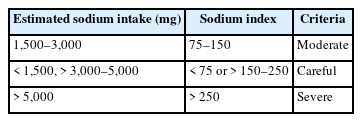
A total of 218 university students—110 Korean (63 males, 47 females) and 108 Chinese (60 males, 48 females)—participated in this study in 2019. Sodium-related awareness, nutritional knowledge, and sodium index were compared between Korean and Chinese students. Obesity indicators were compared according to three criteria for the sodium index of Korean and Chinese students: “moderate,” “careful,” and “severe. ” The association between sodium index levels and risk of obesity was analyzed using multiple logistic regression analysis adjusted for age and sex.
Results
Overall, 84% of students recognized that they consumed large amounts of sodium. Korean students demonstrated higher nutritional knowledge scores than Chinese students. The average estimated sodium intake was 3,751 mg, and no significant difference was observed between Korean (3,857 mg) and Chinese (3,643 mg) students. The overall average sodium index was 187, which falls under the “careful” level. As the sodium index levels increased, the students’ body mass index, waist-hip ratio (WHR), and fat-related indicators significantly increased. At the “severe” level of the sodium index, Korean and Chinese students had 2.402-fold and 1.636-fold increases in the risk of obesity based on body fat percentage, and 3.682-fold and 1.622-fold increases based on WHR, respectively.
Conclusion
This study demonstrated an association between sodium index and obesity risk, showing that excessive sodium intake affects body fat-related indicators in university students. -
Citations
Citations to this article as recorded by
- Vitamin and mineral composition of craft goat milk butter during refrigerated storage
V. A. Davydovych, L. V. Shevchenko, O. D. Baranovska, V. M. Mykhalska, V. M. Poliakovskyi, N. I. Boiko, H. V. Boiko, V. V. Dorozhko, A. O. Zulfigarov
Regulatory Mechanisms in Biosystems.2026; 17(3): e26057. CrossRef
- Vitamin and mineral composition of craft goat milk butter during refrigerated storage
- 908 View
- 25 Download
- 1 Crossref

- [English]
- Self-reported weight change and diet quality in relation to metabolic syndrome among Korean cancer survivors: a cross-sectional study using the Korea National Health and Nutrition Examination Survey 2019–2021
- Hye Won Kim, Ji-Myung Kim
- Korean J Community Nutr 2025;30(5):341-351. Published online October 31, 2025
- DOI: https://doi.org/10.5720/kjcn.2025.00241
-
Abstract
PDF
- Objectives
Using data from the 2019‒2021 Korea National Health and Nutrition Examination Survey, we examined the association between dietary quality and metabolic syndrome by self-reported weight change among adult Korean cancer survivors.
Methods
We analyzed 340 cancer survivors (≥ 5 years post-diagnosis) by one-year weight change (stable, loss, and gain). Dietary quality was assessed using the Korean Healthy Eating Index (KHEI), and metabolic syndrome was defined according to standard criteria. Relative risks (RR) were estimated using a modified Poisson regression.
Results
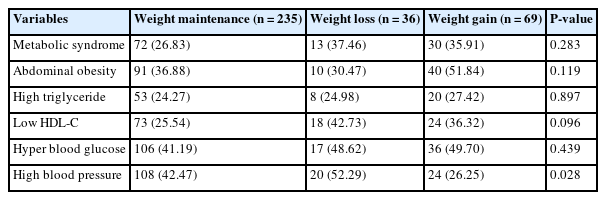
The weight loss group was older than the weight gain group (P < 0.001). Females were more prevalent in the loss and gain than in the maintenance group (P = 0.008). Hypertension prevalence was highest in the loss and lowest in the gain group (P = 0.028); other risk factors were similar. The gain group had the highest body mass index (P = 0.011). KHEI scores were highest in the maintenance (66.59 ± 0.76) and lowest in the gain group (60.42 ± 1.77; P = 0.006), with significantly lower whole grain (P = 0.036) and fruit intake (P = 0.014). Compared with the maintenance group, the gain group demonstrated higher risks of metabolic syndrome (RR: 2.07, 95% confidence interval [CI]: 1.40–3.06; P < 0.001), abdominal obesity (RR: 1.93, 95% CI: 1.36–2.74; P < 0.001), and impaired fasting glucose (RR: 1.70, 95% CI: 1.23–2.34; P < 0.01). Within the gain group, participants in the lowest KHEI quartile had increased risks of metabolic syndrome (RR: 2.81, 95% CI: 1.06–7.43; P < 0.05) and hypertriglyceridemia (RR: 7.29, 95% CI: 1.54–34.61; P < 0.05).
Conclusion
Accordingly, weight change and dietary quality may critically affect the metabolic health of cancer survivors. Lifestyle management, including weight control and tailored diets, may help prevent metabolic disorders and support long-term health.
- 1,752 View
- 39 Download
- [English]
- The impact of flash continuous glucose monitoring and nutrition coaching on dietary self-efficacy and weight management in university students in Korea: a pre-post intervention study
- Soojin Park
- Korean J Community Nutr 2025;30(3):183-196. Published online June 30, 2025
- DOI: https://doi.org/10.5720/kjcn.2025.00073
-
Abstract
PDF
- Objectives
This study aimed to evaluate the impact of a 4-week multicomponent intervention combining flash continuous glucose monitoring (flash-CGM), group nutrition education, and personalized nutrition coaching on dietary self-efficacy (DSE) and weight management in healthy university students.
Methods
A total of 27 university students participated in a pre-post intervention study. The intervention included a single 4-hour group-based nutrition education session, flash-CGM usage (FreeStyle Libre; Abbott Diabetes Care), and weekly one-on-one nutrition coaching. Participants wore the CGM device for 28 days (replaced after 14 days), and were guided in using the FoodLens app (DoingLab) for dietary tracking and a mobile app-linked digital scale for weight monitoring. Outcomes measured before and after the intervention included DSE, body mass index (BMI), nutrition quotient (NQ) and glycemic indicators. Statistical analyses included Wilcoxon signed-rank and Mann-Whitney U-tests with significance set at P < 0.05.
Results
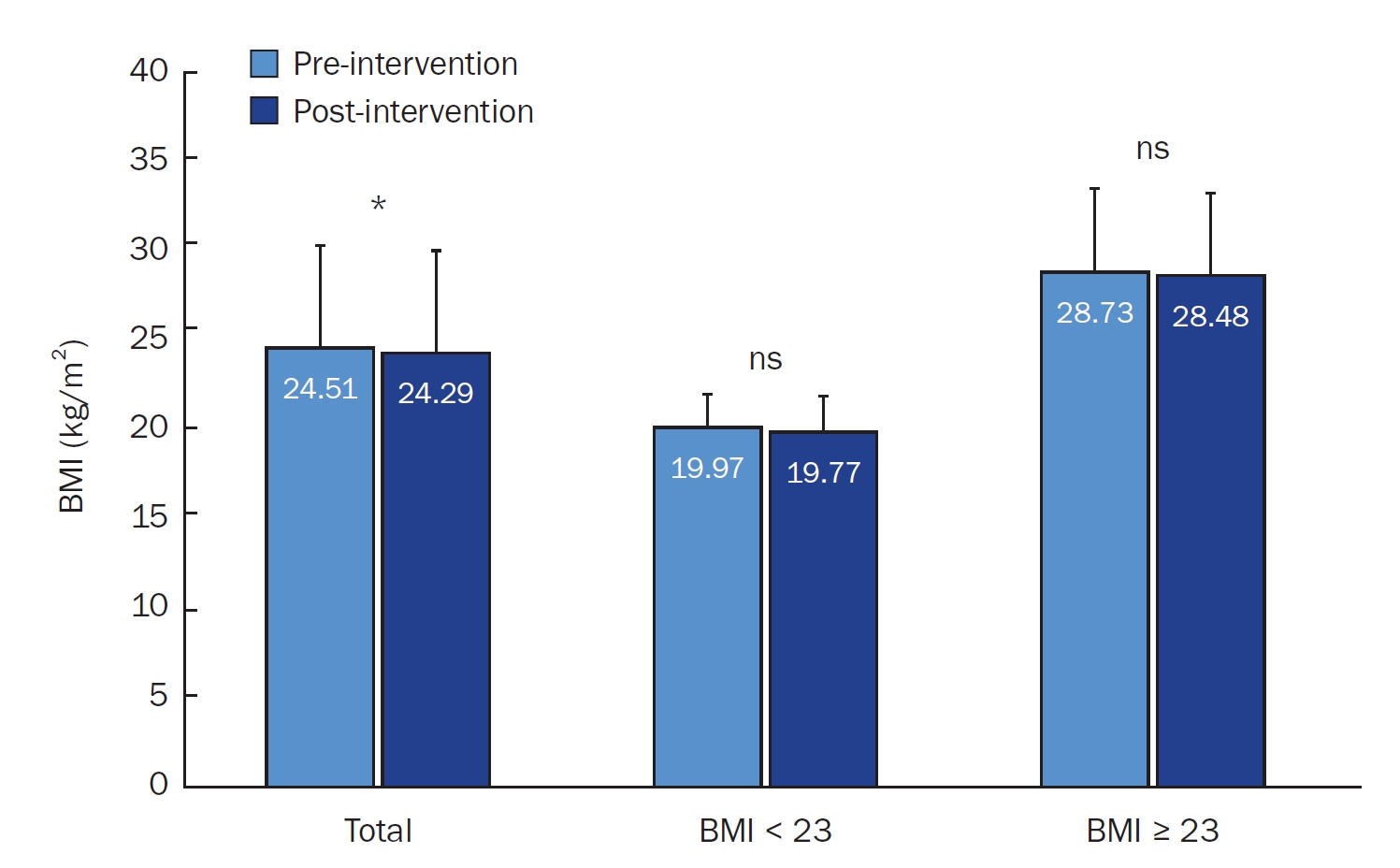
There was a significant increase in DSE (P < 0.05), particularly in managing eating behavior under stress and fatigue. A modest but significant decrease in BMI was observed in the overall group (P < 0.05), though changes were not significant in the BMI ≥ 23 kg/m2 subgroup. Glycemic indicators showed minimal changes. The overall NQ score improved slightly, with significant increases in fruit intake (P < 0.01) and nutrition label checks (P < 0.05). High satisfaction levels (4.52 ± 0.65 on a 5‑point scale) were reported for device usability and coaching services.
Conclusion
The multicomponent intervention improved DSE, NQ scores, and supported modest weight reduction among university students. The combined effect of CGM, nutrition education, and coaching appears promising; however, further studies are needed to isolate the effects of each component and evaluate long-term outcomes. Trial Registration: Clinical Research Information Service Identifier: KCT0010255.
- 2,811 View
- 51 Download
- [English]
- Relationship of sodium index with the obesity indicators of university students in Daegu, South Korea: a cross-sectional study
- Young-Won Jang, Jian Ma, Yeon-Kyung Lee
- Korean J Community Nutr 2024;29(3):189-198. Published online June 30, 2024
- DOI: https://doi.org/10.5720/kjcn.2024.29.3.189
-
Abstract
PDF
- Objectives
The sodium index is an index that converts the estimated sodium intake calculated using a verified and reliable sodium estimation formula. This study aimed to determine the relationship between the sodium index and obesity indicators and the potential impact of excessive sodium consumption on obesity.
Methods
Obesity indicators, such as body mass index (BMI), body fat percentage, waist-to-hip ratio (WHR), and visceral fat levels, were analyzed in 120 university students (60 men and 60 women). The sodium index was calculated by indexing the estimated sodium intake according to age, sex, BMI, salt-eating habits, and salt-eating behaviors. The relationship between sodium index and obesity indicators was analyzed using multiple logistic regression.
Results
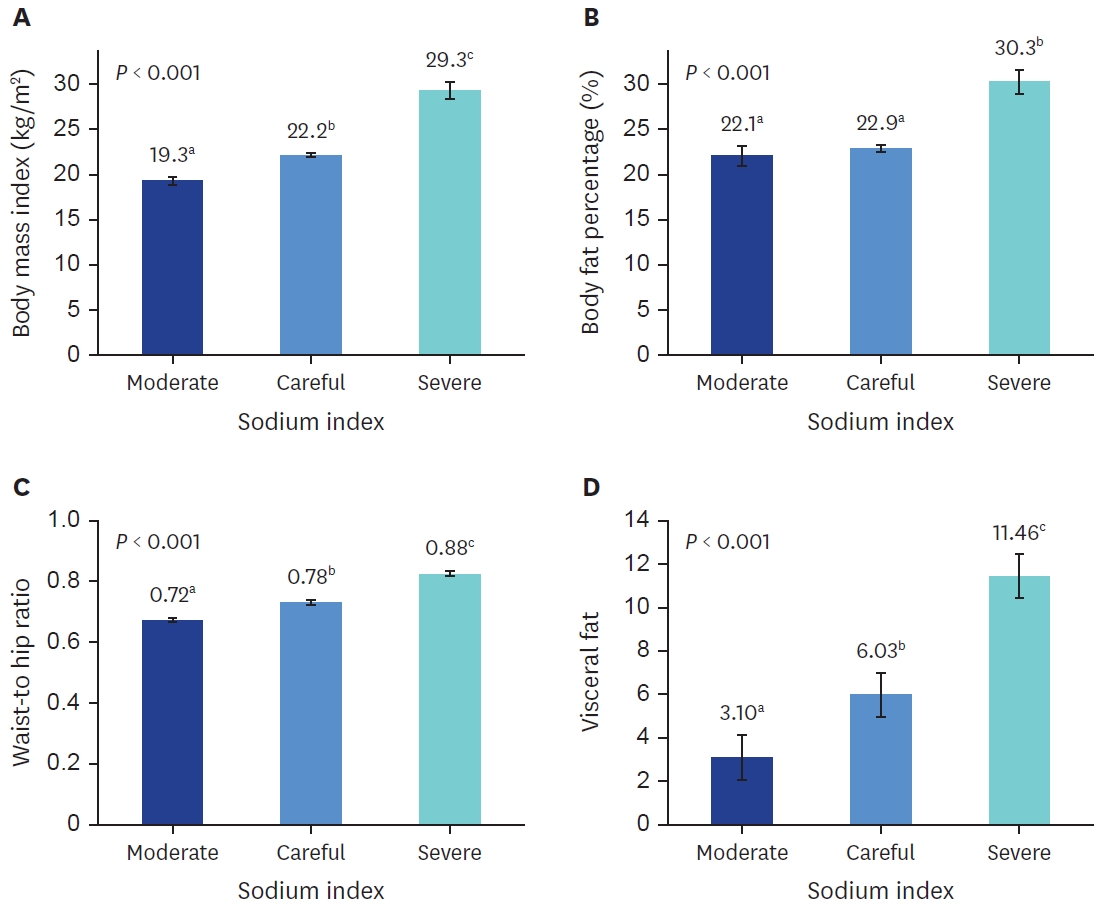
The estimated sodium intake was 3,907.1 mg, with 76.7% of the participants categorized under the “careful” level of sodium index and 10.8% under the “moderate” level. As the sodium index increased, the BMI, body fat percentage, WHR, and visceral fat levels significantly increased. All obesity indicators significantly increased in patients with a “severe” sodium index than in those with a “moderate” sodium index. In addition, a strong positive correlation was identified between obesity indicators and sodium index. When the “severe” sodium index was compared with the “moderate” sodium index, the risk of obesity based on body fat percentage increased by 2.181 times (95% confidence interval [CI], 1.526–3.118), while the risk of obesity based on visceral fat level increased by 4.073 times (95% CI, 2.097–7.911).
Conclusions
Our findings suggest a correlation between excessive sodium intake and obesity. Moreover, the sodium index can be used to determine sodium intake. -
Citations
Citations to this article as recorded by- The association between sodium index and the risk of obesity in Korean and Chinese university students: a cross-sectional study
Linan Wang, Jin-Ah Seok, Yeon-Kyung Lee
Korean Journal of Community Nutrition.2025; 30(6): 419. CrossRef
- The association between sodium index and the risk of obesity in Korean and Chinese university students: a cross-sectional study
- 6,861 View
- 50 Download
- 1 Crossref
- [English]
- Arterial stiffness index, physical activity and food and nutrient intake: cross-sectional study in adults aged 40 years and older
- Eun-A Kim, Yun-Mi Kim, Eun-Kyung Kim
- Korean J Community Nutr 2024;29(2):81-96. Published online April 24, 2024
- DOI: https://doi.org/10.5720/kjcn.2024.29.2.81
-
Abstract
PDF
- Objectives
This study aimed to investigate arterial stiffness index, physical activity, and food and nutrient intake in middle-aged adults over 40 years when the incidence of cardiovascular disease begins to increase.
Methods
This study included 106 subjects (48 males and 58 females) aged between 40 and 64 years. The arterial stiffness index (brachial-ankle pulse wave velocity [baPWV], and ankle-brachial index [ABI]) were measured using a blood pressure pulse wave testing device. Physical activity was assessed using the Korean version of the Global Physical Activity Questionnaire, and food and nutrient intake was calculated using the Food Frequency Questionnaire.
Results
The mean age of the subjects was 54.4 years. Although the ABI of the subjects was within the normal range, they were divided into tertiles to compare physical activity and food and nutrient intake. In males, the time spent on moderate to vigorous physical activity (MVPA) was significantly higher in T3 (600.6 min/week) than in T1 (304.4 min/week). In females, the time spent in sedentary behavior was significantly lower in T3 (294.5 min/week) than in T1 (472.1 min/week). In addition, the frequency of fish consumption was significantly higher in T3 (1.27 frequency/day) than in T1 (0.64 frequency/day) in females. Polyunsaturated fatty acid (PUFA) and ω-3 fatty acid intake, adjusted for energy intake, were significantly positively correlated with ABI (r = 0.200 and r = 0.218, respectively).
Conclusions
High MVPA (in males), low sedentary behavior (in females), and PUFA and ω-3 fatty acid intake through fish consumption may be associated with low peripheral artery stiffness. Therefore, arteriosclerosis can be prevented through physical activity and proper dietary therapy.
- 1,832 View
- 42 Download
- [Korean]
- Sustainable diets: a scoping review and descriptive study of concept, measurement, and suggested methods for the development of Korean version
- Sukyoung Jung
- Korean J Community Nutr 2024;29(1):34-50. Published online February 29, 2024
- DOI: https://doi.org/10.5720/kjcn.2024.29.1.34
-
Abstract
PDFSupplementary Material
- Objectives
Transformation through a sustainable food system to provide healthy diets is essential for enhancing both human and planetary health. This study aimed to explain about sustainable diets and illustrate appropriate measurement of adherence to sustainable diets using a pre-existing index.
Methods
For literature review, we used PubMed and Google Scholar databases by combining the search terms “development,” “validation,” “sustainable diet,” “sustainable diet index,” “planetary healthy diet,” “EAT-Lancet diet,” and “EAT-Lancet reference diet.” For data presentation, we used data from National Health and Nutrition Examination Survey, 2017–2018, among adults aged 20 years and older (n = 3,920). Sustainable Diet Index-US (SDI-US), comprising four sub-indices corresponding to four dimensions of sustainable diets (nutritional quality, environmental impacts, affordability, and sociocultural practices), was calculated using data from 24-hour dietary recall interview, food expenditures, and food choices. A higher SDI-US score indicated greater adherence to sustainable diets (range: 4–20). This study also presented SDI-US scores according to the sociodemographic status. All analyses accounted for a complex survey design.
Results
Of 148 papers, 16 were reviewed. Adherence to sustainable diets fell into 3 categories: EAT-Lancet reference diet-based (n = 8), Food and Agriculture Organization (FAO) definition-based (n = 4), and no specific guidelines but including the sustainability concept (n = 4). Importantly, FAO definition emphasizes on equal importance of four dimensions of diet (nutrition and health, economic, social and cultural, and environmental). The mean SDI-US score was 13 out of 20 points, and was higher in older, female, and highly educated adults than in their counterparts.
Conclusions
This study highlighted that sustainable diets should be assessed using a multidimensional approach because of their complex nature. Currently, SDI can be a good option for operationalizing multidimensional sustainable diets. It is necessary to develop a Korean version of SDI through additional data collection, including environmental impact of food, food price, food budget, and use of ready-made products. -
Citations
Citations to this article as recorded by- Association of the planetary health diet score with obesity, high blood pressure, dyslipidemia, and cardiometabolic risk markers: Using data from the 2016–2020 Korea National Health and Nutrition Examination Survey
Ujin Lee, Eugene Kang, Bomi Kim, Diana Shubekova, Adiyasuren Dookhuu, Heejin Lee, Jung Eun Lee, Minji Kang, Jaspinder Kaur
PLOS One.2026; 21(6): e0350821. CrossRef - How Do the Indices based on the EAT-Lancet Recommendations Measure Adherence to Healthy and Sustainable Diets? A Comparison of Measurement Performance in Adults from a French National Survey
Agustín R Miranda, Florent Vieux, Matthieu Maillot, Eric O Verger
Current Developments in Nutrition.2025; : 104565. CrossRef - Behavioral intention toward planetary health diet among adult users of government worksite cafeterias in Seoul, South Korea: a mixed-methods study based on the theory of planned behavior and focus groups interviews
Ji-Won Kang, Su-Jin Lee, Sil-Ah Kim, Ji-Yun Hwang
Korean Journal of Community Nutrition.2025; 30(3): 224. CrossRef - Trends in sustainable dietary patterns in United States adults, 2007-2018
Sukyoung Jung, Heather A. Young, Barbara H. Braffett, Samuel J. Simmens, Eunice Hong Lim Lee, Cynthia L. Ogden
Epidemiology and Health.2025; 47: e2025045. CrossRef
- Association of the planetary health diet score with obesity, high blood pressure, dyslipidemia, and cardiometabolic risk markers: Using data from the 2016–2020 Korea National Health and Nutrition Examination Survey
- 3,911 View
- 100 Download
- 4 Crossref
- [Korean]
- The Relationship Between the Korean Adults Diet Evaluated Using Dietary Quality Indices and Metabolic Risk Factors: Based on the 2016 ~ 2019 Korea National Health and Nutrition Examination Survey
- Chong-Yu Ding, Pil-Sook Park, Mi-Yeon Park
- Korean J Community Nutr 2022;27(3):223-244. Published online June 30, 2022
- DOI: https://doi.org/10.5720/kjcn.2022.27.3.223
-
Abstract
PDF
- Objectives
This study was designed to investigate the relationship between metabolic risk factors, Index of Nutrition Quality, and the dietary quality index score of Korean adults.
Methods
The subjects were 18,652 Korean adults aged 19 years or older (7,899 males, 10,753 females) who participated in the 2016-2019 Korea National Health and Nutrition Examination Survey. Subjects were divided into normal, pre-metabolic syndrome, and metabolic syndrome (MetS) groups according to the number of their metabolic risk factors. Data were analyzed using the SPSS program.
Results
About 44.7% of men in the MetS group were at least college graduates (P < 0.001), whereas 52.0% of women in the MetS group were middle school graduates or lower (P < 0.001). The frequency of fruit and dairy products intake tended to decrease as the number of metabolic risk factors increased in both men and women (P for trend < 0.001). As the number of metabolic risk factors decreased, the frequency of grain intake tended to decrease in men (P for trend < 0.001) while the frequency of intake of red meat (P for trend = 0.001), poultry (P for trend < 0.001), and eggs (P for trend < 0.001) decreased in women. The total scores of Diet Quality Index-International (DQI-I) (men P < 0.001, women P < 0.01) and Korean Healthy Eating Index (KHEI) (men and women P < 0.001) were significantly lower in the MetS group compared to the other groups, and the total score of DQI-I and KHEI tended to decrease as the number of metabolic risk factors increased.
Conclusions
Dietary quality evaluation using various indices can provide more information on the dietary problems related to metabolic risk factors. Nutrients and foods that have been confirmed to be related to metabolic risk factors can be used to develop dietary guidelines for the nutritional management of metabolic diseases. -
Citations
Citations to this article as recorded by- Association between the Korean Healthy Eating Index sub-domains and the risk of metabolic syndrome in Korean adults: data from the 2022–2023 Korea National Health and Nutrition Examination Survey
Ha-Jeong An, Sang-Jin Chung
Nutrition Research and Practice.2026; 20(1): 114. CrossRef - Relationship between diet quality and risk factors for diabetes complications in Korean adults with type 2 diabetes: based on the 8th Korea National Health and Nutrition Examination Survey (2019–2021)
Ye-In Son, Soo-Kyung Lee
Journal of Nutrition and Health.2025; 58(2): 179. CrossRef - Associations between Home Meal Replacement Consumption Frequency and Public Health Outcomes Among Adults in Their 20s and 30s in Daegu
Hye-Sun Jung, Kyung-Suck Park, Pil-Sook Park
Journal of Health Informatics and Statistics.2025; 50(2): 200. CrossRef - Associations between diet quality and regional factors in Korea vary according to individuals’ characteristics: a cross-sectional study
Hyunmi Han, Clara Yongjoo Park, Jeonghwa Lee
Korean Journal of Community Nutrition.2025; 30(4): 274. CrossRef - Cardiocerebrovascular Disease or Fatty Liver Incidence Associated with Pattern of Metabolic Risk Factors and Nutritional Status of Korean Adults: A Prospective Cohort Study
Pil Sook Park, Mei Sheng Li, Chong Yu Ding, Mi Yeon Park
Journal of Health Informatics and Statistics.2023; 48(2): 165. CrossRef - Assessment of Nutrient Intake and Dietary Quality of Korean Adults in Metabolic Syndrome Patients According to Taking Medical Care: Based on the 2017 Korea National Health and Nutrition Examination Survey
Juhee Lee, Kyungsuk Choi
Korean Journal of Community Nutrition.2022; 27(4): 321. CrossRef
- Association between the Korean Healthy Eating Index sub-domains and the risk of metabolic syndrome in Korean adults: data from the 2022–2023 Korea National Health and Nutrition Examination Survey
- 2,613 View
- 35 Download
- 6 Crossref
- [Korean]
- Consumption of Weight-control or Health Functional Foods, Dietary Habits, and Weight Perceptions According to the Body Mass Index of Adult Women in the Chungcheong Area
- Gayoung Seong, Munkyong Pae
- Korean J Community Nutr 2022;27(2):81-93. Published online April 30, 2022
- DOI: https://doi.org/10.5720/kjcn.2022.27.2.81
-
Abstract
PDF
- Objectives
This study was conducted to investigate the experience and perception among adult women regarding weight control and the consumption of weight-control foods or health functional foods based on their body mass index (BMI).
Methods
The subjects were 634 adult women from the Chungcheong province, Korea, and data were collected through a self-administered questionnaire from July 2021 through September 2021. The subjects were divided into four groups based on their BMI status: underweight (< 18.5 kg/㎡ , 7.6%), normal weight (18.5 ~ 22.9 kg/㎡ , 53.3%), overweight (23 ~ 24.9 kg/㎡ , 19.7%), and obese ( ≥ 25 kg/㎡ , 19.4%).
Results
Over the past 3 years, almost two-thirds (68.6%) of the adult women had tried weight control measures, despite the fact that a significant proportion of them were normal or underweight. More importantly, 57.6% of subjects reported the consumption of weightcontrol foods, with a lower proportion in the underweight (35.4%) group compared to the normal (56.2%), overweight (62.4%), and obese (65.0%) groups. The food items used for weight control were mostly salads, chicken breasts, low fat (soy) milk, slimming tea, protein shakes, low-calorie cereals, and energy/protein bars among others. In addition, one-third (31.1%) of the subjects reported the use of health functional foods containing ingredients for fat reduction. A significantly higher proportion of these was from the overweight (36.0%) and obese (38.2%) groups compared to the underweight (20.8%) and normal weight (28.1%) groups. Products containing Garcinia cambogia extract, green tea, or Cissus extract, were popular among users. Subjects who were obese had a poorer perception of their health and body. Most subjects felt the need for correct information regarding weight control, but this number was significantly more in the higher BMI groups.
Conclusions
Our results suggest that the use of weight-control foods or health functional foods is popular among adult women, especially those who are obese. Thus, nutrition education courses covering facts about weight control and practice need to be developed and provided based on the BMI status of subjects. -
Citations
Citations to this article as recorded by- High-protein diets for weight loss and their associations with bone status and diet quality in female college students
Seon-Young Park, Jee-Young Yeon, Mi-Hyun Kim
Nutrition Research and Practice.2026; 20(2): 317. CrossRef - Coffee Consumption Patterns According to Health Behavior and Dietary Factors among Young Adults : From the Korea National Health and Nutrition Examination Survey 2021
Hyun-Ju Jo, Hyun-Kyoung Bang
Journal of the East Asian Society of Dietary Life.2025; 35(4): 369. CrossRef - Consumption of protein supplements/protein-fortified foods among young adults in Jeju
Hyoju Lee, Youjeong Jang, Sumin Kim, Kyungho Ha
Journal of Nutrition and Health.2024; 57(2): 261. CrossRef - Prediction model of weight control experience in men with obesity in their 30 s and 40 s using decision tree analysis
Myeunghee Han
Scientific Reports.2024;[Epub] CrossRef - A Study on Diet Perceptions and Trends Before and After COVID-19 Using Big Data Analysis
Eunjung Lee, Hyosun Jung, Jina Jang
Journal of the Korean Society of Food Science and Nutrition.2023; 52(6): 659. CrossRef - A Narrative Approach to the Diet History of Female College Students : Focusing on the Role of SNS and Social Media Influencers and Individuals’ Motivation for Dieting
Kyungbo Kim
Korean Journal of Journalism & Communication Studies.2022; 66(3): 139. CrossRef
- High-protein diets for weight loss and their associations with bone status and diet quality in female college students
- 2,372 View
- 38 Download
- 6 Crossref
- [English]
- A Comparative Study of the Dietary Behavior of Adults Aged 20 and Over according to the Mukbang Viewing Time
- Ha-Yan Nam, Bok-Mi Jung
- Korean J Community Nutr 2021;26(2):93-102. Published online April 30, 2021
- DOI: https://doi.org/10.5720/kjcn.2021.26.2.93
-
Abstract
PDF
- Objectives
This study was conducted to investigate the relationship between watching Mukbang (eating broadcasts) and dietary and health behavior in adults who watch Mukbang Methods: The questionnaire was administered on a self-written basis through online and offline formats to 800 adults (400 men and 400 women). The contents of the survey consisted of general characteristics, Mukbang viewing time per week, breakfast intake frequency, preference for menus when viewing Mukbang , delivery food intake frequency per week, late meal intake frequency per week, and health behavior. The subjects were divided into three groups according to Mukbang viewing time.
Results
The body weight of viewers was significantly higher whenMukbang viewing time was over 14 hours for both men and women. In particular, based on the BMI (body mass index), those who watched Mukbang for more than 14 hours were found to be overweight. People with more than 14 hours of Mukbang viewing time per week were found to prefer mostly carbohydrate-rich food and meat, while those with less than 7 hours of Mukbang viewing time per week showed a higher preference for vegetables and fruits. An analysis of the frequency of breakfast eaten showed that the rate of skipping breakfast was the highest for those who watched Mukbang for more than 14 hours per week, and the rate of eating breakfast daily was the highest in the case of fewer than 7 hours of viewing. In the case of high Mukbang viewing time per week, the frequency of food delivery and night eating was high. When Mukbang viewing time was high, the viewer’s interest in health was low and the frequency of exercising too was low.
Conclusions
Viewers with high Mukbang viewing time showed undesirable health and eating behavior. Thus, it is believed that proper nutrition education on improving eating habits and raising the awareness of correct eating habits is necessary for such viewers. -
Citations
Citations to this article as recorded by- The Mukbang (Eating Broadcast) Paradox: Divergent Associations of Viewing Frequency with Improved Dietary Balance and Impaired Moderation in Korean Adults
Ahyoung Yun, Hyein Jung, Byungmi Kim, Yoonjoo Choi
Nutrients.2026; 18(9): 1478. CrossRef - Association between food-related media content and the eating behaviors of Korean adults according to household type
Ahyoung Yun, Hyein Jung, Byungmi Kim, Yoonjoo Choi
Frontiers in Nutrition.2025;[Epub] CrossRef - Dietary patterns and diet quality among adults in their 20s according to rice consumption: a co-occurrence network analysis using the Korea National Health and Nutrition Examination Survey (KNHANES) 2019–2021
Eun-kyung Kim, Jin-Young Lee, Yong-Seok Kwon, Minji Kang
Journal of Nutrition and Health.2025; 58(6): 571. CrossRef - Eating Habits and Health Behaviors According to Long-Form and Short-Form Mukbang Viewing of Adults in Their 20s and 30s
Seogyong Go, Bok-Mi Jung, Yun-Jung Bae, Mi-Kyeong Choi
Journal of the East Asian Society of Dietary Life.2025; 35(6): 597. CrossRef - Addictive symptoms of mukbang watching: A qualitative interview study using directed content analysis
Kagan Kircaburun, Filipa Calado, Andrew Harris, Mark D. Griffiths
Emerging Trends in Drugs, Addictions, and Health.2024; 4: 100147. CrossRef - Mukbang and Cookbang watching and dietary behavior in Korean adolescents
Jimin Sung, Jae-Young Hong, Jihong Kim, Jihye Jung, Seoeun Choi, Ji Yun Kang, Mi Ah Han
Nutrition Research and Practice.2024; 18(4): 523. CrossRef - Effects of watching Mukbang and Cookbang videos on adolescents’ dietary habits and mental health: cross-sectional study using the 18th Korea Youth Risk Behavior Survey
Seung-Hee Hong
Korean Journal of Community Nutrition.2024; 29(2): 156. CrossRef - Mukbang watching in Iran: a brief report validating the Persian version of the mukbang addiction scale and its relationship with disordered eating decisions and habits
Reza Shabahang, Sohee Kim, Xiuhan Chen, Mara S. Aruguete, Ágnes Zsila
Current Psychology.2024; 43(37): 29296. CrossRef - 성인 남녀의 먹방 시청시간에 따른 식행동에 대한 연구
하얀 남, 복미 정, 은례 전
Korean Journal of Food and Cookery Science.2024; 40(4): 275. CrossRef - Changes In the Activation of Supra-hyoid Muscles and Heart Rate of College Students During Food Intake According to Watching Mukbang
Byung-o Ahn, Sung-Min Son, Hyeong-Min Kim
American Journal of Health Behavior.2023; 47(4): 832. CrossRef - 밀키트 이용 고객의 식생활 양식과 밀키트 선택속성이 밀키트 제품의 만족도에 미치는 영향 분석
세은 김, 현주 배
Korean Journal of Food and Cookery Science.2023; 39(3): 187. CrossRef - The Relationship Between Watching Mukbang (Eating Show), Eating Behaviors, and Anthropometric Parameters in Iranian Female Students
Fatemeh Manafi Anari, Shahryar Eghtesadi
Journal of Research in Health Sciences.2023; 23(1): e00574. CrossRef - Health behaviors and eating habits in people’s 20s and 30s according to food content usage level on social media: a cross-sectional study
Seo-Yeon Bang, Bok-Mi Jung
Korean Journal of Community Nutrition.2023; 28(5): 392. CrossRef - Development and validation of Problematic Mukbang Watching Scale and Mukbang Watching Motives Scale: A cross-sectional study with adult mukbang watchers
Kagan Kircaburun, Andrew Harris, Filipa Calado, Mark D. Griffiths
Psychiatry Research Communications.2023; 3(3): 100138. CrossRef - Actual Status of Mukbang Viewing and Food Habits of University Students in Wonju Area
Seung-Lim Lee, Sun Hee Lee
The Korean Journal of Community Living Science.2022; 33(4): 631. CrossRef - Uses and gratifications of problematic mukbang watching – The role of eating and social gratification: A pilot study
Kagan Kircaburun, Mustafa Savcı, Emrah Emirtekin, Mark D. Griffiths
Journal of Psychiatric Research.2022; 146: 28. CrossRef - Problematic video-streaming: a short review
Maryam Rahat, Juliette Mojgani, Grace Lethbridge, Hashim Al-Bya, Beth Patterson, Carolina Goldman Bergmann, Michael Van Ameringen
Current Opinion in Behavioral Sciences.2022; 48: 101232. CrossRef
- The Mukbang (Eating Broadcast) Paradox: Divergent Associations of Viewing Frequency with Improved Dietary Balance and Impaired Moderation in Korean Adults
- 3,496 View
- 83 Download
- 17 Crossref
- [English]
- A Comparisons of Nutritional Intake and Diet Quality Index-International in Gynecological Cancer Survivors and Normal Women - Using the Korea National Health and Nutrition Examination Survey 2013~2016 -
- Bo-Young Seo, Eun-Sil Her
- Korean J Community Nutr 2020;25(5):406-415. Published online October 31, 2020
- DOI: https://doi.org/10.5720/kjcn.2020.25.5.406
-
Abstract
PDF
- Objectives
The aim of this study was to compare the nutritional intake and Diet Quality Index-International (DQI-I) of gynecological cancer survivors and normal women. Methods This study compared the anthropometric indices, dietary behavior, nutritional intake, and DQI-I in women with previous history of breast or uterine cancer [Gynecological cancer survivors group (GCSG, n=126)] and normal women [Normal control group (NCG, n=7,011)] using the 2013~2016 Korea National Health and Nutrition Examination Survey data. Results Body mass index and waist circumference were lower in the GCSG compared the NCG. The frequency of skipping breakfast and eating out was higher in the NCG compared to GCSG. Energy and fat intake were significantly higher in the NCG than in the GCSG, whereas intake of all minerals and vitamins (excluding thiamine), and dietary fiber intake were higher in GCSG. It was observed that the fatty acid intake of the GCSG was significantly lower than that of the NCG. The diet quality evaluation using DQI-I results showed that GCSG was higher in the “within-group” diet variety and adequacy of vegetable group than the NCG, whereas the intake level of the fruit group was higher in NCG. Besides, protein, calcium, and vitamin C intake were higher in the GCSG than in the NCG. The GCSG showed higher levels of total fat and saturated fat moderation than the NCG, whereas cholesterol moderation showed the opposite results. The results of DQI-I comparison according to the cancer survival years showed that the overall score and scores related to diet adequacy and balance were higher in the below 5-year group, whereas the over 5-year group scored higher in terms of moderation of diet. Conclusions The results of this study suggest that a chronic disease based management approach is needed in cancer survivors. The study provides important data which can help in the preparation of guidelines for long-term lifestyle and diet management, in these patients. -
Citations
Citations to this article as recorded by- Mediating Effect of Vitamin Intake on the Relationship Between Depression and Health-related Quality of Life in Cancer Survivors (Using the Korea National Health and Nutrition Examination Survey in 2020)
Min Ho Yun, Jong Eun Oh
Information.2024; 27(2): 131. CrossRef - Comparison of blood biochemical characteristics and dietary intake by sex in gastric cancer patients over 40 years in Korea based on 7th (2016-2018) Korea National Health and Nutrition Examination Survey: a cross-sectional study
Hyeon-Ju Lee, Sung-Won Oh, Sook-Bae Kim
Korean Journal of Community Nutrition.2023; 28(1): 48. CrossRef
- Mediating Effect of Vitamin Intake on the Relationship Between Depression and Health-related Quality of Life in Cancer Survivors (Using the Korea National Health and Nutrition Examination Survey in 2020)
- 1,447 View
- 3 Download
- 2 Crossref
Original Articles
- [English]
- Relation between the Total Diet Quality based on Korean Healthy Eating Index and the Incidence of Metabolic Syndrome Constituents and Metabolic Syndrome among a Prospective Cohort of Korean Adults
- Saerom Shin, Seungmin Lee
- Korean J Community Nutr 2020;25(1):61-70. Published online February 29, 2020
- DOI: https://doi.org/10.5720/kjcn.2020.25.1.61
-
Abstract
PDF
- OBJECTIVES
This study examined the association of the total diet quality with the incidence risk of metabolic syndrome constituents and metabolic syndrome among Korean adults.
METHODS
Based on a community-based cohort of the Korean Genome and Epidemiology Study (KoGES) from 2001 to 2014, data from a total of 5,549 subjects (2,805 men & 2,744 women) aged 40~69 years at the baseline with a total follow-up period of 38,166 person-years were analyzed. The criteria of the National Cholesterol Education Program Adult Treatment Panel was employed to define metabolic syndrome. The total diet quality was estimated using the Korean Healthy Eating Index (KHEI). Hazard ratios (HR) and 95% confidence intervals (CI) for risk of metabolic syndrome constituents and metabolic syndrome in relation to KHEI quintile groups was calculated by multivariate Cox proportional hazards regression model.
RESULTS
After adjusting for age, energy intake, income, education, physical activity, smoking, and drinking, the incidence of abdominal obesity and high blood pressure was significantly lower, by approximately 29.7% (P < 0.01) and 25.2% (P < 0.01), respectively, in the fifth KHEI quintile compared to the first quintile in men. A significant decreasing trend of the metabolic syndrome incidence was observed across the improving levels of KHEI (HRq5vs.q1: 0.775, 95% CIq5vs.q1: 0.619~0.971, P for trend < 0.01). In women, the incidence of abdominal obesity and metabolic syndrome was significantly lower, by approximately 29.8% (P < 0.01) and 22.5% (P < 0.05), respectively, in the fifth KHEI quintile compared to the first quintile adjusting for multiple covariates. On the other hand, the linear trend of metabolic syndrome risk across the KHEI levels did not reach the significance level.
CONCLUSIONS
A better diet quality can prevent future metabolic syndrome and its certain risk factors among Korean men and women. -
Citations
Citations to this article as recorded by- Association between the Korean Healthy Eating Index sub-domains and the risk of metabolic syndrome in Korean adults: data from the 2022–2023 Korea National Health and Nutrition Examination Survey
Ha-Jeong An, Sang-Jin Chung
Nutrition Research and Practice.2026; 20(1): 114. CrossRef - Adherence to the Dietary Approaches to Stop Hypertension score and cardiovascular disease risk in Korean adults: a prospective cohort study using marginal structural models
Soo-Hyun Kim, Hyunju Kim, Dayeon Shin
The American Journal of Clinical Nutrition.2026; 123(6): 101297. CrossRef - Sweet Taste Receptor Genetic Variation TAS1R2 rs35874116 Is Associated with Dietary Quality in a Korean Population
Eunyoung Kim, Jeong-Hwa Choi
Nutrients.2026; 18(8): 1224. CrossRef - The mediating effect of the Korean Healthy Eating Index on the relationship between lifestyle patterns and metabolic syndrome in middle-aged Koreans: data from the 2019–2021 Korea National Health and Nutrition Examination Survey
Sori On, Woori Na, Cheongmin Sohn
Nutrition Research and Practice.2025; 19(1): 96. CrossRef - FTO rs9939609 polymorphism is associated with dietary quality in Korean females
Minjeong Kim, Jeong-Hwa Choi
European Journal of Nutrition.2025;[Epub] CrossRef - Gender-specific association of diet with the risk of loss of muscle mass in Korean baby boomers: a prospective population-based cohort analysis
Eun-Hee Jang, Seungmin Lee
Nutrition Research and Practice.2025; 19(4): 635. CrossRef - Maternal Diet Quality Assessed Using the Korean Healthy Eating Index and Risk of Small-for-Gestational-Age Infants: Findings from the Mothers and Children’s Environmental Health (MOCEH) Study
Won Jang, Minji Kim, Eunhee Ha, Hyesook Kim
Nutrients.2025; 17(19): 3056. CrossRef - Sex differences in the association between Korean Healthy Eating Index and type 2 diabetes mellitus in Korean adults: a prospective cohort study
Yeeun Park, Minji Kim, Kyong Park
Korean Journal of Community Nutrition.2025; 30(5): 331. CrossRef - Association between Korean Healthy Eating Index and abdominal obesity in Korean adults: the mediating effect of high-sensitivity C-reactive protein
Jina Yoon, Dayeon Shin
Journal of Nutrition and Health.2024; 57(1): 88. CrossRef - Association between Dietary Quality and Non-Alcoholic Fatty Liver Disease in Korean Adults: A Nationwide, Population-Based Study Using the Korean Healthy Eating Index (2013–2021)
Seong-Uk Baek, Taeyeon Kim, Yu-Min Lee, Jong-Uk Won, Jin-Ha Yoon
Nutrients.2024; 16(10): 1516. CrossRef - TAS2R38 bitterness receptor genetic variation is associated with diet quality in Koreans
Hae Young Kim, Jeong-Hwa Choi
Appetite.2024; 200: 107561. CrossRef - Contents of Pantothenic Acid in Frequently Consumed Korean Vegetables and Fruits
Jihwan Kim, Jina Lee, Yoonjeong Kim, Eunji Park, Jinju Park, Youngmin Choi, Younghwa Kim
Journal of the Korean Society of Food Science and Nutrition.2024; 53(8): 816. CrossRef - Association of Social Jetlag with the Dietary Quality Among Korean Workers: Findings from a Nationwide Survey
Seong-Uk Baek, Jin-Ha Yoon
Nutrients.2024; 16(23): 4091. CrossRef - Association between green tea consumption and metabolic syndrome among Korean adults: results from the Health Examinees study
Hyeonjin Cho, Sunwoo Han, Jiwon Jeong, Hyein Jung, Sangah Shin
Journal of Nutrition and Health.2023; 56(1): 70. CrossRef - Obesity-Status-Linked Affecting Factors of Dyslipidemia in Korean Young-Adult Men: Based on the Korea National Health and Nutrition Examination Survey (2019–2021)
Min Kwon, Jinheum Kim, Eunjeong Cha
Healthcare.2023; 11(14): 2015. CrossRef - The association of the Korean Healthy Eating Index with chronic conditions in middle-aged single-person households
EunJung Lee, Ji-Myung Kim
Nutrition Research and Practice.2023; 17(2): 316. CrossRef - Association between the Korean Healthy Eating Index and Serum Vitamin D Level in Korean Adults: 2013–2015 Korea National Health and Nutrition Examination Survey
So-Yoon Choi, Yu-Jin Kwon, Ji-Won Lee
Korean Journal of Family Practice.2023; 13(4): 218. CrossRef - Benefits of adherence to the Korea Healthy Eating Index on the risk factors and incidence of the metabolic syndrome: analysis of the 7th (2016–2018) Korea National Health and Nutrition Examination Survey
Sun A Choi, Sung Suk Chung, Jeong Ok Rho
Journal of Nutrition and Health.2022; 55(1): 120. CrossRef - Prediction of metabolic and pre-metabolic syndromes using machine learning models with anthropometric, lifestyle, and biochemical factors from a middle-aged population in Korea
Junho Kim, Sujeong Mun, Siwoo Lee, Kyoungsik Jeong, Younghwa Baek
BMC Public Health.2022;[Epub] CrossRef - Comparison of the Nutrition Composition and Antioxidant Activity of Carrots and Parsnips
Yeon-Jin Park, So-Yeon Han, Jae-Joon Lee
The Korean Journal of Community Living Science.2022; 33(1): 83. CrossRef - Analysis of Fruit Consumption and the Korean Healthy Eating Index of Adults Using the 2018 Korea National Health and Nutrition Examination Survey
Sun A Choi, Sung Suk Chung, Jeong Ok Rho
Journal of the Korean Society of Food Science and Nutrition.2021; 50(10): 1124. CrossRef - Association of Dietary Quality with Subjective Health-Related Perception and Chronic Diseases According to Age Segmentation of Korean Elderly
Sojeong Lee, Seungmin Lee
Korean Journal of Community Nutrition.2021; 26(5): 363. CrossRef - Association between frailty and dietary quality in community-dwelling elderly: data from the 6th Korea National Health and Nutrition Examination Survey (2014–2015)
Woori Na, Hyeji Kim, Cheongmin Sohn
Journal of Clinical Biochemistry and Nutrition.2021; 68(3): 268. CrossRef - Changes in Prevalence of Body Mass Index and Metabolic Syndrome during COVID-19 Lockdown Period
Ji Young Kwon, Sang-Wook Song, Ha-Na Kim, Sung Gu Kang
Korean Journal of Family Practice.2021; 11(4): 304. CrossRef
- Association between the Korean Healthy Eating Index sub-domains and the risk of metabolic syndrome in Korean adults: data from the 2022–2023 Korea National Health and Nutrition Examination Survey
- 2,763 View
- 68 Download
- 24 Crossref
- [English]
- Effect of Geographic Area on Dietary Quality across Different Age Groups in Korea
- Hyun Ja Kim, Kirang Kim
- Korean J Community Nutr 2019;24(6):453-464. Published online December 31, 2019
- DOI: https://doi.org/10.5720/kjcn.2019.24.6.453
-
Abstract
PDF
- OBJECTIVES
The objective of this study was to examine whether dietary quality varies among different age groups and geographic areas, and whether the difference between geographic areas varies across several age groups in Korea.
METHODS
The subjects were 14,170 subjects who participated in the 2013–2015 Korea National Health and Nutrition Examination Survey. The dietary quality was assessed using the Korean Health Eating Index (KHEI). Age groups were categorized into six groupings, and areas were categorized into urban and rural according to their administrative districts. The effect of area on the KHEI score was analyzed by multiple linear regression analysis.
RESULTS
The KHEI was the lowest in the 20-30s group (57.7 ± 0.4 score for 20s and 61.2 ± 0.3 score for 30s) and increased with age (p<0.001), showing the highest score in the 60s (67.9 ± 0.3 score), and then decreased again in the 70s and older (64.6 ± 0.3 score). As a result of comparing the KHEI score by area, the urban areas had higher KHEI scores than did the rural areas (63.5 ± 0.2 score for urban area and 62.2 ± 0.4 score for rural area, p=0.002). The difference between areas was dependent on the age group, showing a significant difference for subjects who were aged from 50s and older (p=0.002 for 50s, p<0.001 for 60s and p<0.001 for 70s and older). After adjusting for confounding factors, the effect of area on the KHEI score was only shown for those subjects in the over 60 years old group (p=0.035 for 60s and p<0.001 for 70s and older).
CONCLUSIONS
The dietary quality differed according to the age group and geographic area. The dietary quality was lower for younger people than that for older people, and in rural areas compared to that in urban areas, and especially for older adults. The area factor was a very important factor for the dietary quality. -
Citations
Citations to this article as recorded by- Effects of senior-friendly foods on health, nutritional status, and dietary intake among rural elderly women in Korea: a quasi-experimental study
Sang-ju Lee, Ji-hyeon Kim, Jin-suk Han
Korean Journal of Community Nutrition.2026; 31(1): 101. CrossRef - Dietary habits of Koreans aged 95 years and older residing in rural and metropolitan areas
Jieun Mun, Sein Kim, Suyoung Kim, Seunghee Kim, Sang Chul Park, Jae-Young Han, Kwangsung Park, Clara Yongjoo Park
Nutrition Research and Practice.2025; 19(1): 66. CrossRef - Prediction model for identifying a high-risk group for food insecurity among elderly South Koreans
Myeunghee Han
Scientific Reports.2025;[Epub] CrossRef - Individual- and neighborhood-level factors influencing diet quality: a multilevel analysis using Korea National Health and Nutrition Examination Survey data, 2010-2019
Dahyun Park, Min-Jeong Shin, S V Subramanian, Clara Yongjoo Park, Rockli Kim
Epidemiology and Health.2025; 47: e2025043. CrossRef - Risk of all-cause mortality is associated with multiple health-related lifestyle behaviors and does not differ between urban and rural areas in Korea
Seunghee Kim, Clara Yongjoo Park
Nutrition Research and Practice.2024; 18(4): 554. CrossRef - Regional differences in protein intake and protein sources of Korean older adults and their association with metabolic syndrome using the 2016–2019 Korea National Health and Nutrition Examination Surveys: a cross-sectional study
You-Sin Lee, Yoonna Lee
Korean Journal of Community Nutrition.2024; 29(3): 173. CrossRef - Development and Validation of a Perceived Community Food Accessibility Measurement Questionnaire for Korean Older Adults
Jisoo Hong, Narae Yang, Kirang Kim
Nutrients.2023; 15(19): 4301. CrossRef - Improving the nutrition quotient and dietary self-efficacy through personalized goal setting and smartphone-based nutrition counseling among adults in their 20s and 30s
Dahyeon Kim, Dawon Park, Young-Hee Han, Taisun Hyun
Journal of Nutrition and Health.2023; 56(4): 419. CrossRef - Regional Difference in the Effect of Food Accessibility and Affordability on Vegetable and Fruit Acquisition and Healthy Eating Behaviors for Older Adults
Dong Eun Lee, Kirang Kim
International Journal of Environmental Research and Public Health.2022; 19(22): 14973. CrossRef - Regional Differences in Dietary Total Fat and Saturated Fatty Acid Intake and Their Associations with Metabolic Diseases among Korean Adults: Using the 2016~2019 Korea National Health and Nutrition Examination Surveys
SuJin Song, Jae Eun Shim
Korean Journal of Community Nutrition.2021; 26(6): 495. CrossRef - Basic Concepts and Detailed Dimensions of Food Security and Related Indicators for Policy Development and Evaluation
Sohyun Park, Ji-Yun Hwang, Jae Eun Shim, Kirang Kim
Korean Journal of Community Nutrition.2021; 26(6): 429. CrossRef
- Effects of senior-friendly foods on health, nutritional status, and dietary intake among rural elderly women in Korea: a quasi-experimental study
- 2,145 View
- 7 Download
- 11 Crossref
- [English]
- Relationship between Bone Mineral Density and Bone Metabolic Biochemical Markers and Diet Quality Index-International(DQI-I) in Postmenopausal Obese Women
- Yeonah Jeong, Misung Kim, Saeron Shin, Ahreum Han, Geomsuk Seo, Cheongmin Sohn
- Korean J Community Nutr 2016;21(3):284-292. Published online June 30, 2016
- DOI: https://doi.org/10.5720/kjcn.2016.21.3.284
-
Abstract
PDF
- OBJECTIVES
This study compared the differences of postmenopausal women's bone mineral density in relation to the degree of obesity, metabolism index and dietary factors that affect bone mineral density.
METHODS
The subjects included in the study are 39 postmenopausal women of normal weight with body mass index less than 25 kg/m2 and 32 postmenopausal who are obese. Anthropometry and biochemical analysis were performed and nutrient intakes and DQI-I were assessed.
RESULTS
Normal weight women were 56.03 ± 3.76 years old and obese women were 58.09 ± 5.13 years old and there was no significant difference in age between the two groups. The T-score of bone mineral density was 0.03 ± 1.06 in normal weight women and -0.60 ± 1.47 in obese women and this was significantly different between the two groups (p<0.05). Blood Leptin concentration was significantly lower in normal weight women (6.09 ± 3.37 ng/mL) compared to obese women in (9.01 ± 4.99 ng/mL) (p<0.05). The total score of diet quality index-international was 70.41±9.34 in normal weight women and 64.93 ± 7.82 in obese women (p<0.05). T-score of bone mineral density showed negative correlations with percentage of body fat (r = -0.233, p=0.05), BMI (r = -0.197, p=0.017), triglyceride (r = -0.281, p=0.020) and leptin (r = -0.308, p=0.011). The results of multiple regression analysis performed as the method of entry showed that with 22.0% of explanation power, percentage of body fat (β=-0.048, p<0.05), triglyceride (β=-0.005, p<0.05) and HDL-cholesterol (β=0.034, p<0.01), moderation of DQI-I (β=-0.231, p<0.05) affected T-score significantly.
CONCLUSIONS
The results of the study showed that obese women have less bone density than those with normal weight women. In addition, the factor analysis result that affect bone mineral density showed that intake of fat is a very important factor. Therefore, postmenopausal women need to maintain normal weight and manage blood lipid levels within normal range. They also need to take various sources of protein and reduce consumption of empty calorie foods that have high calories, fat, cholesterol and sodium.
- 1,576 View
- 0 Download
- [English]
- Factors Related to Eating Habits and Nutrition Status of Mother Affecting on Body Mass Index of Children aged 1-5years: Data from the Fifth Korea National Health and Nutrition Examination Survey, 2010-2011
- Miyeon Park, Pilsook Park
- Korean J Community Nutr 2016;21(1):102-111. Published online February 29, 2016
- DOI: https://doi.org/10.5720/kjcn.2016.21.1.102
-
Abstract
PDF
- OBJECTIVES
The intention of this study was to find out the impact of mother's body mass index, eating habits, nutrition status and sociodemographic factors on the body mass index of the children.
METHODS
The study used original data of Korea National Health and Nutrition Examination Survey (2010-2011) and had 957 children in the ages of 1-5 years and 957 mothers of these children, a total 1,914 as subjects. The weights (body mass indexes) of the children, subjects under 5th percentile were classified into a underweight group, 5~84th percentile into a normal weight group, 85-94th percentile into an overweight group and more than 95th percentile into an obesity group based on the 2007 Korean children and adolescents growth chart.
RESULTS
We observed that when the body mass index of a mother increased by 1, the possibility that her child would belong to the overweight group increased by 6.5% (95% confidence interval: 1.01~1.13), and the possibility that the child would belong to the obesity group increased by 95% (confidence interval: 1.01~1.18). With regard to the number of deficient nutrients which were ingested according to estimated average requirements (EAR) amid nutrients ingested by the mother increased by 1, the possibility that the child would belong to the obesity group increased by 16.6% (95% confidence interval: 1.01~1.35). In case the birth weight of child increased by 1kg, the odds ratio that the child would belong to the obesity group was 2.022 (95% confidence interval: 1.08~3.77).
CONCLUSIONS
We conclude that the body mass index, eating habits and nutrition status of the mother had significant effects on the body mass index of the child. Therefore, it is critical to recognize the importance of this observation and provide practical training for eating habits and nutrient intakes in order to achieve healthy growth and prevention of obesity among children. -
Citations
Citations to this article as recorded by- Dietary Assessment and Trends Among Preschoolers in South Korea: Data from KNHANES 2012–2021
Yong-Seok Kwon, Ye-Jun Kim, Eun-Kyung Kim, Jin-Young Lee, Yangsuk Kim, Sohye Kim
Nutrients.2026; 18(2): 240. CrossRef - Relationship between the Dietary Behavior of Young Children and Their Mothers in Daejeon, Korea Using the Nutrition Quotient for Preschoolers and Adults
InYoung Jeong, SuJin Song
Korean Journal of Community Nutrition.2021; 26(1): 12. CrossRef - Exploring parenting variables associated with sweetness preferences and sweets intake of children
Taejung Woo, Kyung-Hea Lee
Nutrition Research and Practice.2019; 13(2): 169. CrossRef - Effect of Dietary Education Experience (Home, School, and Mass Media) on Food Consumer Information literacy
Ji Eun Kim, Kyoung Sook Choi
Korean Journal of Community Nutrition.2019; 24(5): 363. CrossRef - Study on the correlation between nutrition knowledge, dietary attitudes of guardians, and nutritional status of infants and toddlers - Nutrition-Plus program in Jeonju
Eun Young Song, Jeong Ok Rho
Journal of Nutrition and Health.2018; 51(3): 242. CrossRef - Factors Related to Recommended Nutrient Intakes of Young Children and Their Mothers
Jung Mi Kim, Soon Rim Suh
Journal of Health Informatics and Statistics.2018; 43(4): 282. CrossRef - Nutritional status of 3~5 year old children attending kindergarten and childcare facilities: Using data from the 2010 and 2014 Korea National Health and Nutrition Examination Surveys
Mi Yeon Park, Pil Sook Park
Journal of Nutrition and Health.2017; 50(4): 361. CrossRef - Mother's Parenting Style at Meal Time and Their Preschooler's Dietary Behavior
Soyeon Park, Youngmee Lee
Korean Journal of Community Nutrition.2017; 22(1): 13. CrossRef - Factors Affecting the Frequency of Skipping Meals of Prime-Aged Mothers with Children : Data from the Fifth Korea National Health and Nutrition Examination Survey, 2010-2011
Mi-Yeon Park, Pil-Sook Park
Korean Journal of Community Nutrition.2016; 21(5): 451. CrossRef
- Dietary Assessment and Trends Among Preschoolers in South Korea: Data from KNHANES 2012–2021
- 2,012 View
- 5 Download
- 9 Crossref
- [English]
- Quality of Nutrient Adequacy and Health-related Quality of life of the Rural Elderly
- Mee Sook Lee
- Korean J Community Nutr 2015;20(6):423-432. Published online December 31, 2015
- DOI: https://doi.org/10.5720/kjcn.2015.20.6.423
-
Abstract
PDF
- OBJECTIVES
In Korea, the percentage of elderly is increasing at an unprecedented rate, and is expected to account for 40% of the population by 2060. This massive demographic change stresses the importance of research on aging as it is necessary to improve the quality of life (QoL) of this population. This study aimed to examine the health-related quality of life (HRQoL) of the rural elderly and to clarify its association with the nutrient adequacy ratio (NAR).
METHODS
A cross-sectional study was performed in S-gun, Chonbuk, a critical agricultural area. The elderly people without abnormal physical functioning composed our study population and the data were collected by personal visits to 336 elderly people aged over 65 years (110 males and 226 females). Subjects were interviewed with questionnaires pertaining to general characteristics and EuroQol (EQ-5D). Nutrient intakes were assessed two days by 24-hours recall method. Subjects were defined as high QOL group if EQ-5D index with Nam's model was above the median.
RESULTS
Generally, EQ-5D index was lower in women than in man, and lower in older subjects than in younger subjects. The percentages of people below the median were 42% (low QoL group) and 58% (high QoL group) were found to be the above the median. The high QoL group had higher NAR, especially for vitamin C, vitamin B1, vitamin B2 and folate. All dimensions in the EQ-5D were affected by NAR of some nutrients and especially anxiety/depression dimension was significantly correlated with NAR of 5 nutrients (protein, calcium, iron, vitamin C and vitamin B1) and EQ-5D scores.
CONCLUSIONS
HRQol was significantly reduced in elderly with increasing age and this was more pronounced in women than in man. The NAR of some nutrients were associated with the EQ-5D index, especially anxiety/depression dimension, among rural elderly. -
Citations
Citations to this article as recorded by- Health and dietary characteristics of the men and women in their middle age according to health-related quality of life: using the Korea National Health and Nutrition Examination Survey data in 2019 and 2021
Sarim Kim, Yoon Jung Yang
Journal of Nutrition and Health.2024; 57(3): 307. CrossRef - Snack Provision Practice in Long-Term Care Hospitals and Facilities in Korea
Dayeong Yeo, Hae Jin Kang, Hyejin Ahn, Yoo Kyoung Park
Clinical Nutrition Research.2024; 13(2): 108. CrossRef - Relationship between Dietary Patterns and Cardiovascular Disease Risk in Korean Older Adults
Ae-Rim Seo, Tae-Yoon Hwang
International Journal of Environmental Research and Public Health.2021; 18(7): 3703. CrossRef - Food and nutrient intake status of Korean elderly by perceived anxiety and depressive condition: data from Korean National Health and Nutrition Examination Survey 2013 ~ 2015
Da-Mee Kim, Kyung-Hee Kim
Journal of Nutrition and Health.2019; 52(1): 58. CrossRef
- Health and dietary characteristics of the men and women in their middle age according to health-related quality of life: using the Korea National Health and Nutrition Examination Survey data in 2019 and 2021
- 1,961 View
- 1 Download
- 4 Crossref
- [English]
- The Effects of Low-sodium Diet Education Program on Dietary Habits, Diet Quality and Obesity Index in Overweight and Obese Middle-aged Women
- Soo Bin Jeong, Seoyun Park, Sohyun Ahn, Jin Nam Kim, Hye Kyeong Kim
- Korean J Community Nutr 2014;19(6):513-526. Published online December 31, 2014
- DOI: https://doi.org/10.5720/kjcn.2014.19.6.513
-
Abstract
PDF
- OBJECTIVES
This study was conducted to investigate the effect of low sodium diet education program on dietary habits, diet quality, and measures of obesity in overweight or obese middle-aged women.
METHODS
Subjects were 81 individuals aged 45 years or over, who completed an 8-week nutrition education. The subjects were divided into a normal group (N = 30) and an overweight-obese group (N = 51) according to the BMI. The effects were evaluated by anthropometric measurement, biochemical analysis, questionnaire, and diet records before and after the program.
RESULTS
Overweight-obese group showed significant decreases in weight (p < 0.0001), BMI (p < 0.0001), percent of body fat (p = 0.0087), waist circumference (p < 0.0001), systolic (p = 0.0003) and diastolic blood pressure (p = 0.0261). Nutrients intakes were not different between the two groups and only sodium intake was decreased after education. Total score of general dietary habits, dietary behavior related to sodium intake, dietary diversity score (DDS), diet variety score (DVS), and diet quality index-international (DQI-I) were improved in both groups compared to the baseline. Overweight-obese group showed significant improvement in 'having fruits everyday', 'having fish everyday', 'trying to eat many kinds of food', 'eating less broth when eating soup, stew, and noodles', 'eating less kimchi and salt-fermented vegetable', and 'propensity to think that dishes should be pretty seasoned'. In addition, moderation of empty calories food (p = 0.0064) and macronutrient ratio (p = 0.0004) were improved in the overweigh-obese group, but in the normal group, the results did not reach statistical significance.
CONCLUSIONS
These results suggested that low sodium diet education program may contribute to obesity management by improving diet quality and dietary habits in middle-aged women.
- 1,555 View
- 3 Download
- [English]
- A Comparison between Asia-Pacific Region Criteria and Entropy Model Criteria about Body Mass Index of Elderly Females Using Morbidity of Chronic Disease
- Gu Beom Jeong, Jin Yong Park, Se Young Kwon, Kyung Ok Park, Pil Sook Park, Mi Yeon Park
- Korean J Community Nutr 2014;19(5):490-498. Published online October 31, 2014
- DOI: https://doi.org/10.5720/kjcn.2014.19.5.490
-
Abstract
PDF
- OBJECTIVES
This study was conducted to propose the need of re-establishing the criteria of the body weight classification in the elderly. We compared the Asia-Pacific Region Criteria (APR-C) with Entropy Model Criteria (ENT-C) using Morbidity rate of chronic diseases which correlates significantly with Body Mass Index (BMI).
METHODS
Subjects were 886 elderly female participating in the 2007-2009 Korea National Health and Nutrition Examination Survey (KNHANES). We compared APR-C with those of ENT-C using Receiver Operating Characteristics (ROC) curve and logistic regression analysis.
RESULTS
In the case of the morbidity of hypertension, the results were as follows: Where it was in the T-off point of APR-C, sensitivity was 67.5%, specificity was 43.1%, and Youden's index was 10.6. While in the cut-off point of ENT-C, it was 56.7%, 56.6%, and 13.3 respectively. In the case of the morbidity of diabetes, the results were as follows: In the cut-off point of APR-C, Youden's index was 14.2. While in the cut-off point of ENT-C, it was 17.2 respectively. The Area Under the ROC Curve (AUC) of the subjects who had more than 2 diseases among hypertension, diabetes, and dyslipidemia was 0.615 (95% CI: 0.578-0.652). Compared to the normal group, the odds ratio of the hypertension group which will belong to the overweight or obesity was 1.79 (95% CI: 1.30-2.47) in the APR-C, and 2.04 (95% CI: 1.49-2.80) in the ENT-C (p > 0.001).
CONCLUSIONS
We conclude that the optimal cut-off point of BMI to distinguish between normal weight and overweight was 24 kg/m2 (ENT-C) rather than 23 kg/m2 (APR-C). -
Citations
Citations to this article as recorded by- Factors related to cancer screening behaviors
Boyoung Choi, Tae Rim Um, Kwang-Soo Lee
Epidemiology and Health.2018; 40: e2018011. CrossRef - Nutrition States and Related Factors of Female Elderly according to Residence
Mi-Yeon Park
Journal of the East Asian Society of Dietary Life.2015; 25(1): 39. CrossRef
- Factors related to cancer screening behaviors
- 1,663 View
- 0 Download
- 2 Crossref
- [English]
- Association of Food and Nutrient Intakes with Periodontitis by Smoking Status among Korean Adults
- Sunghee Kim, Areum Yu, Yoon Jung Yang
- Korean J Community Nutr 2014;19(1):84-94. Published online February 28, 2014
- DOI: https://doi.org/10.5720/kjcn.2014.19.1.84
-
Abstract
PDF
- Periodontal disease is one of the most common chronic inflammatory diseases in the oral cavity, and this is the leading cause of loss of teeth. Studies on the association between diet and periodontal diseases are very limited. The purpose of this study was to investigate the association between food and nutrient intakes and the prevalence of periodontitis. Subjects were 13,391 adults participating in the 2008-2010 Korea Health and Nutrition Examination Survey. Periodontitis was diagnosed by dentists using the Community Periodontal Index. Nutrient intakes were estimated by the 24-hour dietary recall. Consumption frequencies of foods were from the food frequency questionnaire. Subjects were categorized into 'smoking' or 'non-smoking' groups. Multiple logistic regression analysis was applied to determine the association between diet and periodontitis. The proportions of subjects having periodontitis were 26% in the non-smoking group and 37.5% in the smoking group. In the non-smoking group, intakes of fruits, dairy products, green tea, energy and vitamin C were inversely associated with the prevalence of periodontitis, but fish and coffee intakes were positively associated with the prevalence of periodontitis after adjusting for covariates. In the smoking group, protein and retinol intakes were inversely associated with the prevalence of periodontitis after adjusting for covariates. These results suggest that certain food and nutrient intakes such as fruits, dairy products, green tea, vitamin C, protein, or retinol intakes may affect the prevalence of periodontitis among Korean adults. Further studies are required to confirm these findings in other research settings.
-
Citations
Citations to this article as recorded by- Association between consumption of milk and dairy products, calcium and riboflavin, and periodontitis in Korean adults: Using the 2007-2010 Korea National Health and Nutrition Examination Surveys
Sang Mi Koo, Deog-Gyu Seo, Yoon Jung Park, Ji-Yun Hwang
Journal of Nutrition and Health.2014; 47(4): 258. CrossRef
- Association between consumption of milk and dairy products, calcium and riboflavin, and periodontitis in Korean adults: Using the 2007-2010 Korea National Health and Nutrition Examination Surveys
- 1,967 View
- 5 Download
- 1 Crossref
- [English]
- Effect of a Diet Program for Adult Women on Body Weight Loss and Health Related Indices
- Heejung Park, Seongkyung Cho, Jea Ok Koo
- Korean J Community Nutr 2013;18(6):599-610. Published online December 31, 2013
- DOI: https://doi.org/10.5720/kjcn.2013.18.6.599
-
Abstract
PDF
- This study was carried out to analyze the effect of a diet program for adult women on weight loss, BMI, eating habits, sleeping habits, health related indices. The subjects was 415 participants of the 10 weeks (20 time participation program). The data was collected by basic somatometry and HRV (Heart Rate Variability) / APG (Accelerated Plethysmograph) Analyzer. The average age, height, weight and BMI were 28.6 years, 162.1 cm, 62.8 kg and 23.9 kg/m2, respectively. Their body types by BMI were under weight (1.2%), normal (45.8%), overweight (24.8%), mild obesity (22.7%) and obesity (5.5%). There were significant reductions of average weight (4.6 kg) and average BMI (1.75 kg/m2) on the 10th week. There were positive changes in vascular age (50.4%), stress index (44.6%), fatigue index (43.9%), health index (54.5%) of the subjects during the program. There was a meaningful difference of the average variation for the vascular age, stress index, fatigue index, and health index between two groups; one improving the eating habit and the other did not (p < 0.05), and also there was a meaningful difference of the average variation for the fatigue index in both groups improving the sleeping habit (p < 0.05), but was not a meaningful difference of the average variation for the vascular age, stress index, and health index between two groups. There was a meaningful difference of the average variation for the vascular age, stress index, fatigue index, and health index between two groups improving both eating and sleeping habit (p < 0.05). In conclusion, the weight loss program was effective on the weight loss and BMI reduction and health related indices.
-
Citations
Citations to this article as recorded by- A Narrative Inquiry of Fitness Models’ Diet Experience
Woo-Jeong Jang, Wi-Young So, Hyungsik Jo, Eui-Jae Lee
The Asian Journal of Kinesiology.2025; 27(2): 90. CrossRef - Effects of Mat Pilates on the Autonomic Nervous System in the Elderly Women
Kyung-Tae Yoo
Journal of The Korean Society of Physical Medicine.2022; 17(4): 27. CrossRef - Effect of Nutrition Counseling Program on Weight Control in Obese University Students
Bo Ryeong Kim, Seung Yeon Seo, Na Gyeong Oh, Jung-Sook Seo
Clinical Nutrition Research.2017; 6(1): 7. CrossRef - Effects of 12-week Vegetarian Diet on the Nutritional Status, Stress Status and Bowel Habits in Middle School Students and Teachers
Bo Ra Lee, Yu Mi Ko, Mi Hee Cho, Young Ran Yoon, Seung Hee Kye, Yoo Kyoung Park
Clinical Nutrition Research.2016; 5(2): 102. CrossRef
- A Narrative Inquiry of Fitness Models’ Diet Experience
- 2,205 View
- 4 Download
- 4 Crossref
- [English]
- A Study on Classification of Obesity for Koreans based on the Articles in the Korean Journal of Community Nutrition: Articles Enlisted from 1996 to 2011
- Youngnam Kim
- Korean J Community Nutr 2013;18(5):525-538. Published online October 31, 2013
- DOI: https://doi.org/10.5720/kjcn.2013.18.5.525
-
Abstract
PDF
- The purpose of this study was to provide information on obesity assessment for Koreans. Among total of 1012 research papers enlisted in the Korean J Community Nutrition form 1996 to 2011, 248 articles were examined in which subjects were divided into more than 2 groups by obesity rate. About the method of anthropometric data collection, more than half of the research papers examined 52.5% and 28.7% of studies utilized the directly measured data and self-described data, respectively. About the utilization of obesity assessment methods, indirect methods of weight-height index (BMI, BMI percentile, and Rohrer index) and PIBW (WLR, Broca index, and KDA) were 62.4% and 23.2%, respectably, and the direct method of percent body fat assessment was only 9.3%. The most frequently utilized methods were WLR in under primary and primary school children, and BMI in the middle and high school students and in adults. For primary school students, WLR was the most frequently utilized method up to 2007, but it changed to BMI percentile afterward. Broca Index was no longer utilized since 2008. There were no articles utilizing BMI percentile and Rohrer index for obesity assessment in adults. Criteria for obesity assessment were not consistent among research papers: for example, % body fat, 19~40%; BMI, 20~30; BMI percentile, 85th or 95th. In the case of PIBW, 120% of ideal weight was the most frequently utilized criterion for obesity. Based on these findings, we suggest that proper methods and criteria of obesity assessment for each age group should be determined and proclaimed.
-
Citations
Citations to this article as recorded by- Factors Contributing to Diabetic Foot Ulcer among Patients with Type 2 Diabetes Mellitus
Seo Jin Park, Taeyoung Yang, Jun Young Lee, Jinhee Kim
Korean Journal of Adult Nursing.2018; 30(1): 106. CrossRef - A Comparative Study of Dietary and Weight Control Behavior of Female College Students in Korea and China
Li Song, Na Young An, Ho Kyung Ryu
The Korean Journal of Community Living Science.2015; 26(4): 761. CrossRef
- Factors Contributing to Diabetic Foot Ulcer among Patients with Type 2 Diabetes Mellitus
- 1,924 View
- 0 Download
- 2 Crossref
- [English]
- Comparison of Serum Adiponectin Levels According to Body Mass Index and Dietary Behaviors of Female University Students in Seoul
- Mi Joung Kim, Hyun Young Jun, Hye Bog Rha
- Korean J Community Nutr 2013;18(4):354-364. Published online August 31, 2013
- DOI: https://doi.org/10.5720/kjcn.2013.18.4.354
-
Abstract
PDF
- This study was conducted to determine whether dietary factors could be related with serum adiponectin concentrations in 243, year-three female university students living in Seoul. The mean of body mass index (BMI) and adiponectin levels of all subjects were 20.17 kg/m2 and 11.07 microg/ml, respectively. When the subjects were divided into 3 groups based on BMI (underweight: < 18.5, normal: 18.5 < or = < 23, overweight and obesity: > or = 23), serum adiponectin levels in underweight group was significantly higher than that in 'normal' or 'overweight and 'obesity' groups. Also when the subjects were divided into two groups by mean adequacy ratio (MAR), serum adiponectin concentration of the high MAR group (MAR > 75) was slightly higher than that the low MAR group (MAR < or = 75). Serum adiponectin levels showed a negative correlation with body weight (p < 0.01) or BMI (p < 0.001) and a positive correlation with intakes of of animal or total protein (please clarify) or vegetable protein.Among the dietary behaviors, serum adiponectin levels of females who answered 'yes' to the question about 'eating breakfast' was significantly higher than that of those who answered 'sometimes' or 'No' (p < 0.05) and serum adiponectin levels were higher among those who reported higher fruit intakes. Overall, our results suggested that healthy lifestyle including acceptable BMI, eating breakfast and higher fruit consumption might play an important role in the prevention of obesity and enhancement of blood adiponectin levels.
-
Citations
Citations to this article as recorded by- Comparison of nutritional status between adults with and without disabilities: a population-based cross-sectional study in South Korea
Jong Eun Park, Tae Hui Jang, So Young Kim, Jong Hyock Park
Nutrition Research and Practice.2025; 19(6): 967. CrossRef - A Study on Food Habits and Nutrient Intakes according to BMI in Food and Nutrition Major and Non-major Female Students in Kyungnam University
Eun-Hee Seo
Korean Journal of Community Nutrition.2014; 19(4): 297. CrossRef - Relationships among Serum Adiponectin, Leptin and Vitamin D Concentrations and the Metabolic Syndrome in Farmers
Seo-Eun Yeon, Hee-Ryoung Son, Jung-Sook Choi, Eun-Kyung Kim
Korean Journal of Community Nutrition.2014; 19(1): 12. CrossRef
- Comparison of nutritional status between adults with and without disabilities: a population-based cross-sectional study in South Korea
- 1,776 View
- 1 Download
- 3 Crossref
- [English]
- Wanting Extremely Low BMI May be Associated with Higher Depression and Undesirable Dietary Habits in High School Girls Who were Not Overweight
- Hyeyoung Park, Hongmie Lee
- Korean J Community Nutr 2013;18(4):344-353. Published online August 31, 2013
- DOI: https://doi.org/10.5720/kjcn.2013.18.4.344
-
Abstract
PDF
- The widespread pursuit for the thin physique may have detrimental impact on the wellbeing of the young generation, especially females. This study aimed to determine the effect of wanting very low body weight on dietary habits and psychological factors of female adolescents. Participants were 619 girls from 5 high schools in Kyeonggi, Korea. Information on dietary behaviors, psychological factors as well as current heights and weights and the desired weight for current height were obtained by questionnaire. Of total subjects, 38.1%, 35.5%, and 26.5% desired weights corresponding to normal (10~85 percentile), low (3~10 percentile) and very low BMI (< 3 percentile), respectively. The subjects who wanted to be very low weight had the average BMI of 18.57 kg/m2, which was significantly lower than 21.21 kg/m2 of those who wanted to be normal weight (p < 0.001). The subjects who desired very low weight had significantly higher scores for depression symptoms (p < 0.05), while there were no differences in obsession to lose weight and obesity stress. Moreover, more subjects in this group had undesirable dietary habits such as eating fast foods more than weekly (p < 0.05). These findings suggest that the desire for extreme thinness may lead female adolescents to have not only unreasonably similar obesity stress and obsession to lose weight but also higher depression symptoms, along with undesirable dietary habits. The findings suggest the potential harm from excessive weight concerns of female adolescents; thus efforts to teach this group about healthy weights are urgently needed.
-
Citations
Citations to this article as recorded by- Facing Sexual Objectification: A Qualitative Study on South Korean Adolescent Girls’ Perspectives
In Chi Hwang, Keunyoung Baek
The Counseling Psychologist.2026; 54(3): 354. CrossRef - Body Image Perception and Eating Behaviors among Male Middle and High School Students according to Weight Status in Seoul
Bo-Mi Kim, Kyung-Hee Kim
Journal of the East Asian Society of Dietary Life.2018; 28(2): 123. CrossRef - Agreement Between Actual and Perceived Body Weight in Adolescents and Their Weight Control Behaviors
Sun Mi Shin
Journal of Obesity & Metabolic Syndrome.2017; 26(2): 138. CrossRef - Body Image Perception, Eating Disorder Risk, and Depression Level according to Dieting Experience of Female High School Students in Seoul
Jisun Min, Kyunghee Song, Hongmie Lee
Journal of the Korean Dietetic Association.2016; 22(4): 241. CrossRef - The Associations between Discordance of Body Image and Physical Activities among Adults Aged 19 to 64 Years: Based on the Data from 2010 Community Health Survey
In Ae Chun, So Yeon Ryu, Jong Park, Mi Ah Han, Seong Woo Choi, Dae Sik Ko
The Korean Journal of Obesity.2014; 23(4): 274. CrossRef
- Facing Sexual Objectification: A Qualitative Study on South Korean Adolescent Girls’ Perspectives
- 2,154 View
- 1 Download
- 5 Crossref
- [English]
- Assessment of Menu Plan Prepared by Middle School Students According to Ordinary Meal Pattern and Single Serving Size
- Jung Ok Kim, Youngnam Kim
- Korean J Community Nutr 2013;18(4):333-343. Published online August 31, 2013
- DOI: https://doi.org/10.5720/kjcn.2013.18.4.333
-
Abstract
PDF
- It is important to prepare and execute the menu plan for proper and balanced intake of nutrients in the adolescence. This study investigated the new approach for planning menu by ordinary meal pattern based on cooked foods groups. The amounts of cooked foods in the menu plan assumed to be single serving size. The middle school second graders participated for the study. A total of 313 questionnaires were analyzed using CAN-pro 3.0 and SPSS WIN 12.0 program. The average content of energy in the menu plan was 2,453 kcal, the average ratios of energy contribution by carbohydrate, protein and fat were 54.3%, 17.9%, 27.8%, respectively. A total of 56.9% menu plans (94.9% of male and 8.7% of female students') were below the lowest limit of optimum carbohydrate energy ratio of 55%. A total of 29.1% menu plans (33.1% of male and 23.9% of female students') were exceed the highest limit of optimum fat energy ratio of 30%. The NAR of minerals and vitamins were all 1.0 except for calcium (0.92) and folate (0.88). When INQ of the individual cooked food groups were calculated, kimch was the highest in all minerals and vitamins examined, suggesting that kimch may be the best source for all minerals and vitamins, including calcium and folate with the minimum change in energy content. In conclusion, the menu plan by ordinary meal pattern in this study was low in carbohydrate, high in fat, and contained enough minerals and vitamins except for calcium and folate for middle school students.
-
Citations
Citations to this article as recorded by- Status of serving labeling of home meal replacement-soups and stews, and evaluation of their energy and nutrient content per serving
Mi-Hyun Kim, In-Young Choi, Jee-Young Yeon
Journal of Nutrition and Health.2021; 54(5): 560. CrossRef - Nutritional Adequacy Analysis of Recommended Menu in Dietary Reference Intakes for Koreans 2015
Youngnam Kim
Korean Journal of Community Nutrition.2017; 22(4): 279. CrossRef - Proposition and Application of a Dish-Based Target Pattern for Korean Adolescent Girls
Mi Jin Park, Youngnam Kim
Korean Journal of Community Nutrition.2015; 20(2): 87. CrossRef - Validation of Nutrient Intake Estimation based on One Serving Size
Yi-Yeong Kim, Mi-Hyun Kim, Mi-Kyeong Choi
The Korean Journal of Food And Nutrition.2015; 28(5): 871. CrossRef - Revision of the Target Pattern based on Single Serving Size of Dishes for Korean Adolescent Meal Plan
Mi Jin Park, Youngnam Kim
Korean Journal of Community Nutrition.2015; 20(1): 21. CrossRef - Revision and Application of the Target Pattern in Food Guidance System: Administered to 2nd grade middle school students
Ha Yeon Lee, Youngnam Kim
Korean Journal of Community Nutrition.2014; 19(3): 274. CrossRef
- Status of serving labeling of home meal replacement-soups and stews, and evaluation of their energy and nutrient content per serving
- 2,085 View
- 2 Download
- 6 Crossref
- [English]
- Health-Related Factors Influencing the Quality of Life of Rural Elderly Subjects: Activities of Daily Living, Cognitive Functions, Prevalence of Chronic Diseases and Nutritional Assessment
- Mee Sook Lee
- Korean J Community Nutr 2012;17(6):772-781. Published online December 31, 2012
- DOI: https://doi.org/10.5720/kjcn.2012.17.6.772
-
Abstract
PDF
- In order to supply the reference data to define the quality of life of the rural agricultural elderly population in the simplified steps, the data were collected by personal visits to 232 elder people over 65 (89 males and 143 females) in Sunchang area. The survey was conducted with written questionnaires concerning the quality of life, health-related habits, basic physical functions and cognitive behavior. The prevalence of the degenerative diseases were assessed by anthropometric and biochemical determinations. The averaged overall quality of life represented by EQ-5D index with Nam's model was calculated to be 0.865 +/- 0.1509, and the percentages of people below the average were 38% (low QOL group) and 62% (high QOL group) were found to be the above the average. Generally, the subjects with male gender, higher educational background, higher self-rated health status, higher social activities were belonged to the high QOL group. The high QOL group had higher scores of daily living activities KADL and IADL, and lower risks in cognitive functions K-MMSE and depression scale GDS. There was no statistically significant correlation between biochemical indexes of blood and cognitive function and EQ-5D scores when the results were adjusted for age and gender. There were significant differences in nutritional assessment determined by the MNA between the high and low QOL groups. The low QOL group showed inferior nutritional status. The rapidly measurable factors of the quality of life of rural elderly were turned out to be physical activity scores and the simplified nutritional status measurement.
-
Citations
Citations to this article as recorded by- Effect of home-based exercise program on balance, activities of daily living, depression and quality of life in elderly with chronic diseases
Il Yong Jang, Yo Han Song, Jae Woon Kim, Young Sung Moon
The Journal of Korean Academy of Physical Therapy Science.2024; 31(2): 41. CrossRef - Study on the relationship between dietary habits and the quality of life of some high school students in Seoul based on the nutrition quotient for adolescents (NQ-A)
Ho-Jung Kim, Jung-Sug Lee, Yookyung Kim
Journal of Nutrition and Health.2024; 57(3): 320. CrossRef - Factors associated with malnutrition in demented and non-demented elderly residing in the community of Korea: a cross-sectional descriptive and analytical study
Jinhee Kwon, Jung Hee Kim, Hyeonjin Jeong, Jung Suk Lee
Korean Journal of Community Nutrition.2024; 29(5): 359. CrossRef - Effects of Cognicise-Neurofeedback on Health Locus of Control, Depression, and Quantitative Electroencephalography Alpha Asymmetry in Elderly Women
Heewook Weon, Jieun Yoo, Jumhwa Yu, Miso Park, Haekyoung Son
Brain Sciences.2021; 11(7): 899. CrossRef - Study on the Nutrient Intake and Dietary Quality of Elderly Residents on Various Meal Types in Long-Term Care Facility
Hee-Sook Lim, Eun Bi Oh, Yoo Kyoung Park, Hae-Yun Chung
Journal of the East Asian Society of Dietary Life.2020; 30(2): 172. CrossRef - Evaluation of the dietary quality and nutritional status of elderly people using the Nutrition Quotient for Elderly (NQ-E) in Seoul
Sun-Wook Ham, Kyung-Hee Kim
Journal of Nutrition and Health.2020; 53(1): 68. CrossRef - Effect of Geographic Area on Dietary Quality across Different Age Groups in Korea
Hyun Ja Kim, Kirang Kim
Korean Journal of Community Nutrition.2019; 24(6): 453. CrossRef - Health Related Quality of Life Assessment by the EQ-5D of Agriculture, Forestry, and Fishery Workers
Woun-Jong Choi, Kyeong-Su Kim, Hyeon-Gyeong Lee, Hyo-Cher Kim, Hye-seon Chae, Kyung-Suk Lee, Dong-Phil Choi
The Korean Journal of Community Living Science.2018; 29(3): 399. CrossRef - Association between masticatory ability, oral health-related quality of life and cognitive function in the elderly population using structural equation modeling
Hae-Eun Shin, Ic-Jun Chang, Min-Jeong Cho, Keun-Bae Song, Youn-Hee Choi
Journal of Korean Academy of Oral Health.2018; 42(4): 159. CrossRef - A study on the Needs for Nutrition Management Program for Elderly Who use Welfare Facilities
Min-June Lee, Jung-Hyun Kim, Ok-Jin Park, Young-Mi Lee
Korean Journal of Community Nutrition.2016; 21(1): 65. CrossRef - Risk factors for functional disability among community dwelling elderly
Hyun-jong Song
Korean Journal of Health Education and Promotion.2015; 32(3): 109. CrossRef - Quality of Nutrient Adequacy and Health-related Quality of life of the Rural Elderly
Mee Sook Lee
Korean Journal of Community Nutrition.2015; 20(6): 423. CrossRef - Effects of the Social Activity and Leisure Activity of the Rural Elderly on the Subjective Quality of Life
Jong-Cheol An, Wang-Kyu Lim
The Journal of the Korea Contents Association.2014; 14(4): 189. CrossRef - Changes in Rural Health and Environmental Factors (2001-2010) A Comparison between Agricultural and Nonagricultural Groups
Seung Gyo Rhie, Jeong-Im Hwang, Hyang Rye Won
The Korean Journal of Community Living Science.2014; 25(1): 99. CrossRef - The Effects of Social Activity and Leisure Activity on Life Satisfaction of the Rural Elderly
Myeong-Soo Jeon
The Journal of the Korea Contents Association.2014; 14(9): 298. CrossRef - An Evaluation of the Dietary Status for Developing Assistance Programs for Daily Lives of Elderly Individuals in Rural Korea
Jin-Sook Yoon, Min-Kyoung Song, Hye-Jin Lee, Shin-Young Lee, Hee-Keum Cho, Yoon-Ji Choi
The Korean Journal of Community Living Science.2014; 25(2): 163. CrossRef
- Effect of home-based exercise program on balance, activities of daily living, depression and quality of life in elderly with chronic diseases
- 2,111 View
- 3 Download
- 16 Crossref
- [English]
- Anthropometric Index, Dietary Habits and Nutrient Intake of the Oldest-old Population Aged 95 and Over Living in Seoul
- Chung Shil Kwak, Ji Hyun Cho, Miyong Yon, Sang Chul Park
- Korean J Community Nutr 2012;17(5):603-622. Published online October 31, 2012
- DOI: https://doi.org/10.5720/kjcn.2012.17.5.603
-
Abstract
PDF
- The population aged 95 years and older in Seoul approximately increased to five-fold over the past 10 years, while nationwide rates increased to three-fold. In order to examine the dietary habit and nutritional status of oldest-old population living in Seoul, we recruited 87 subjects (25 males and 62 females) aged 95 years and older. The prevalence of underweight (BMI < 18.5 kg/m2) and obesity (BMI > or = 25 kg/m2) were 18.2% and 18.2% in males, and 20.8% and 9.4% in females, respectively. In self-assessment of health, only 25.3% answered to be unhealthy. More males exercised regularly and reported a wide range of activities than females. The average of %Kcal from carbohydrate, protein and fat (C : P : F) was 64.9 : 13.8 : 21.2 in males and 68.1 : 14.2 : 17.7 in females. The average daily energy intake was 1,307 kcal in males and 1,304 kcal in females. More than 75% of subjects were taking under estimated average requirements (EAR) for vitamin B1, B2 & C and Ca. The average of mean adequacy ratio (MAR) was 0.66 in males and 0.70 in females, and 28.8% of males and 12.9% of females were in MAR < 0.50. Based on MAR, 32.0% of males and 14.5% females were classified as normal and 16.0% of males and 25.8% of females were classified as malnourished. Our subjects were taking more animal food, especially milk and its products, compared to those living, in rural areas. However, a significant proportion did not meet the EAR for vitamin B1, B2 & C and Ca.
-
Citations
Citations to this article as recorded by- Dietary habits of Koreans aged 95 years and older residing in rural and metropolitan areas
Jieun Mun, Sein Kim, Suyoung Kim, Seunghee Kim, Sang Chul Park, Jae-Young Han, Kwangsung Park, Clara Yongjoo Park
Nutrition Research and Practice.2025; 19(1): 66. CrossRef - Association of Dietary Quality with Subjective Health-Related Perception and Chronic Diseases According to Age Segmentation of Korean Elderly
Sojeong Lee, Seungmin Lee
Korean Journal of Community Nutrition.2021; 26(5): 363. CrossRef - Commentary for the Elderly in the Pandemic Era
Asif Khattak, Badar Kanwar, Consolato Sergi, Chul Joong Lee, Jenny Balentine, Jong-Hoon Lee, Jungwuk Park, So Jeong Lee, Su-Hee Choi
Dementia and Geriatric Cognitive Disorders Extra.2021; 11(2): 168. CrossRef - Status of health and nutritional intake of the elderly in long-term care facilities: focus on Gwangju Metropolitan City
Gyusang Han, Eunju Yang
Journal of Nutrition and Health.2020; 53(1): 27. CrossRef - Study on Energy and Nutrient Intake and Food Preference of the Elderly in Care Facilities
Jong-Sook Kwon, Seung Hee Lee, Kang Min Lee, Yoonna Lee
Korean Journal of Community Nutrition.2016; 21(2): 200. CrossRef - A study on the Needs for Nutrition Management Program for Elderly Who use Welfare Facilities
Min-June Lee, Jung-Hyun Kim, Ok-Jin Park, Young-Mi Lee
Korean Journal of Community Nutrition.2016; 21(1): 65. CrossRef - The Prevalence of Obesity by Percentage of Body Fat, Waist Circumference, and Body Mass Index and Their Association with Prevalence of Chronic Diseases of Elderly in Seoul Area
Min Jeong Kang, Jung Young Park, Jung Yun Kim, Yeon Joo Lee, Min Hee Do, Sang Sun Lee
The Korean Journal of Food And Nutrition.2014; 27(3): 358. CrossRef
- Dietary habits of Koreans aged 95 years and older residing in rural and metropolitan areas
- 1,930 View
- 1 Download
- 7 Crossref
- [English]
- A Study of Glycemic Index, Glycemic Load and Food Sources according to Body Mass Index in Female College Students
- Jee Young Yeon, Eun Young Kim
- Korean J Community Nutr 2012;17(4):429-439. Published online August 31, 2012
- DOI: https://doi.org/10.5720/kjcn.2012.17.4.429
-
Abstract
PDF
- The purpose of this study was to evaluate nutrients intakes, glycemic index (GI), glycemic load (GL) according to body mass index (BMI) in female college students (n = 320). The study subjects were divided into 3 groups based on their body mass index, an underweight group (BMI < 18.5 kg/m2, n = 55), a normal group (18.5 kg/m2 < or = BMI < 23 kg/m2, n = 231), and an overweight group (23 kg/m2 < or = BMI < 25 kg/m2, n = 34). The food and nutrition intake data obtained by administering a 3-day food record and were analyzed by using Can pro 3.0 software. Anthropometric measurements were collected from each subject. Body weights and BMI of the underweight group were 45.9 kg, 17.6 kg/m2, those of the normal group were 53.8 kg, 20.5 kg/m2, and those of overweight group were 62.6 kg, 23.8 kg/m2, respectively. The mean daily dietary GI of underweight, normal and overweight groups was 66.2, 65.8 and 66.5, respectively. These differences were statistically non-significant. The mean daily dietary GL of underweight, normal and overweight groups were 159.2, 149.4, and 148.9, respectively. The major food source of dietary GI and GL was rice in the three groups. Dietary GI and GL were not significantly correlated with obesity when adjusted for energy, carbohydrate and dietary fiber intake.
-
Citations
Citations to this article as recorded by- Utility of the Glycemic Index in Practical Diabetes Management
Jung Hwa Lee
The Journal of Korean Diabetes.2015; 16(2): 135. CrossRef
- Utility of the Glycemic Index in Practical Diabetes Management
- 1,981 View
- 6 Download
- 1 Crossref
- [English]
- Evaluation of Nutrient Intake and Anthropometric Parameters related to Obesity in Korean Female Adolescents according to Dietary Diversity Score: From the Korean National Health and Nutrition Examination Surveys, 2007-2009
- Yun Jung Bae
- Korean J Community Nutr 2012;17(4):419-428. Published online August 31, 2012
- DOI: https://doi.org/10.5720/kjcn.2012.17.4.419
-
Abstract
PDF
- The purpose of this study was to evaluate nutrient intake and anthropometric parameters related to obesity in Korean female adolescents according to dietary diversity score. We analyzed data from the combined 2007-2009 Korean National Health and Nutrition Examination Survey (KNHANES). The subjects were 770 female adolescents. Nutrient intakes, Dietary Diversity Score (DDS) ) and Dietary Variety Score (DVS) were derived by using the data from the 24-recall method. The DDS was defined as the number of six food groups (cereals, meats, fruits, vegetables, dairy, fats and oils) consumed. The DVS was defined as the number of food items consumed. The average age of the subjects of the study was 15.02 years and the average height, weight, and BMI were 159.50 cm, 52.58 kg, 20.62 kg/m2, respectively. The energy and nutrients intakes, percent of the recommended intake for nutrients in DDS = 5~6 group were significantly higher than those of the other groups. Calcium and vitamin C INQ in DDS = 5~6 group were significantly higher than those of the other groups. The average DVS of the subjects was 29.33. The most frequent style of food pattern was CMDFVO (cereals, meats, dairy, fruits, vegetables, fats and oils) = 111011. In conclusion, in healthy Korean female adolescents, food diversity intake variety did beneficially affect the intakes of calcium and vitamin C. Further studies are needed to confirm these findings.
-
Citations
Citations to this article as recorded by- Integrated analysis of nutrition profiles and dried blood spot proteomics reveals patterns associated with autism spectrum disorder
Hoshik Kwon, Su-In Yoon, Sooyeon Baek, Yerin Hyun, Ju Yeon Kim, Dong Hui Park, Jiyoung Yu, Jin Ah Cho, Hyo-Won Kim, Kyunggon Kim
Nutritional Neuroscience.2026; : 1. CrossRef - Evaluation of Dietary Nutrient Intake and Food Variety by Milk Consumption in Postmenopausal Korean Women: Data Based on the Korea National Health and Nutrition Examination Survey 2013~2015
Ae Wha Ha, Woo Kyung Kim, Sun Hyo Kim
Journal of the Korean Society of Food Science and Nutrition.2022; 51(9): 912. CrossRef - Relationship between dietary diversity score and general health in female students
Azadeh AMINIANFAR, Fereydoun SIASSI, Mostafa QORBANI, Javad KARIMI, Gity SOTOUDEH, Yas KALIKIAS, Sanaz SOLTANI
Minerva Pediatrics.2021;[Epub] CrossRef - Index of Nutritional Quality (INQ) and the Risk of Obesity in Male Adolescents: a Case-Control Study
Maryam Gholamalizadeh, Samira Rastgoo, Saeid Doaei, Farhad Vahid, Hanieh Malmir, Narges Ashoori, Alireza Mosavi Jarrahi
Biological Trace Element Research.2021; 199(5): 1701. CrossRef - Relationship between dietary intakes and the double burden of malnutrition in adults of Malang, Indonesia: An exploratory study
Soo Jin Lee, Ho Kyung Ryu
Nutrition Research and Practice.2018; 12(5): 426. CrossRef - Night eating status according to body mass index of Korean adolescents
Mi-Kyeong Choi, Yu-Jin Cho, Myung-Hee Kim, Yun Jung Bae
Nutrition & Food Science.2017; 47(1): 89. CrossRef - Systematic Review on the Study of the Childhood and Adolescent Obesity in Korea: Dietary Risk Factors
Eun Jeong Heo, Jae Eun Shim, Eun Young Yoon
Korean Journal of Community Nutrition.2017; 22(3): 191. CrossRef - Development of NQ-A, Nutrition Quotient for Korean Adolescents, to assess dietary quality and food behavior
Hye-Young Kim, Jung-Sug Lee, Ji-Yun Hwang, Sehyug Kwon, Hae Rang Chung, Tong-Kyung Kwak, Myung-Hee Kang, Young-Sun Choi
Journal of Nutrition and Health.2017; 50(2): 142. CrossRef - Comparison of Diet Quality and Diversity according to Obesity Type among 19-64 year old Korean Adults
Hyae Min Gu, So Yeon Ryu, Jong Park, Mi Ah Han, Yeong Eun Son
Korean Journal of Community Nutrition.2016; 21(6): 545. CrossRef - Effects of brown rice-vegetable school meal program on subjective health status, BMI and hematological parameters among high school students
Kyoung-Ja Moon, Hye-Young Kim
Journal of the Korea Academia-Industrial cooperation Society.2015; 16(11): 7385. CrossRef - Evaluation of the Nutritional Value of Traditional Korean Noodles through Energy Density and Diversity
YoonKyoung Yang, SungOk Kim, Juhyeon Kim
The Korean Journal of Food And Nutrition.2014; 27(4): 732. CrossRef - Effects of a Brown Rice and Vegetable Diet on the Defecation Conditions and Health Status of High School Students
Hye Young Kim
Journal of Korean Public Health Nursing.2013; 27(1): 179. CrossRef
- Integrated analysis of nutrition profiles and dried blood spot proteomics reveals patterns associated with autism spectrum disorder
- 1,874 View
- 3 Download
- 12 Crossref
- [English]
- Effect of Nutrition Education and Exercise Intervention on Physical and Dietary Patterns of Some Obese Children
- Myoung Sook Kim, Mee Sook Choi, Ki Nam Kim
- Korean J Community Nutr 2011;16(4):426-438. Published online August 31, 2011
- DOI: https://doi.org/10.5720/kjcn.2011.16.4.426
-
Abstract
PDF
- This study set out to investigate the effects of 16-week nutrition education and exercise intervention run by a public health center on the physical activities and dietary patterns of obese children at the before, after, and after one month point. After the program, the obese index of the obese children dropped by 5.9% from 38.4% to 32.5%. One month after the end of the program, their obese index increased by 1.4% to 33.9% (p < 0.001). The obese children's hours of walking of physical activities increased to 2.6 hours from 1.2 hours after the program and remained at the 2.6 hours range one month after the end of the program (p < 0.01). The total scores of their food habits increased to 10.4 points from 9.1 points after the program and 10.3 points one month after the end of the program with significant differences (p < 0.01). The total scores of their eating behavior made a significant increase to 6.5 points from 5.3 points after the program and then dropped to 5.9 points one month after the end of the program (p < 0.05). As for changes to their dietary pattern scores according to the obese index, only the food habits scores showed significant main effects of term (p < 0.05). According to these results, there is still a need to develop proper programs to help them increase regular exercise, improve their physical activities by cutting down time with TV, computer, Internet, and video games, and enhance their nutritional knowledge and to provide them with ongoing management and guidance until the improved food habits and eating behavior become part of their habits.
-
Citations
Citations to this article as recorded by- 코로나19 시기 범불안장애 위험 정도와 영양교육 참여 여부에 따른 우리나라 청소년 식생활 및 건강행태에 관한 연구: 제17차 청소년건강행태조사 자료를 이용하여
수은 윤, 은주 윤
Korean Journal of Food and Cookery Science.2024; 40(2): 96. CrossRef - Delphi Survey for Designing a Intervention Research Study on Childhood Obesity Prevention
Min Jeong Kim, Eunju Sung, Eun Young Choi, Young-Su Ju, Eal-Whan Park, Yoo-Seock Cheong, Sunmi Yoo, Kyung Hee Park, Hyung Jin Choi, Seolhye Kim
Korean Journal of Family Medicine.2017; 38(5): 284. CrossRef - A Study on Dietary Habits and Lifestyle of Girls with Precocious Puberty
Jae-Seong Heo, Hyeok-Soo Moon, Mi-Kyeong Kim
Pediatric Gastroenterology, Hepatology & Nutrition.2016; 19(2): 130. CrossRef - Improvement of Food Habits and Eating Behavior of Children with Obesity and/or Precocious Puberty by Nutrition Education Monitoring
Jae Hee Kim, Yun Jin Choi, Hyun Sook Lim, Jong Hee Chyun
Journal of The Korean Society of Food Culture.2015; 30(1): 129. CrossRef - Effects of Dietary Education on Elementary Children in After-school Program in Seoul
Kyung-Hee Kim
Journal of the Korean Society of Food Culture.2014; 29(2): 222. CrossRef - Perception of environment-friendly foods and satisfaction with school meals among students, their parents, and nutrition teachers at elementary schools in the Jindo area, Jeonnam
Moon-Hee Jung, Moon-Jeong Chang, Sun-Hee Kim
Journal of Nutrition and Health.2013; 46(4): 369. CrossRef - A Study on Classification of Obesity for Koreans based on the Articles in the Korean Journal of Community Nutrition - Articles Enlisted from 1996 to 2011 -
Youngnam Kim
Korean Journal of Community Nutrition.2013; 18(5): 525. CrossRef - Actual Status of School Dietitians' Recognition and Use of Superior Agricultural Products in Daegu
Jin A Jang, Sun Woo Ahn, Mi-Kyung Choi
Korean Journal of Community Nutrition.2012; 17(3): 312. CrossRef - The Effects of Participation in Exercise and Nutrition Education Program on Physical Fitness, Dietary Habits and Nutrition Intake Status for Adolescents
Ok Hyun Kim, Jin Kyung Park
The Korean Journal of Obesity.2012; 21(3): 158. CrossRef
- 코로나19 시기 범불안장애 위험 정도와 영양교육 참여 여부에 따른 우리나라 청소년 식생활 및 건강행태에 관한 연구: 제17차 청소년건강행태조사 자료를 이용하여
- 1,866 View
- 7 Download
- 9 Crossref
- [English]
- Relationship between Nutrients Intakes, Dietary Quality, and Serum Concentrations of Inflammatory Markers in Metabolic Syndrome Patients
- Misung Kim, Juyoung Kim, Wookyung Bae, Sohye Kim, Yesong Lee, Woori Na, Cheongmin Sohn
- Korean J Community Nutr 2011;16(1):51-61. Published online February 28, 2011
- DOI: https://doi.org/10.5720/KJCN.2011.16.1.51
-
Abstract
PDF
- Elevated serum concentration of inflammation markers is known as an independent risk factor of metabolic syndrome (MS) and dietary intake is an important factor to control MS. The purpose of this study was to investigated the hypothesis that inflammatory indices are associated with dietary intake and diet quality index-international (DQI-I) in subjects with MS. A cross-sectional study was conducted on 156 men and 73 postmenopausal women with MS, defined by three or more risk factors of the modified Adult Treatment Panel III criteria. Serum levels of high sensitive C-reactive protein (hs-CRP), adiponectin were examined and nutrients intake and DQI-I were assessed using a semi-quantitative food frequency questionnaire. The total DQI-I score was significantly higher in female subjects (65.87 +/- 9.86) than in male subjects (62.60 +/- 8.95). There was a positive association between hs-CRP and polyunsaturated fatty acid intake (p < 0.05) and a negative association between adiponectin and lipid (p < 0.05), total sugar (p < 0.01), and total fatty acids (p < 0.05). When the subjects were divided into 5 groups by quintile according to serum adiponectin and hs-CRP level, there was no association between DQI-I score and hs-CRP levels. Moderation score of DQI-I was significantly higher in highest quintile group than the lower quintile groups. Therefore, our results provide some evidence that dietary intake and diet quality are associated with inflammation markers and dietary modification might be a predictor to decrease risk for metabolic syndrome complications. However further research is needed to develop the dietary quality index reflecting the inflammatory change by considering the dietary habit and pattern of Koreans.
-
Citations
Citations to this article as recorded by- The relationship between diet quality index (DQI) with inflammatory indices and body mass index (BMI) in inflammatory bowel disease (IBD) patients
Parisa Karimi, Elmira Ramezani, Naser Ebrahimi Daryani, Ariyo Movahedi
Scientific Reports.2025;[Epub] CrossRef - Exploring metabolic syndrome and dietary quality in Iranian adults: a cross-sectional study
Zahra Namkhah, Kiyavash Irankhah, Sina Sarviha, Seyyed Reza Sobhani
BMC Nutrition.2024;[Epub] CrossRef - Association of Diet Quality and Food Insecurity with Metabolic Syndrome in Obese Adults
Ahmed Abdurahman, Mohammed Bule, Masoume Fallahyekt, Maryem Abshirini, Leila Azadbakht, Mostafa Qorbani, A. R. Dorosty
International Journal of Preventive Medicine.2021;[Epub] CrossRef - A Comparisons of Nutritional Intake and Diet Quality Index-International in Gynecological Cancer Survivors and Normal Women: Using the Korea National Health and Nutrition Examination Survey 2013~2016
Bo-Young Seo, Eun-Sil Her
Korean Journal of Community Nutrition.2020; 25(5): 406. CrossRef - Relation between the Total Diet Quality based on Korean Healthy Eating Index and the Incidence of Metabolic Syndrome Constituents and Metabolic Syndrome among a Prospective Cohort of Korean Adults
Saerom Shin, Seungmin Lee
Korean Journal of Community Nutrition.2020; 25(1): 61. CrossRef - Development of a food-based index of dietary inflammatory potential for Koreans and its relationship with metabolic syndrome
Woori Na, Tae Yang Yu, Cheongmin Sohn
Nutrition Research and Practice.2019; 13(2): 150. CrossRef - Association between Total Diet Quality and Metabolic Syndrome Incidence Risk in a Prospective Cohort of Korean Adults
Saerom Shin, Seungmin Lee
Clinical Nutrition Research.2019; 8(1): 46. CrossRef - Effects of food items and related nutrients on metabolic syndrome using Bayesian multilevel modelling using the Tehran Lipid and Glucose Study (TLGS): a cohort study
Zahra Cheraghi, Saharnaz Nedjat, Parvin Mirmiran, Nazanin Moslehi, Nasrin Mansournia, Mahyar Etminan, Mohammad Ali Mansournia, Lawrence C McCandless
BMJ Open.2018; 8(12): e020642. CrossRef - Development and Validation of Korean Inflammtory Index(K-DII) for Metabolic Disease Patients: by Using the Health Examinee Cohort (2012-2014)
Woori Na, Misung Kim, Susan Park, Minhyung Lee, Cheongmin Sohn
Korean Journal of Human Ecology.2017; 26(4): 369. CrossRef - Amelioration of metabolic disturbances and adipokine dysregulation by mugwort (Artemisia princeps P.) extract in high-fat diet-induced obese rats
Yun-Hye Kim, Chung-Mu Park, Gun-Ae Yoon
Journal of Nutrition and Health.2016; 49(6): 411. CrossRef - Development of dietary pattern evaluation tool for adults and correlation with Dietary Quality Index
Yeo Do Lee, Kyung Won Kim, Kyung-Suk Choi, Misung Kim, Yeo Jin Cho, Cheongmin Sohn
Nutrition Research and Practice.2016; 10(3): 305. CrossRef - Analysis of Dietary Inflammatory Index of Metabolic Syndrome in Korean : Data from the Health Examinee Cohort (2012-2014)
Mi-Sung Kim, Cheong-Min Sohn
Korean Journal of Human Ecology.2016; 25(6): 823. CrossRef - A study on dietary habits, nutrient intakes and dietary quality in adults of a health screening and promotion center according to non-alcoholic fatty liver disease
Ji Ho Chang, Hye Seung Lee, Eun Hee Kang
Journal of Nutrition and Health.2014; 47(5): 330. CrossRef - Correlation between vitamin D and cardiovascular disease predictors in overweight and obese Koreans
Misung Kim, Woori Na, Cheongmin Sohn
Journal of Clinical Biochemistry and Nutrition.2013; : 167. CrossRef - Comparison of health outcomes according to intervention compliance in male Korean workers with metabolic syndrome
Kyung-Hui Nam, Ji-Yeon Kang, Yeon-Ju Lee, Sook-Hee Sung, Youn-Koun Chang, Ji-Young Lee, Ill-Keun Park, Tae-In Choi
Korean Journal of Nutrition.2013; 46(2): 156. CrossRef - Effect of the Telephone-Delivered Nutrition Education on Dietary Intake and Biochemical Parameters in Subjects with Metabolic Syndrome
Juyoung Kim, Wookyung Bea, Kiheon Lee, Jongsoo Han, Sohye Kim, Misung Kim, Woori Na, Cheongmin Sohn
Clinical Nutrition Research.2013; 2(2): 115. CrossRef - Evaluation of nutrient intake and diet quality of gastric cancer patients in Korea
Heesook Lim, Gyuseok Cho, Soonkyung Kim
Nutrition Research and Practice.2012; 6(3): 213. CrossRef - The framingham risk score, diet, and inflammatory markers in Korean men with metabolic syndrome
Cheongmin Sohn, Juyong Kim, Wookyung Bae
Nutrition Research and Practice.2012; 6(3): 246. CrossRef - The Effects of 12-Weeks Intensive Intervention Program on Cardiovascular Risk Factors, Adipocytokines and Nutrients Intakes in Industrial Male Workers
Kieun Moon, Ill Keun Park, Yeon Sang Jo, Yun Kyun Chang, Yun Mi Paek, Tae In Choi
The Korean Journal of Nutrition.2011; 44(4): 292. CrossRef
- The relationship between diet quality index (DQI) with inflammatory indices and body mass index (BMI) in inflammatory bowel disease (IBD) patients
- 2,099 View
- 4 Download
- 19 Crossref
- [English]
- A Study on Premenstrual Syndrome (PMS), Nutrient Intake, Psychological Index according to the Obesity Degree of College Women
- Se Na Kang, Jung Hwa Park, Hye Jin Hwang
- Korean J Community Nutr 2011;16(1):14-22. Published online February 28, 2011
- DOI: https://doi.org/10.5720/kjcn.2011.16.1.14
-
Abstract
PDF
- This study was designed to compare the incidence and severity of premenstrual syndrome (PMS) between normal (N = 85) and overweight or obese (N = 28) college female students and investigated correlation between PMS, nutrient intake, hematological index and psychological index (depression, anxiety, stress). Each subject was asked a Menstrual Discomfort Questionnaire (MDQ) for PMS by 5 Likert scale. The PMS scores of women in the normal weight subjects ranked in order of severity were water retention (2.71), followed by behavioral change (2.58), negative affect (2.46), pain (2.31), autonomic reaction (2.27), decreased concentration (2.16). The symptoms of 'pain' and 'behavioral change' of overweight or obese subject were significantly higher than those of normal subject (p < 0.05). And total cholesterol concentration of overweight or obese subjects was significantly higher than in normal subject (p < 0.05). There was a significant positive correlation (p < 0.05) between the symptoms of 'negative effect' and BMI. And the triglyceride concentration was positively related with 'water retention (p < 0.01)'. The symptoms of 'decreased concentration' were negatively correlated with calcium (p < 0.01) and vitamin B6 intake (p < 0.05). The depression score were positively related with symptoms of 'behavioral change (p < 0.05)', 'negative affect' (p < 0.01), and the anxiety score was positively correlated with 'behavioral change (p < 0.05)' and 'decreased concentration (p < 0.05)'. The stress score was positively correlated with 'decreased concentration (p < 0.01)', 'behavioral change (p < 0.05)' and 'negative affect (p < 0.05)'. This suggests that PMS represents the clinical manifestation of a calcium, vitamin B6 deficiency and psychological disorder. Therefore we concluded that nutrient supplementation, depression and stress management may help to relieve PMS symptoms.
-
Citations
Citations to this article as recorded by- Physical, Psychological, and Behavioral Symptoms of Premenstrual Syndrome in Relation to Body Size and Shape
Janina Tutkuviene, Simona Gervickaite, Martyna Sveikataite, Gabija Stulgyte, Julija Rugelyte, Renata Simkunaite‐Rizgeliene, Diana Ramasauskaite
American Journal of Human Biology.2025;[Epub] CrossRef - Premenstrual symptom clusters and women’s coping style in Korea: happy healthy 20s application study
Chiyoung Cha, Su Jin Nam
Journal of Psychosomatic Obstetrics & Gynecology.2016; 37(3): 91. CrossRef
- Physical, Psychological, and Behavioral Symptoms of Premenstrual Syndrome in Relation to Body Size and Shape
- 1,951 View
- 6 Download
- 2 Crossref
- [English]
- Assessment for Nutrient Intakes in Korean Women according to Obesity and Metabolic Syndrome
- Hye Kyung Chung, Ju Hee Kang, Min Jeong Shin
- Korean J Community Nutr 2010;15(5):694-703. Published online October 31, 2010
-
Abstract
PDF
- Recent studies have reported that a subset of obese individuals who were metabolically healthy but obese had more favorable clinical outcomes than obese subjects with metabolic disturbances. The purpose of this study was to evaluate the distribution and agreement of obesity subtypes according to body mass index (BMI) and metabolic syndrome (MS). Furthermore, we examined the differences of nutrient intake among the groups. Data was analyzed for 1,095 female subjects older than 40 years using Korean National Health and Nutrition Survey in 2008. The degree of obesity was classified by two methods, using BMI (obese > or = 25 kg/m2, not obese < 25 kg/m2) and MS (meet > or = 3 criteria among 5 index: waist circumference, triglyceride, glucose, HDL-cholesterol and blood pressure). Subjects were divided into 4 groups according to 2x2 cross table: non-obese without MS, non-obese with MS, obese without MS and obese with MS. Nutrient intakes were compared among 4 groups. The results showed that the proportions of non-obese without MS, non-obese with MS, obese without MS and obese with MS were 47.6%, 13.6%, 16.6%, and 22.2% of total subjects, respectively. The agreement (kappa value) of two methods was 0.354 (fair) in total subjects, 0.365 (fair) in 40-60 year old subjects and 0.304 (fair) in > or = 61 year old subjects. In > or = 61 years old subjects, intakes of percentage energy from carbohydrate, percentage of energy from fat, calcium, phosphorous, sodium, vitamin A, carotene, thiamine, riboflavin and niacin were significantly different among the groups. In contrast, the subjects of 40-60 years old, no differences in nutrient intakes were observed. In conclusion, there were differences in nutrient intakes among the groups subdivided by obesity and MS, especially in elderly female subjects. Individualized dietary guideline for subtype of obesity will be needed to treat metabolic disturbance of obesity.
- 507 View
- 1 Download
- [English]
- Anthropometric Index and Nutrient Intake in Korean Aged 50 Plus Years Living in Kugoksoondam Longevity-belt Region in Korea
- Chung Shil Kwak, Miyong Yon, Mee Sook Lee, Se In Oh, Sang Chul Park
- Korean J Community Nutr 2010;15(3):308-328. Published online June 30, 2010
-
Abstract
PDF
- As the older adult period (> or = 65 y) is increasing, it is needed to investigate the trend of aging-dependent anthropomeric index and nutrient intake, and establish the more specific dietary guide for the different stages of aging period. To find the difference in nutrient intake among the Koreans aged 50-64, 65-74 and 75 years and older, and also any characteristics of dwellers in longevity area, we recruited 1,083 subjects (385 male and 698 female) aged 50-95 years (mean age, 71.3 yrs) living in Kugoksoondam area (Kurye, Goksung, Soonchang and Damyang counties), known as a longevity-belt region in Jeonlaprovince, Korea. We measured some anthropometric index and collected 2 day-dietary record. Nutrient intakes were analyzed by using DW24 program. The mean height and weight of subjects aged 75 years and older were lower than Korean national reference. BMI and obesity (BMI > or = 25 kg/m2) prevalence were significantly decreasing with aging. Underweight (BMI < 18.5 kg/m2) prevalence was also increasing with aging, especially in males, and it was slightly higher than national average, but similar to that in some other rural area. Obesity prevalence of male subjects was lower compared to national prevalence, but abdominal obesity prevalence (waist > or = 80 cm) was very high in females (about 89%). In both genders, the average proportional contribution of carbohydrate, protein and fat to energy intake was not different between 65-74 years and 75 years and older. On overall, nutrient intake and quality of diet of females were inferior to those of males so that many of females aged 75 years and older assumed to be at risk of malnourished status. Fiber, folate and vitamin E intakes were substantially higher compared to those in 2007 KNHNES and other some studies in rural area. While almost nutrient %EAR was significantly decreased with aging in females, there was no significant difference in %EAR for protein, vitamin A, B1, B6, B12, niacin, Ca and Zn between 65-74 years and 75 years and older in males. Vitamin B2 for male aged 50-64 years, vitamin B2 and Ca for male aged 65 years and over and female aged 50-74 years, and vitamin B2, vitamin C, Ca and folate intake for female aged 75 years and older were assessed to be at risk to undernutrition based on the prevalence of intake below EAR. MAR of 13 nutrients and the number of nutrients consuming below EAR were significantly decreasing with aging in both genders, however, the number of nutrients of INQ < 1 and the average mini-nutritional assessment score were not significantly different between 65-74 years and 75 years and older. Taken together, decreasing tendency of nutrients intake and the quality of diet with aging was more evident in females than in males, and it is unique that our subjects consumed substantially higher fiber, folate and vitamin E compared to not only urban but also some other rural areas.
- 620 View
- 2 Download
- [English]
- Evaluation of Diet Quality of Children and Adolescents Based on Nutrient and Food Group Intake and Diet Quality Index-International (DQI-I)
- Mi Hyun Kim, Yun Jung Bae
- Korean J Community Nutr 2010;15(1):1-14. Published online February 28, 2010
-
Abstract
PDF
- It is suggested that evaluation of diet quality may be a great indicator of nutritional assessment. The aim of this study was to evaluate the diet quality of children and adolescents based on nutrient and food group intake and Diet Quality Index-International (DQI-I). This survey was conducted through questionnaires and diet record survey to 477 students (elementary school students; n = 131, middle school students; n = 136, and high school students; n = 210). The results showed that high school students were significantly more often to skip breakfast compared with the other groups. The middle and high school students consumed significantly higher intakes of food and energy compared to the elementary school students. Also the number of nutrients in Index of Nutritional Quality (INQ) < 1.0 of high school students were significantly higher than that of elementary and middle school students. The Korean's dietary diversity score (KDDS) of elementary school, middle school and high school students were 4.1, 4.4 and 4.3 respectively. The average DQI-I of elementary school, middle school and high school students were 66.7, 65.5, and 63.7, respectively and there was significant difference. Also, middle school students showed to have higher score in variety and adequacy category compared with the other groups, and elementary school students appeared to have higher score in moderation category. In conclusion, high school students appeared to have unhealthy dietary habits in terms of high frequency of skipping breakfast and lower INQ and DQI-I score compared to the elementary school and middle school students. Therefore, the proper dietary management should be needed for high school students.
- 583 View
- 10 Download
- [English]
- Changes of Obesity Index, Serum Lipid Profiles and Nutrient Intakes in Obese Children after the Weight Control Program of Nutrition Education
- Eun Ju Lee, Kyung Hee Kim
- Korean J Community Nutr 2010;15(1):61-72. Published online February 28, 2010
-
Abstract
PDF
- The purpose of this study was to evaluate the effect of a weight control program on anthropometric values, serum lipid profiles and nutrient intakes. The subjects of this study were 38 obese children (boy : 17, girl : 21) with obesity index over 120%. The weight control program for obese children included nutritional education (50 min) and exercise (50 min) for 10 weeks. The nutrition intakes of the children were surveyed before and after the weight control program by 24hr recall test. The BMI, Rohrer Index, Obesity Index, WHR (Waist - Hip ratio) and body fat(%) were significantly decreased after completion of the weight control program. The total cholesterol and HDL-cholesterol of subjects were significantly increased after the weight control program. Distribution of serum lipid profiles was slightly changed. The energy intakes were significantly decreased (p < 0.001). from 1760.8 kcal to 1435.2 kcal. In addition, the intakes of P, Zn, retinol, vitamin B1, vitamin B2, vitamin E and niacin were significantly decreased. while intakes of vitamin C and folate were increased. Calcium and folic acid were upper 25% of subjects, under EAR(Estimated Average Requirements) intake before the weight control program. The distribution of energy intakes was significantly changed into positive status; fat percentage was decreased 26.3% to 22.1% (p < 0.01). Carbohydrate was increased 58.6% to 61.2% (p < 0.05). Meal distribution of energy intakes was changed; calorie percentage from lunch significantly increased from 32.2% to 38.3%. Calorie percentage from snack significantly decreased from 17.7% to 13.5%. In conclusion, weight control program for 10 weeks is effective in obesity index and nutrient intakes although serum lipid values were a little changed.
- 463 View
- 0 Download
- [English]
- Effects of Frequent Eating-out and Breakfast Skipping on Body Mass Index and Nutrients Intake of Working Male Adults: Analysis of 2001 Korea National Health and Nutrition Survey Data
- Joung Won Lee
- Korean J Community Nutr 2009;14(6):789-797. Published online December 31, 2009
-
Abstract
PDF
- In order to investigate the effects of frequent eating-out and breakfast skipping of working men on body mass index and nutrients intake status, working male adults aged 20 or over were selected (n = 1883) from the data of 2001 Korea national health and nutrition survey. The subjects were divided into 4 groups according to the eating-out frequency(high: once or more daily, low: less than once daily) and breakfast eating or not. Four groups were high eating-out with breakfast eating (n = 609), high eating-out with breakfast skipping (n = 192), low eating-out with breakfast eating (n = 877), and low eatingout with breakfast skipping (n = 205). High eating-out group showed higher body mass index (BMI) than low eating-out group, but the difference of BMI was disappeared when adjusted with age, residence region and family income. However high eating-out group in case of breakfast eating, compared with the low eating-out, showed higher intakes or densities of energy, fat, fat-energy% and higher ratio of energy-fat overintake, and also showed higher mean nutritional adequacy ratio and lower ratio of nutrients intake deficiency. Calcium, iron, vitamin A and C intakes were not affected by eating-out frequency, but were lowered by breakfast skipping. Breakfast skipping also decreased intake frequency of unprocessed cereals and increased those of ramyon and carbonated and alcoholic beverages. From the results frequent eating-out with breakfast eating caused increased intakes of energy and fat, but did not cause BMI increase. Breakfast skipping, but not eating-out, had negative influences on mineral and vitamin intakes. Accordingly good eating-out as well as breakfast eating should be exceedingly emphasized at nutrition education for the working males.
- 553 View
- 2 Download
Evaluation Studies
- [English]
- The Evaluation Study on Eating Behavior and Dietary Quality of Elderly People Residing in Samcheok According to Age Group
- Mi Hyun Kim, Jae Cheol Lee, Yun Jung Bae
- Korean J Community Nutr 2009;14(5):495-508. Published online October 31, 2009
-
Abstract
PDF
- The purpose of this study was to evaluate the eating behaviors and dietary quality of various aged adults. This study conducted through questionnaire and dietary survey by 24-hr recall to 850 adults residing in Samcheok. Subjects were divided into four groups according to the age in male and female, which included 20~29 yrs group (male n = 94, female n = 66), 30~49 yrs group (male n = 201, female n = 216), 50~64 yrs group (male n = 88, female n = 96), and >or = 65 yrs group (n = 46, female n = 43). In male, 20~29 yrs group had a larger proportion of subjects who skipped breakfast, lunch and dinner compared to other groups (p<0.001, p<0.05, p<0.01). The daily food and energy intakes in > or = 50 yrs group were significantly lower than those of < 50 yrs. Protein and fat intakes of 20~29 yrs group were significantly higher than those of the other groups. But ND (Nutrient Density) of minerals as like calcium, iron and plant iron in 20~29 yrs group were significantly lower than those of other groups. The KDDS (Korean's Dietary Diversity Score) of 20~29 yrs group, 30~49 yrs group, 50~64 yrs group and > or = 65 yrs group in male were 4.1, 3.8, 3.7 and 3.5 respectively and there was significant difference (p < 0.001). In female, skipping breakfast and dinner were significantly higher in 20~29 yrs group than in other groups (p<0.001, p<0.001). And the use of nutrient supplementation was higher in 30~49 yrs group than that of other groups (p<0.05). The daily energy intakes was higher in 20~49 yrs group than that of >or = 65 yrs group. The ND (Nutrient Density) of animal protein, vitamins A and B1 in 20~29 yrs group were significantly lower than those of other groups. The KDDS of 20~29 yrs group, 30~49 yrs group, 50~64 yrs group and > or = 65 yrs group in female were 4.0, 3.9, 3.9 and 3.6 respectively and >or = 65 yrs group was significant lower than other groups. According to these results, >or = 65 yrs and 20~29 yrs group had more dietary habit problems and poor nutrition status than 30~64 yrs group. The results of this study revealed that nutritional management and education for adequate meals should be emphasized in adults and elderly.
- 470 View
- 0 Download
Original Articles
- [English]
- Age-related Circulating Inflammatory Markers and Cardiovascular Disease Risk Factors in Korean Women
- Ho Kyung Kwak, Mi Joung Kim
- Korean J Community Nutr 2009;14(4):451-461. Published online August 31, 2009
-
Abstract
PDF
- The purpose of this study was to investigate the age-related changes of cardiovascular disease risk factors and inflammatory markers in non-obese Korean women. Subjects were 112 women over 20 years old with body mass index (BMI) less than 30 kg/m2 and were divided into 3 groups (< 40 years, 40~59 years, > or = 60 years). Mean weight and BMI in the oldest group were significantly higher than those in the other 2 younger groups (P <0.05). Mean total cholesterol, triglyceride, LDL-cholesterol and apolipoprotein B/apolipoprotein A1 ratio (BAR) in the oldest group were significantly higher than those in the youngest group (P <0.05), and mean HDL-cholesterol of the oldest group was significantly lower than that of the youngest group (P <0.05). The older-aged group showed significantly higher mean values of atherogenic index (AI) and LDL/HDL ratio (P <0.05) than the respective younger-aged group, and AI was significantly correlated with age, nitric oxide and thiobarbituric acid reactive substances (P <0.01). In addition, mean vascular cell adhesion molecule-l (VCAM-1) tended to be higher in the older-aged group than the younger group. Tumor necrosis factor-alpha, a proinflammatory maker, was significantly positively correlated with serum homocysteine, a cardiovascular disease risk factor (P <0.01). In addition, a significantly positive correlation was observed between C-reactive protein and BAR (P <0.01). Overall results suggested that the aging might affect the increase of cardiovascular disease risk factors including the serum lipid profiles, weight and BMI, and age-related increases of weight and BMI might play a role in changes in certain biomarkers of inflammation.
- 491 View
- 0 Download
- [English]
- Nutritional Environment Influences Hypertension in the Middle-aged Korean Adults: based on 1998 & 2001 National Health and Nutrition Survey
- Hae Jeung Lee, Haeng Shin Lee, Yoonna Lee, Young Ai Jang, Jae Jin Moon, Cho il Kim
- Korean J Community Nutr 2007;12(3):272-283. Published online June 30, 2007
-
Abstract
PDF
- This study was performed to delineate the relationship between lifestyle and nutritional risk factors associated with hypertension in representative middle-aged Korean population. Hypertension in this study is defined as hypertensive (SBP> or = 140 mmHg or DBP> or = 90 mmHg) adults without recognition of a disease state before a health exam. With data from the 1998 and 2001 National Health and Nutritional Survey, nutrient intakes of 6,112 adults, 40-64 years of age were calculated using food composition database and matched with health examination records by individual ID. After excluding those with extreme intake values, the number of final subjects included in the analysis was 5,200 (male 2,458, female 2,742). Using logistic regression method, socio-demographic data, lifestyle factors, and nutrient intakes were analyzed. Risky factors for hypertension revealed in this study were age, sex, BMI over 23, waist circumference, alcohol intake of more than 16 g (male) or 8 g (female). Regarding nutrient intakes, the intakes of highest quartile for energy (> or = 2363.0 kcal) and protein (> or = 90.2 g) were significantly associated with higher risk of hypertension after adjusting for age, sex, and other socio-demographic factors (OR = 1.312 (1.046-1.711), OR = 1.488(1.194-1.854), respectively)). Although high intakes of sodium (> or = 6604.0 mg) and phosphorus seemed to be risk factors of hypertension also before energy adjustment (OR = 1.278(1.034-1.581), OR = 1.280(1.024 -1.600), respectively), only high intakes of energy and protein remained significant after adjustment. This study revealed that modifying risky lifestyles and dietary patterns, especially high energy intake, high protein intake, and high alcohol drinking, in middle-aged Korean adults could result in a prevalence decrease and/or prevention of hypertension.
- 513 View
- 1 Download
- [English]
- The Comparison in Daily Intake of Nutrients and Dietary Habits of College Students in Busan
- Myung Soo Ko
- Korean J Community Nutr 2007;12(3):259-271. Published online June 30, 2007
-
Abstract
PDF
- The purpose of this study was to investigate the dietary habits and daily intake of nutrients in college students. This survey was conducted using a self-administered questionaire. The average heights and weights were 173.5 cm and 72.3 kg of male students and 161.8 cm and 57.2 kg of female students. The average of BMI was 24.2 kg/m2 of male and 21.9 kg/m2 of female, and the value of male students was higher than the value of female students. The response to the daily meals was 54.6% for '2~3 times/week'. The regularity of mealtime was 41.7% for irregular and the frequency eating after nine was 45.7% for '5-6 times/week', respectively. The repast was 72.2% for 'overeating and little eating' and was a significant difference of male and female students (p < 0.05). The eating rate was higher '10 ~20 min'. As for breakfast food eaten, skipping breakfast was 23.6% for 'no/week' and female students were higher than male students (p < 0.05). The frequency of snacks was 36.0% for 'nothing' of males students and 34.8% for '3- 4 times/week' of female students (p < 0.05). The type of snack was a significant difference of males and females students (p < 0.01), and was the highest 75.0% for carbonated drinks of males and 37.5% for snacks of females. The eating due to stress solution was a significant difference of male and female students (p < 0.01), and was the highest 23.0% for 'frequency' of males and 44.7% for 'sometime' of females. As for food intake of male and female students, the meat intake was 66.7% for 'everything of male and female students. The fish intake was 68.1% for '1- 2times/week'. The milk, milk products, eggs and beans were each 40.3%, 58.3%, 56.9%, 47.2% for '1-2 times/week' (p < 0.05). The fat intake was 55.6% for '1~2 times/week'. The average consumption of energy was 58% of male and 67% of female of estimated energy requirement (EER). Their mean ratio of carbohydrate : protein : fat was 57 : 15 : 28 of all subjects. The mean intakes of vitamin C and folic acid were 70% and 51% of males and 62% and 52% of females of recommended intake (RI). The mean intakes of Ca, P, Fe and Na were 71%, 140%, 146% of males and 72%, 122%, 76% of female of RI and 273% of males and 233% of females of adequate intake (AI). Therefore, nutritional education is necessary for college students to establish physicall and mentall optimal health conditions through nutritional intervention.
- 618 View
- 11 Download
- [English]
- Glycemic Index Lowering Effects of Breads Supplemented with Resistant Starch, Whole Rye Grain and Fructooligosaccharide
- Min A Park, Joung Won Lee, Mal Shick Shin, Sun Yung Ly
- Korean J Community Nutr 2007;12(2):189-197. Published online April 30, 2007
-
Abstract
PDF
- Low glycemic index (GI) foods have been reported to be very important in the control of blood glucose levels in diseases such as diabetes mellitus and obesity, which are becoming more prevalent in Korea. Bread consumption at breakfast and as a snack is also on the rise. To provide low GI alternatives, breads supplemented with dietary fibersfructooligosaccharide (FOS), ground whole rye, and 2 types of resistance starch (RS2 and RS4)-were developed. The GIs for these breads were evaluated with 13 healthy college students (M6, F7) and sensory tests were done. Four kinds of breads were made through the modification of a basic recipe for white bread (the control, B) as follows: for Bf, the entire amount of sugar was replaced with FOS. For Ryef, 50% of the white wheat flower was replaced with roughly ground wholerye (20 mesh: 12-20 mesh = 1 : 3) in addition to replacing sugar with FOS. For RS2f and RS4f, 20% of the white wheat flower was replaced with RS2 or RS4, in addition to replacing sugar with FOS. The overall preference score of Bf was similar to that of B, while those of Ryef, RS2f and RS4f were lower than that of B, but showed the acceptable degree of the overall preference. The glycemic indices of Ryef and RS2f were 46.1 and 45.9 respectively, which were significantly lower than the GI of B, 67.8. The GIs of Bf and RS4f were, however, 66.7 and 80.5 respectively, showing no significant difference compared to B. The glycemic loads for a 30 g serving were 9.5, 5.9, 6.2, 11.0 and 9.0 for B, Bf, Ryef, RS2f and RS4f, respectively. In conclusion, addition of RS2 or roughly ground whole rye to the dough formula significantly lowered the GI. Since the preferences shown for those two breads were acceptable, they may be recommended as a substitute for white bread for persons who need blood glucose management. More studies on the bread making process are required to improve preference and acceptance. Although GI lowering effects for F and RS4 were not found in this study, further studies are needed to verify their effects.
- 1,833 View
- 1 Download
- [English]
- Seasonal Nutrient Intakes of Elderly Women Living Alone as Compared to Those Living with Family in the Gyeongbuk Rural Area
- Young Jee Lim, Young Sun Choi
- Korean J Community Nutr 2007;12(1):58-67. Published online February 28, 2007
-
Abstract
PDF
- For the rapidly growing elderly population, the achievement and maintenance of good nutritional status is critical to health, functioning and quality of life. Elderly women living alone have been identified as a group associated with poor nutrition. The purpose of this study was to assess dietary intakes of elderly women living alone as compared to those of elderly women living with family in a rural area and to examine seasonal variation. The subjects are 49 elderly women living alone and 41 elderly women living with family who reside in Goryeong-gun, Gyeongbuk, and their food intakes were assessed once each time in summer 2005, winter 2005-2006, and spring 2006. The average ages were 74.7 years for living alone and 72.8 years for living with family. Education level was not different between the two groups. Height, weight, body mass index, systolic and diastolic blood pressures, and fasting blood glucose were not significantly different between the two groups. Average intakes of major nutrients, nutrient adequacy ratio, mean adequacy ratio and index of nutritional quality were lower in the elderly women living alone compared with the elderly women living with family in summer, but the differences in intakes of most nutrients became insignificant both in winter and in spring. High carbohydrate and low fat diet was prevalent and intakes of carbohydrate and fat in summer deviated from macronutrient acceptable distribution ranges. Percentages of the subjects who consumed energy less than 75% of the estimated energy requirement and nutrients less than the estimated average requirement were higher than those reported by the Third National Health and Nutrition Examination Survey. In summer, the percentage of the subjects who consumed energy less than both 75% of the estimated energy requirement and 4 nutrients less than estimated average requirements was 58.5% of the elderly women living alone, which was higher than 26.5% of the elderly women living with family and that of National Nutrition Survey. Therefore, nutrition policies including nutrition education and support are necessary to improve nutritional status of elderly, especially elderly women living alone and should reflect regional and seasonal characteristics.
- 511 View
- 1 Download
- [English]
- Development of Nutrition Screening Index for Hospitalized Patients
- Suan Kim, Soyeon Kim, Cheongmin Sohn
- Korean J Community Nutr 2006;11(6):779-784. Published online December 31, 2006
-
Abstract
PDF
- Several studies about hospital malnutrition have been reported that about more than 40% of hospitalized patients are having nutritional risk factors and hospital malnutrition presents a high prevalence. People in a more severe nutritional status ended up with a longer length of hospital stay and higher hospital cost. Nutrition screening tools identify individuals who are malnourished or at risk of becoming malnourished and who may benefit from nutritional support. For the early detection and treatment of malnourished hospital patients, few valid screening instruments for Koreans exist. Therefore, the aim of this study was to develop a simple, reliable and valid malnutrition screening tool that could be used at hospital admission to identify adult patients at risk of malnutrition using medical electrical record data. Two hundred and one patients of the university affiliated medical center were assessed on nutritional status and classified as well nourished, moderately or severely malnourished by a Patient-Generated subjective global assessment (PG-SGA) being chosen as the 'gold standard' for defining malnutrition. The combination of nutrition screening questions with the highest sensitivity and specificity at prediction PG-SGA was termed the nutrition screening index (NSI). Odd ratio, and binary logistic regression were used to predict the best nutritional status predictors. Based on regression coefficient score, albumin less than 3.5 g/dl, body mass index (BMI) less than 18.5 kg/m2, total lymphocyte count less than 900 and age over 65 were determined as the best set of NSI. By using best nutritional predictors receiver operating characteristic curve with the area under the curve, sensitivity and 1-specificity were analyzed to determine the best optimal cut-off point to decide normal or abnormal in nutritional status. Therefore simple and beneficial NSI was developed for identifying patients with severe malnutrition. Using NSI, nutritional information of the severe malnutrition patient should be shared with physicians and they should be cared for by clinical dietitians to improve their nutritional status.
- 554 View
- 9 Download
- [English]
- A Study of the Body Weight Control and Dietary Habits According to the Obese Index in Male Middle School Students
- Shin Mi Son, Eun Sook Park
- Korean J Community Nutr 2006;11(6):683-694. Published online December 31, 2006
-
Abstract
PDF
- The purpose of this study was to determine the body weight control, food habits and nutrient intakes according to the obese index in male middle school students. This study was carried out through questionnaires and measurement by body fat analyzer (Inbody 4.0). The subjects were 275 male middle school students in Iksan, Chonbuk province. The average age, height, weight, and BMI of the subjects were 14.4 years old, 167.8 cm, 60.2 kg and 21.3 kg/m2, respectively. Seventeen point one percent of the subjects were the underweight group, 47.6% were the normalweight group, and 35.3% were the overweight group by the classification of the Korean Pediatrics Society standard. Body fat of underweight, normalweight, and overweight were 16.1%, 19.0%, and 26.6%, respectively. Thirty one point nine percent of underweight, 39.7% of normalweight, and 31.9% of overweight had misperceptions of their weight (p<0.001). Sixty two point two percent of the males were dissatisfied with their body weight, and 55.3% of the whole tried to reduce their body weights. Even though they were normalweight, half of them dissatisfied with their weight. The source of weight control method was friends and family, TV.radio, Internet, and school nutrition education, in order. The subjects exercised 3.4 days per week, 70.2 minutes per day, but it was not different significantly by the obese index. Forty percent of the subjects had meals fast, 58.5% of them have biased food habits even if they didn't differ by the obese index. Activity rate was different by the obese index significantly (p<0.05), the number of severe activity was most in underweight. In conclusion, nutrition education programs should contain the necessity of normalweight, and regularity of life habits and activities for energy expenditure in overweight students. It made them to recognize their weight correctly, establish healthy body images, and raise the ability to promote health and improve nutritional status.
- 547 View
- 0 Download
- [English]
- Food Intake and Clinical Blood Indices of Female College Students by Body Mass Index
- Ok Hyun Kim, Jung Hee Kim
- Korean J Community Nutr 2006;11(3):307-316. Published online June 30, 2006
-
Abstract
PDF
- This study was conducted to investigate the relationships among body composition, dietary intake, and clinical blood indices in college students by body mass index (BMI). Their body compositions were determined by means of BIA (Bioelectrical Impedance Analysis) method. Their dietary intake was determined using a 3-day record method and their hematological indices were determined by semi-automated microcell counter (Sysmex F-520). Their serum lipid levels were measured using biochemical analyzer (Spotchem). Subjects were classified as underweight, normal or overweight groups according to their BMI. The subjects were 69 healthy college students aged 20 to 26 years. The average age, height, weight, and BMI was 21.3 years, 162.6 cm, 54.4 kg, and 20.6 cm/m2, respectively. Their average consumption of energy was 1693 kcal, 84.7% of RDA and their mean ratio of carbohydrate: protein: fat were 54.5 : 16.4 : 29.0. There was no significant difference in nutrient intake among the groups except beta-carotene and vitamin C. The beta-carotene intake was significantly higher in the underweight group. Vitamin C intake was significantly higher in the overweight group. The mean intakes of Ca, Fe, Zn and folate of subjects were 74.8% to 83.2% of RDA. Especially, intakes of Ca, Fe, Zn and folate were lower in the abnormal weight groups. The overall mean values of the hematological indices in female college students were within the normal range and there was no significant difference among the groups. However, anemic subjects with hemoglobin (<12 g/dl) and hematocrit (<36 g/dl) accounted for about 11% of the subjects. The overall mean values of the serum lipid levels were within the normal range and there was no significant difference among the groups. But serum HDL-cholesterol level of the overweight group was lower than that of the other groups. LDL-/HDL-cholesterol ratio and AI index were significantly higher in the overweight group compared to the other groups. Based upon this study, it is necessary for college women to be educated regarding consuming more Ca, Fe, Zn, folate and less fat and cholesterol in order to have better health promotion.
- 539 View
- 0 Download
- [English]
- Comparison of Indices for Diet Quality Evaluation of Korean Adolescents by Residence Area and Body Size
- Min Young Park, Ji Sook Um, Hwa Jin Hyun, Hae Ryun Park, Young Jin Chung
- Korean J Community Nutr 2006;11(2):180-190. Published online April 30, 2006
-
Abstract
PDF
- The purpose of this study was to assess several indices of diet quality based on nutrient, food and food group intake of Korean adolescents based on several indices on diet quality according to residence area and body size. Using the data from the 1998 National Health and Nutrition Survey, twenty-four-hour-dietary recalls of a total of 1,110 Korean adolescents aged 13-19 years (male 543, female 567) were analyzed for nutrient adequacy ratio (NAR), index of nutritional quality (INQ), the number of foods (Dietary Variety Score, DVS) and food group consumed (Dietary Diversity Score, DDS). In doing that, it was attempted to apply only the minimum amount of solid foods of Kant's without inclusion of liquid foods because of the very limited variety in Korean foods. Based on weight length index, 13.1% of the subjects were categorized as obese, 14.2%, overweight, 44.4%, normal and 28.3%, underweight. Only vitamin B2 intake was higher in the obese group than in the underweight group. There was no meaningful difference in energy, protein and fat intakes according to the grade of the body size. In terms of residence area, intake of fat, niacin, vitamin B6 and folic acid were lower in the rural areas than in the metropolitan city. Only vitamin E intake was higher in the rural areas. Mean value of NARs (MAR) and INQs (mINQ) was also higher in the metropolitan city than in the rural areas, but there was no significant difference of these two values according to body size of the subjects. Mean DVS was 21.02 for total subjects, and has no difference between male and female and between metropolitan city and other medium-small city. But, the rural areas showed the lowest DVS of 19.05. Mean DDS in which five is a maximum score was 3.3 with no significant difference by sex and by residence area in male subjects. However, in female subjects, DDS in the rural areas was the lowest. According to body size of the subjects, there was no meaningful difference in both scores of DVS and DDS. In conclusion, most indices of nutrient intake and food and food group intake were not significantly different by body size of the subjects, while most indices were significantly different by residence areas: higher in the metropolitan city than in the rural area.
- 488 View
- 0 Download
- [English]
- Obesity Indices and Plasma Total Antioxidant Status in Hypertensive Elderly Living in Ulsan Area
- Jung Hee Kim, Mi Joung Kim, Ho Kyung Kwak
- Korean J Community Nutr 2006;11(2):279-288. Published online April 30, 2006
-
Abstract
PDF
- The role of free radicals in the progression of many diseases and aging has been given a great attention and total antioxidant status (TAS) has shown to be reduced with aging. The incidence of hypertension has shown to be relatively high in the aged population, and it is known to be associated with increased obesity and oxidative stress. The aim of this study was to examine the obesity indices and the total antioxidant status in hypertensive elderly (64y
- 435 View
- 0 Download
Validation Studies
- [English]
- Development and Evaluation of Validity of Dish Frequency Questionnaire (DFQ) and Short DFQ Using Na Index for Estimation of Habitual Sodium Intake
- Sook Mee Son, Gwui Yeop Huh, Hong Sup Lee
- Korean J Community Nutr 2005;10(5):677-692. Published online October 31, 2005
-
Abstract
PDF
- The assessment of sodium intake is complex because of the variety and nature of dietary sodium. This study intended to develop a dish frequency questionnaire (DFQ) for estimating the habitual sodium intake and a short DFQ for screening subjects with high or low sodium intake. For DFQ112, one hundred and twelve dish items were selected based on the information of sodium content of the one serving size and consumption frequency. Frequency of consumption was determined through nine categories ranging from more than 3 times a day to almost never to indicate how often the specified amount of each food item was consumed during the past 6 months. One hundred seventy one adults (male: 78, female: 93) who visited hypertension or health examination clinic participated in the validation study. DFQ55 was developed from DFQ112 by omitting the food items not frequently consumed, selecting the dish items that showed higher sodium content per one portion size and higher consumption frequency. To develop a short DFQs for classifying subjects with low or high sodium intakes, the weighed score according to the sodium content of one protion size was given to each dish item of DFQ25 or DFQ14 and multiplied with the consumption frequency score. A sum index of all the dish items was formed and called sodium index (Na index). For validation study the DFQ112, 2-day diet record and one 24-hour urine collection were analyzed to estimate sodium intakes. The sodium intakes estimated with DFQ112 and 24-h urine analysis showed 65% agreement to be classified into the same quartile and showed significant correlation (r = 0.563 p < 0.05). However, the actual amount of sodium intake estimated with DFQ112 (male: 6221.9 mg, female: 6127.6 mg) showed substantial difference with that of 24-h urine analysis (male: 4556.9 mg, female: 5107.4 mg). The sodium intake estimated with DFQ55 (male: 4848.5 mg, female: 4884.3 mg) showed small difference from that estimated with 24-h urine analysis, higher proportion to be classfied into the same quartile and higher correlation with the sodium intakes estimated with 24-h urine analysis and systolic blood pressure. It seems DFQ55 can be used as a tool for quantitative estimation of sodium intake. Na index25 or Na index14 showed 39~50% agreement to be classified into the same quartile, substantial correlations with the sodium intake estimated with DFQ55 and significant correlations with the sodium intake estimated with 24-h urine analysis. When point 119 for Na index25 was used as a criterion of low sodium intake, sensitivity, specificity and positive predictive value was 62.5%, 81.8% and 53.2%, respectively. When point 102 for Na index14 was used as a criterion of high sodium intake, sensitivity, specificity and positive predictive value were 73.8%, 84.0%, 62.0%, respectively. It seems the short DFQs using Na index14 or Na index25 are simple, easy and proper instruments to classify the low or high sodium intake group.
- 604 View
- 7 Download
Original Articles
- [English]
- Effect of Nutrition Education Program in Obese Children and Their Parents(I): Focus on Anthropometric Values and Serum Biochemical Index
- Eun Kyung Shin, Hye Sung Lee, Yeun Kyung Lee
- Korean J Community Nutr 2004;9(5):566-577. Published online October 31, 2004
-
Abstract
PDF
- The present study was conducted to investigate the effect of nutrition education program on anthropometric values and boichemical index in obese children who live in Gumi city. The subjects were 16 obese boys, 20 obese girls with obesity index over 130 and 36 of their parents. The nutrition education was carried out by the professional personnel such as doctors, professors, and dietitians. The children were provided with well-balanced lunch meals and had 40min-lectures on the reasonable weight management, 40 min-games and also had regular exercises (stretching, swimming) for 90 mins everyday during 2weeks of the program. The parents had 90 min-lectures on childhood obesity, diet therapy, behavior modification, and exercise for 6times. After the program, obesity index, BMI, % body fat were significantly decreased (p < 0.05) in boys and obese index, BMI, % body fat and WHR were significantly decreased (p < 0.05) in girls. Blood cholesterol and TG levels of girls were significantly decreased (p < 0.05). These findings show that the well-designed nutrition education program for obese children can be an effective approach to help them to improve their anthropometric values and biochemical index.
- 504 View
- 2 Download
- [English]
- Effect of Resistant Starch on Human Glycemic Response
- Young Hee Lee, Seung Ho Oh
- Korean J Community Nutr 2004;9(4):528-535. Published online August 31, 2004
-
Abstract
PDF
- In order to observe the effects of resistant starches on human glycemic response, nine female university students were investigated using cellulose (CED), resistant starch 3 (RS3D) and resistant starch 4 (RS4D) diets. Each woman's blood sugar and insulin, triacylglycerol and free fatty in plasma concentration were measured at fasting state, then 15, 30, 45, 60, 75, 90 and 120 minute after each test diet feeding. Glycemic indices of the Cellulose diet (CED: 57.9 +/- 3.00), the Resistant starch 3 diet (RS3D: 52.6 +/- 7.9) and the Resistant starch 4 diet (RS4D: 52.9 +/- 10.2) were similar to each other, but they were significantly lower in comparison with those of white wheat bread diet (WWBD: 100). Insulinemic indices of the CED (49.8 +/- 8.2), RS3D (50.0 +/- 7.3) and RS4D (72.4 +/- 7.7) were significantly lower in comparison with the white wheat bread diet (WWBD: 100), but among the dietary fiber diets, the insulinemic index of RS4D was significantly higher than the CED and the RS3D. Plasma triacylglycerol contents of the CED, RS3D and RS4D including WWBD showed gradual increase in tendency after lowering in early stage of each test diet feeding, but not significantly different in each dietary fiber added diet. Plasma free fatty acid contents of the CED, RS3D and RS4D including WWBD showed gradual decrease in tendency after each test diet feeding, but not significantly different by each dietary fiber added diet. In above results, we speculate that resistant starch 3 controls rapid elevation of blood sugar by delaying intestinal digestion and absorption of cellulose, but the result appears to be different from RS4 in comparison. Thus, RS3 intakes may contribute to the diet therapy of diabetic humans, but more studies on RS4 is needed in the future.
- 894 View
- 13 Download
- [English]
- Factors Affecting Bone Mineral Status of Premenopausal Women
- Se In Oh, Hang Shin Lee, Mee Sook Lee, Cho Il Kim, In Soon Kwon, Sang Chul Park
- Korean J Community Nutr 2003;8(6):927-937. Published online December 31, 2003
-
Abstract
PDF
- This study was conducted to investigate dietary and other factors affecting bone mineral density (BMD) in Korean premenopausal women. Seventy-eight premenopausal women who visited the Health Promotion Center for health examinations volunteered to participate in this study. They were divided into two groups according to their bone status as shown by their T-scores: a non-osteoporotic group and a osteoporotic group. The results are as follows: The mean BMDs of the lumbar spine and femoral neck were 1.21 +/- 0.02 g/cm2 and 0.97 +/- 0.04 g/cm2, respectively. The BMD levels of the osteoporotic group were significantly lower than those of the non-osteoporotic group (p < 0.001, respectively). The heights of the women in the osteoporotic group were significantly lower than those of the non-osteoporotic group (p < 0.01) however, their body weights did not show any significant differences although they tended to be lower. The mean daily intake of energy was 1720 +/- 52 kcal. When the nutrient intake was compared with the Korean recommended dietary allowances (RDA), calcium, Fe, vitamin A and riboflavin intakes were lower than the RDA. Their was no significant difference in the nutrient intake of the non-osteoporotic group and osteoporotic group except for the intakes of protein, fat and niacin. Their was no significant difference between the non-osteoporotic group and the osteoporotic group and all were within the normal range. However, the serum alkaline phosphatase level of the osteoporotic group was significantly higher than that of the non-osteoporotic group (p < 0.001). Height measurements showed positive correlations with lumbar spine bone mineral density (LBMD, r = 0.332, p < 0.01) however there was no correlation with femoral neck bone mineral density (NBMD). Age, age at menarche, body weight, body mass index (BMI) and obesity showed no correlation with BMD. The BMD of the lumbar spine was significantly and positively related to the intake of niacin and vitamin C (r = 0.236, p < 0.05; r = 0.274, p < 0.05). Serum levels of calcium and phosphorus showed negative correlations with LBMD (r = -0.698, p = 0.0001; r = -0.503, p = 0.0001, respectively). The results suggested that the BMD of the lumbar spine was positively related to the intake of niacin and vitamin C in premenopausal women. Therefore, this study confirmed that one of the most effective ways to minimize bone loss would be have a higher intake of niacin and vitamin C rich foods and engaging habitually in physical activity may have a beneficial effect on BMD in the premenopausal period.
- 579 View
- 0 Download
 First
First Prev
Prev



